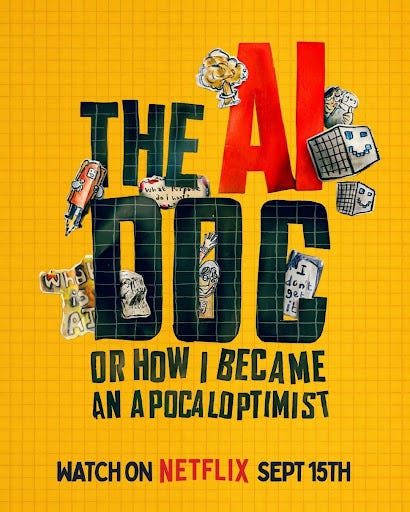
What happened
The AI Doc: Or How I Became an Apocaloptimist is now on Netflix, Amazon Prime, YouTube, and other major streaming platforms, following director Daniel Roher as he talks to AI experts including Tristan Harris, Aza Raskin, and Randima Fernando.
Why it matters
The film's wide release gives hundreds of millions of people a chance to watch, a shift from its previous availability, which the CHT Team says creates an opportunity to accelerate public understanding of AI and its implications for jobs, surveillance, relationships, children, and society.
What to watch
The CHT Team's call for public pressure hinges on whether viewers actually act—checking out the film, sharing it with five people, and hosting screenings—to shift culture, law, and incentives so AI is deployed thoughtfully; that outcome is framed as a collective opportunity, not a guaranteed result.
WHO IT HITSThis lands on general audiences—especially parents, educators, and everyday viewers—who now have easily accessible material to inform their understanding of AI, as well as on advocates at the Center for Humane Technology, who hope the film's reach translates into public pressure on AI companies and policymakers.
Ask the AI about this article →
Summaries like this, in your inbox every morning.
The film comes from a team with significant awards pedigree—the Oscar-sweeping team behind Everything Everywhere All At Once and the Oscar-winning director of Navalny—which may lend it credibility and attention beyond typical AI documentaries. Its director, Daniel Roher, is described as soon to be a first-time father, framing his journey as one that mirrors common questions people ask: How does AI work? What's promising? What are the risks? The film features conversations with AI experts including CHT Co-Founders Tristan Harris, Aza Raskin, and Randima Fernando, positioning it as a broad survey rather than a technical deep-dive.
The release on Netflix, Amazon Prime, YouTube, and other major platforms means it reaches hundreds of millions of people, a scale that the CHT Team says creates a huge opportunity to accelerate public understanding of AI, the race AI companies are in, and the enormous implications across jobs, surveillance, relationships, children, and society. That reach is the key difference from a limited release, but the film's impact hinges on whether viewers go beyond watching—sharing it with five people or hosting screenings—to create what the team calls massive public pressure that shifts culture, law, and incentives so AI is deployed thoughtfully to serve everyone, not just a select few. Whether that translates into lasting change is an open question, but the accessibility of the film on major platforms lowers a barrier for broader engagement.
For example, today's edition would include:
AI-summarized, only the topics you pick — one digest a day via Email, Slack, or Discord.
Free · 30 seconds with Google · unsubscribe anytimeWhat is AIToday? →
Ask AI anything about this article. Q&As are published on this page for other readers too.
Chevron jumped about 2.1% to $216.58 Tuesday afternoon as Brent crude climbed to $109.20 per barrel amid Saudi…
Walmart CEO John Furner is turning the retailer's 5,200 U.S

Coca-Cola President and CFO John Murphy told Yahoo Finance that AI is not 'the path forward' for the company's…

Perplexity released Portable Computer for Windows in partnership with Nvidia, via its existing Windows app
Meta introduced Meta One, a global subscription with 50+ features across Instagram, Facebook, WhatsApp, and Me…

Bank of America is replacing only 75% of employees who leave while doubling its budget for AI, per eFinancialC…