
Vaultak is a runtime governance layer that sits between AI agents and the systems they access—databases, files, APIs, processes. It intercepts every action before execution, scores it for risk, enforces policies (alert, pause, or rollback), and logs everything in a dashboard.
The product launches with two deployment options: an SDK wrapper or a zero-code desktop app.
It matters because 92% of security leaders worry about AI agent security, only 6% of organizations have an advanced strategy, and the average AI breach costs $4.6M.
What happened
Vaultak, a new security layer for AI agents, intercepts and controls every action an agent attempts—file writes, database queries, API calls—before execution. It scores each action across five dimensions, blocks violations based on policy, pauses agents for review, and can automatically reverse the last N actions if a breach occurs. The product launches with two deployment modes: an SDK (five lines of code) and a desktop app (zero code changes) that feed into a shared dashboard.
Why it matters
Security leaders report that 92% are concerned about AI agent security impact, 48% of cybersecurity professionals identify agentic AI as the single most dangerous attack vector, and only 6% of organizations have an advanced AI security strategy. The average cost of a shadow AI breach is $4.6M—$670K more than a standard breach. Vaultak addresses the runtime layer that Project Glasswing (endorsed by Cisco, AWS, Microsoft, Google, JPMorgan Chase, and others) does not: pre-deployment scanning finds vulnerabilities, but Vaultak governs what agents do once running.
What to watch
Vaultak is free to start with no credit card required. The Sentry desktop app (version 1.0.3) supports Python, Node.js, Ruby, and Go on Mac, Windows, and Linux. The Core SDK integrates with LangChain, CrewAI, AutoGen, and custom agents. All actions flow to a single dashboard with full audit trail, policy management, and rollback history.
Ask the AI about this article →
The article positions Vaultak as the missing second layer of AI security. Project Glasswing (a public-private initiative announced by Anthropic in April 2026 with backing from Cisco, AWS, Microsoft, Google, JPMorgan Chase, and others) addresses pre-deployment vulnerability scanning. But runtime governance—what happens once agents are live and executing—has been unaddressed until now. That gap is material: the body cites that 92% of security leaders worry about AI agent security, 48% of cybersecurity professionals rank agentic AI as the single most dangerous attack vector, and only 6% of organizations have an advanced AI security strategy. The financial stakes are high: a shadow AI breach costs $4.6M on average, $670K more than a standard breach (IBM, 2025). Vaultak's value proposition is enforcement without code changes—either via a five-line SDK or a process-monitoring desktop app that both feed a shared dashboard—and the ability to reverse actions, a capability the body notes no other tool offers.
For example, today's edition would include:
AI-summarized, only the topics you pick — one digest a day via Email, Slack, or Discord.
Free · takes 30 seconds · unsubscribe anytimeWhat is AIToday? →
Ask AI anything about this article. Q&As are published on this page for other readers too.
CBTS Technology Solutions LLC launched Forge Agents, a platform that turns a plain-language job description in…

Imec CEO Patrick Vandenameele said at SEMICON Taiwan 2026 that the Belgian research center is broadening its c…
Alphabet's AI Overviews now reach over 2.5 billion monthly users through Google Search, and its ad business ge…
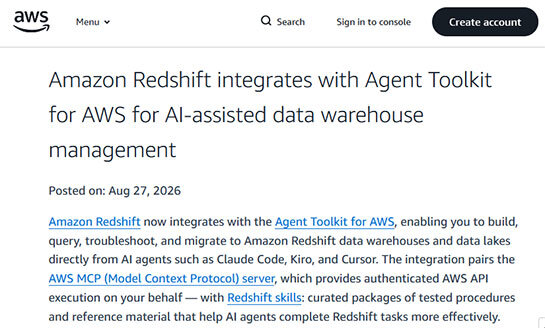
Amazon Web Services (AWS) has integrated its fully managed data warehouse service, Amazon Redshift, with Agent…
Visual Studio Code 1.135 now includes an experimental 'Rubber Duck' feature that lets developers request a sec…
Sonos announced a new app update with generative AI features, a new soundbar called the Beam Ultra, and its se…