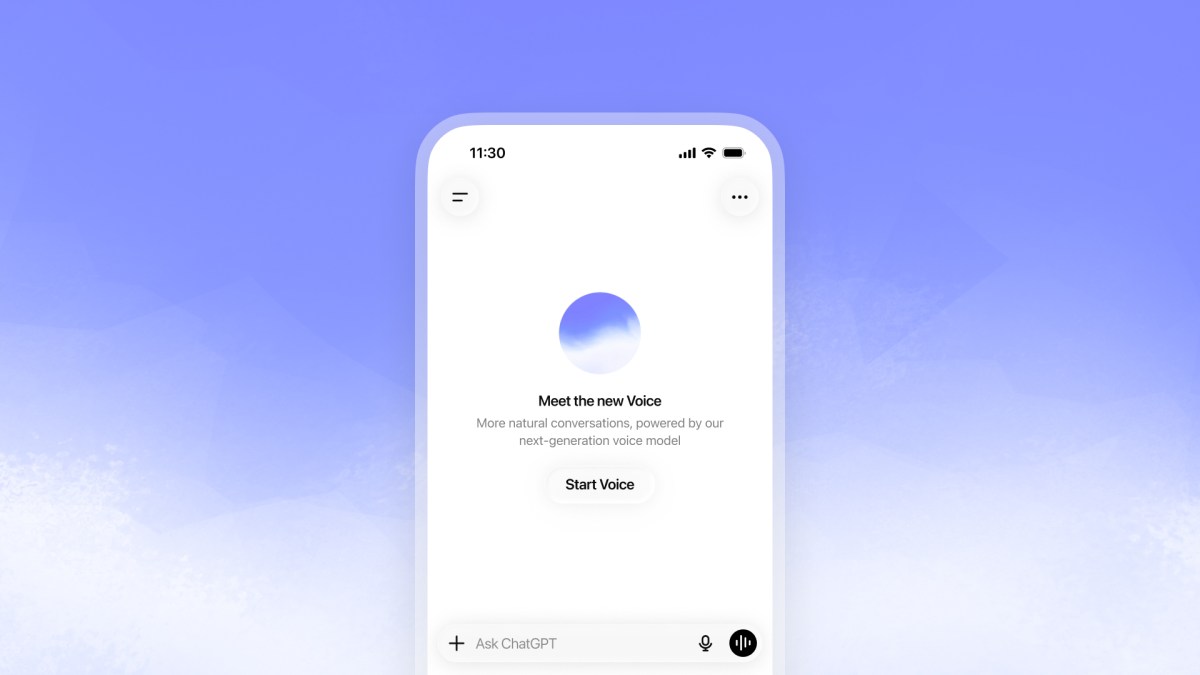
What happened
OpenAI released two new conversational voice models—GPT-Live-1 and GPT-Live-1 mini—that can speak and listen simultaneously, allowing users to interrupt naturally. The company is replacing ChatGPT's current Advanced Voice Mode with GPT-Live-1 mini by default; paid users get access to the larger GPT-Live-1 model.
Why it matters
The new models address a key gap in the previous design: they can stay silent and absorb conversation context until called upon, and they connect to OpenAI's latest text models (like GPT-5.5) for search, reasoning, and task automation while the conversation continues. This means richer, longer discussions without the delays and dropped context of the older pipeline. Over 150 million people already use ChatGPT's voice features.
What to watch
OpenAI sees voice as a potential primary interface for complex, long-running work—product lead Atty Eleti noted having 30- to 40-minute conversations during walks. The new mode includes safeguards for age-appropriate responses and self-harm resources. Live translation is enabled but still needs refinement (the Hindi demo showed a heavy American accent and unnatural phrasing).
Summaries like this, in your inbox every morning.
OpenAI's release of full-duplex voice models reflects a broader industry push toward more conversational, context-aware assistants. The company has spent years strengthening voice features to sound more natural—over 150 million people already use ChatGPT's voice and dictation tools—but the architecture itself presented a bottleneck. By moving from a three-stage pipeline (speech-to-text, LLM, text-to-speech) to a unified model that can handle bidirectional communication, OpenAI removes latency and context loss that plagued real-time dialogue.
The new models' ability to access GPT-5.5 for reasoning and agentic capabilities (self-directed task automation) while staying in conversation suggests OpenAI is positioning voice not as a gimmick but as a gateway to hands-free interaction with complex work. Product lead Atty Eleti's mention of 30- to 40-minute walks with the voice feature signals that the company sees potential for extended, uninterrupted use—a departure from brief voice commands. Rivals including Apple, Amazon, and startups like Sesame are also updating their assistants for longer, more natural dialogue, indicating the market sees value in this direction.
Still, refinement remains incomplete. The live translation demo revealed that Hindi output sounded unnatural and heavily American-accented, and OpenAI noted the new mode is optimized only for "most spoken languages" without specifying which. The company also explicitly distanced the new voice mode from "AI companion" positioning, acknowledging the line between utility and over-anthropomorphism. These caveats suggest the rollout is a significant step forward within bounded scope, not a fully mature offering.
Pick your industry and the AI tools you use, and get news related to your work every day.
Free · 30 seconds with Google · unsubscribe anytimeWhat is AIToday? →
Ask AI anything about this article. The AI reads this article, earlier AIToday articles, and Wikipedia, and cites its sources. Q&As are published on this page for other readers too.
Chunghwa Telecom president Rong-shy Lin said the shift from conversational AI to autonomous AI agents is resha…

CoreWeave fell 5% in premarket trading Friday and was on track to finish the week down 15%, after rebounding f…

Apple and Meta said they would jointly release a new open-weight AI model designed to run on high-end Macs, ai…
Investors put $38.5 billion into Asian startups in Q3, per Crunchbase data

A longtime Anthropic investor told Fortune he expects shares priced around $1.8 trillion, below the company's…
In Q2, billionaires or their funds sold six 'Magnificent Seven' AI stocks