AIToday
Large Language ModelsAudio & SpeechOpen-Source AIHacker NewsPublished: Aug 15, 2026, 10:00 JST3 min read

Dictata: Local Whisper voice dictation for Windows, no data leaves machine

Dictata: Local Whisper voice dictation for Windows, no data leaves machine

Key takeaway

  • A developer has released Dictata, a Windows voice-dictation tool that runs entirely on a user's machine using Whisper speech recognition and optional local AI cleanup, with no data transmission to external servers.

  • The application supports GPU acceleration, multiple audio sources (microphone, system audio, or both), and custom vocabulary injection; it is available as open-source under MIT with Commons Clause licensing, allowing free personal use but prohibiting commercial resale.

3 Key Points

  1. What happened

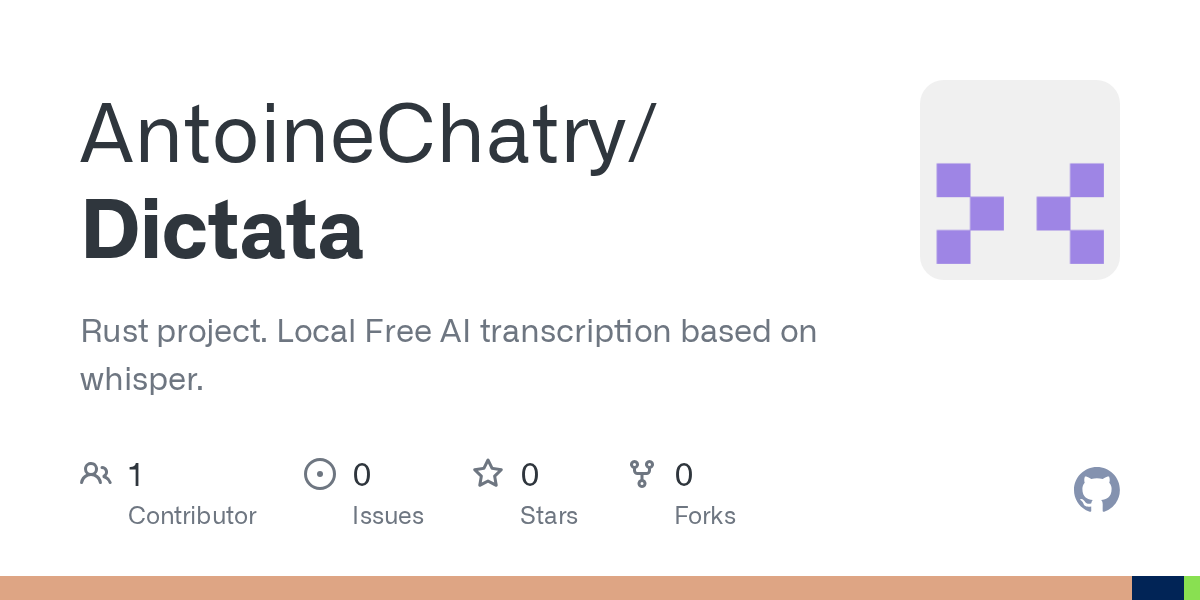
    A developer released Dictata v0.1.0, a Windows application that transcribes speech locally using Whisper (an AI speech-to-text model) and whisper.cpp, then pastes the text into any active application—all without sending audio or text off the device.

  2. Why it matters

    Businesses and individuals handling sensitive information can now dictate without exposing audio to cloud services; the tool also offers local LLM post-processing (cleanup, email formatting, lists) and supports GPU acceleration (Vulkan for AMD/Intel/NVIDIA), making it practical for real-world use on personal machines.

  3. What to watch

    The tool requires Windows 10/11, ffmpeg for file transcription, and optional Vulkan SDK for GPU support; it is open-source under MIT with Commons Clause (free for personal use, not for commercial resale), with a built-in model library and HuggingFace integration for easy model downloads.

In Depth

Read the full story

Dictata is a Windows native application written in Rust that enables system-wide voice dictation without uploading audio or text to external servers. The core workflow is simple: a user presses a global hotkey (default Ctrl+Alt+Space), speaks, presses again, and the transcribed text is automatically pasted into the active window. The transcription itself is handled by whisper.cpp, a local inference engine for Whisper. The tool supports three interaction modes: standard hotkey dictation (press-to-record), continuous streaming (text appears as the user speaks, pausing at detected silence), and file transcription (audio or video files in any ffmpeg-supported format). Optional voice-activity detection (VAD) reduces computational load and hallucinations by skipping silent sections, downloading a small ~2 MB model on first use.

For GPU acceleration, Dictata leverages Vulkan to support AMD, Intel, and NVIDIA graphics; alternatively, users can run transcription on CPU alone. The application offers multiple audio sources via cpal and WASAPI loopback: microphone, system audio, or a mix (useful for meeting transcription). A floating dock displays the audio waveform in real time and can be configured for size, opacity, and position. Output can be raw transcription or post-processed through a local OpenAI-compatible LLM using customizable prompts (for cleanup, email formatting, message formatting, list generation, etc.). Users can inject custom vocabulary and term replacements as the initial prompt to the LLM.

The application includes a built-in ggml model library that lets users download, delete, and receive hardware-aware recommendations; it also supports direct installation of any ggml .bin model from HuggingFace via URL, repository name, or keyword search. The user interface supports French, English, and Spanish, includes a dark theme, system tray integration, and a transcription history page. Configuration is stored in a config.json file next to the executable or in a directory specified by the DICTATA_HOME environment variable. The developer notes that the file must be UTF-8 without BOM.

The codebase is modular, with 64 unit tests covering configuration, resampling, mixing, output modes, settings logic, hardware detection, HuggingFace query parsing, and safety. The executable is self-contained, requiring only ffmpeg in PATH for file transcription and optionally the Vulkan SDK and Visual Studio Build Tools for GPU builds. The tool is licensed under MIT with Commons Clause, permitting free use, modification, distribution, and self-hosting for personal or non-commercial purposes, but prohibiting commercial resale or paid services derived substantially from the software.

Context & Analysis

Dictata addresses a growing demand for local, privacy-preserving dictation tools. The application combines Whisper (OpenAI's open-source speech recognition model, run via whisper.cpp) with optional local LLM post-processing, eliminating the privacy trade-off inherent in cloud-based dictation services. The developer designed the tool to be self-contained—the Windows executable carries its own icon and version metadata, requires no DLL files, and uses the Vulkan loader supplied by the graphics driver, simplifying deployment. The feature set reflects practical workflow needs: hotkey activation (toggle or push-to-talk), automatic paste into the active application, continuous streaming mode, and silence-skipping via voice-activity detection all reduce friction. The built-in ggml model library with hardware-aware recommendations and HuggingFace integration lower the barrier to model selection. The MIT-with-Commons-Clause licensing permits free personal and self-hosted use while blocking commercial resale, a choice that protects the creator's work while remaining permissive for non-business users.

FAQ

What platforms does Dictata support?
Dictata runs on Windows 10 and Windows 11 only; Linux is not supported in this release.
Can Dictata use my GPU for transcription?
Yes, it supports Vulkan GPU transcription for AMD, Intel, and NVIDIA graphics, or CPU-only transcription; the app automatically detects GPU and VRAM or CPU and RAM and recommends hardware-appropriate models.

Get the latest Large Language Models news every morning

AI-summarized, only the topics you pick — one digest a day via Email, Slack, or Discord.

Free · takes 30 seconds · unsubscribe anytime

Ask AI

Ask AI anything about this article. Q&As are published on this page for other readers too.

Related Articles

Next articleBroadcom sinks 6% on $370B AI debt estimate; AMD rallies 4% on $1,250 price target

The AI news that matters, in one minute each morning.

Sign up free