What happened
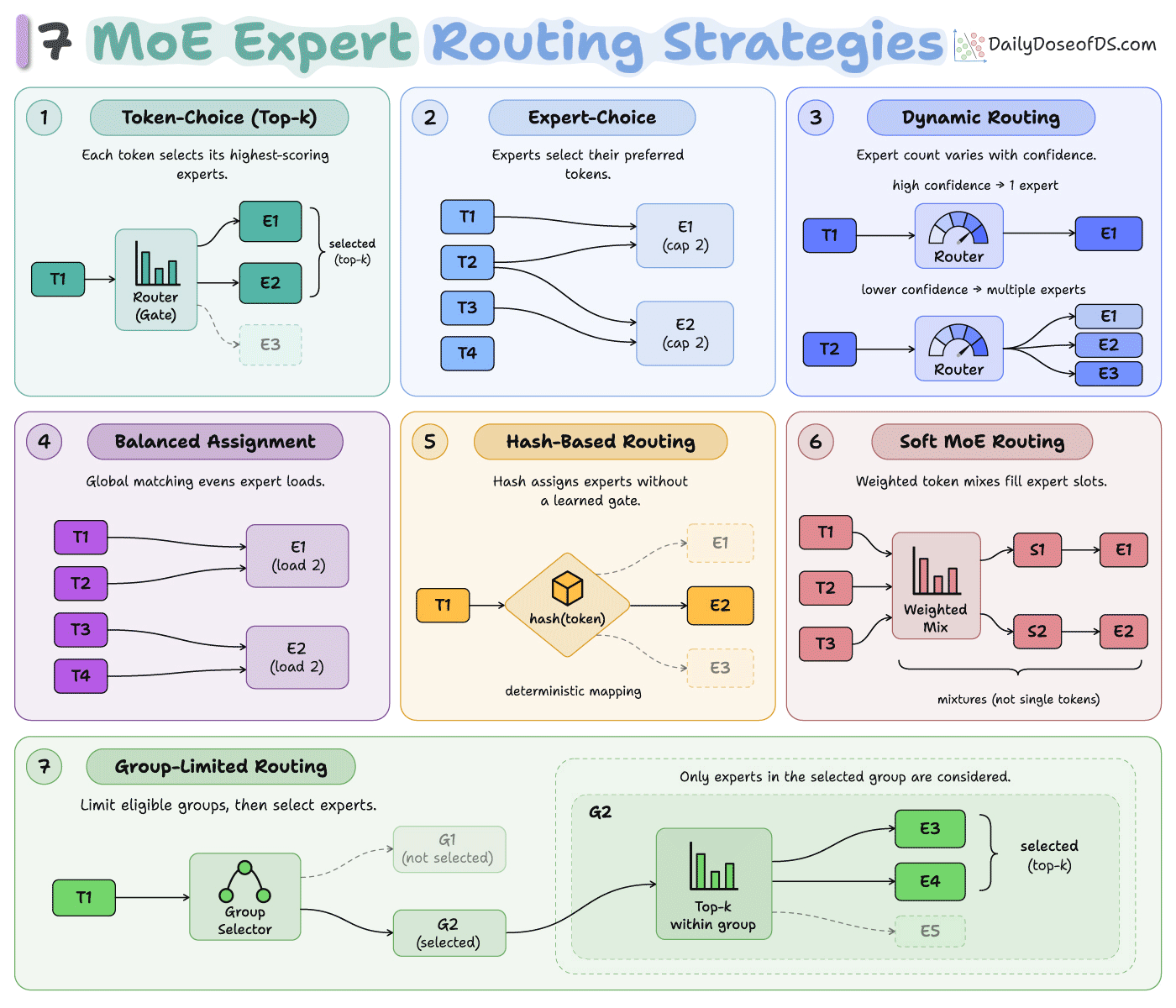
The newsletter lays out seven ways MoE (mixture-of-experts) models assign tokens to experts, including DeepSeek-V3's node-limited routing that sends each token to at most four nodes, and Soft MoE's weighted token mixtures.
Why it matters
Sending every token to its highest-scoring experts can overload some experts and drop assignments, so routing design affects whether MoE's compute savings actually show up in serving.
Summaries like this, every morning.
The issue frames routing as the place where MoE's promised compute savings can quietly disappear. Sending every token to its highest-scoring experts looks efficient, but if many tokens prefer the same experts, those experts become overloaded while others sit idle; with fixed capacity and a dropping rule, some assignments may be dropped, and uneven workloads plus communication overhead across GPUs can erode the savings.
The seven designs each handle that tradeoff differently. Expert Choice reverses the selection so each expert picks its highest-scoring tokens within a fixed capacity, but equal expert workloads can still mean unequal computation per token. Dynamic routing lets the number of active experts vary, and global matching such as BASE Layers accepts that some tokens may miss their first-choice expert to balance the batch. Hashing removes the learned gate entirely at the cost of flexibility, Soft MoE has experts process weighted mixtures of token representations, and hardware-aligned grouping — as in DeepSeek-V3's node-limited routing — narrows where a token can travel. The newsletter cautions that these are routing designs, not interchangeable serving-engine settings, and that some come from training or vision research and need care for autoregressive generation.
The practical thread is measurement. Evenly distributing tokens does not guarantee low latency, because expert batches may still be small and moving tokens between devices takes time. Profiling should separate routing, token movement, expert computation, and combination so the slowest stage is visible, and the issue points to a 10-week inference-engineering roadmap on GitHub for building and benchmarking that path.
Pick your industry and the AI tools you use, and get news related to your work every day.
Free · 30 seconds with Google · unsubscribe anytimeWhat is AIToday? →
Ask AI anything about this article. The AI reads this article, earlier AIToday articles, and Wikipedia, and cites its sources. Q&As are published on this page for other readers too.
Alignable's Eric Groves writes that Meta brought its Muse agent to small businesses in September, while Anthro…

In Verge testing, NYT Cooking's AI assistant rewrote a One-Pot Chicken and Rice With Ginger recipe around the…

At Fal.Con in Europe on Nov

In the "Into the Unknown" benchmark, nine AI agents produced 135 submissions on 15 open research tasks from te…

Nous Research fine-tuned Alibaba's Qwen3.8-27B on 53 million tokens to create Arete-27B, which reduced its pro…

Owen Queen and James Zou re-tested 50 cited LLM claims across 20 models, finding 44% expired, 34% weakened, 16…