What happened
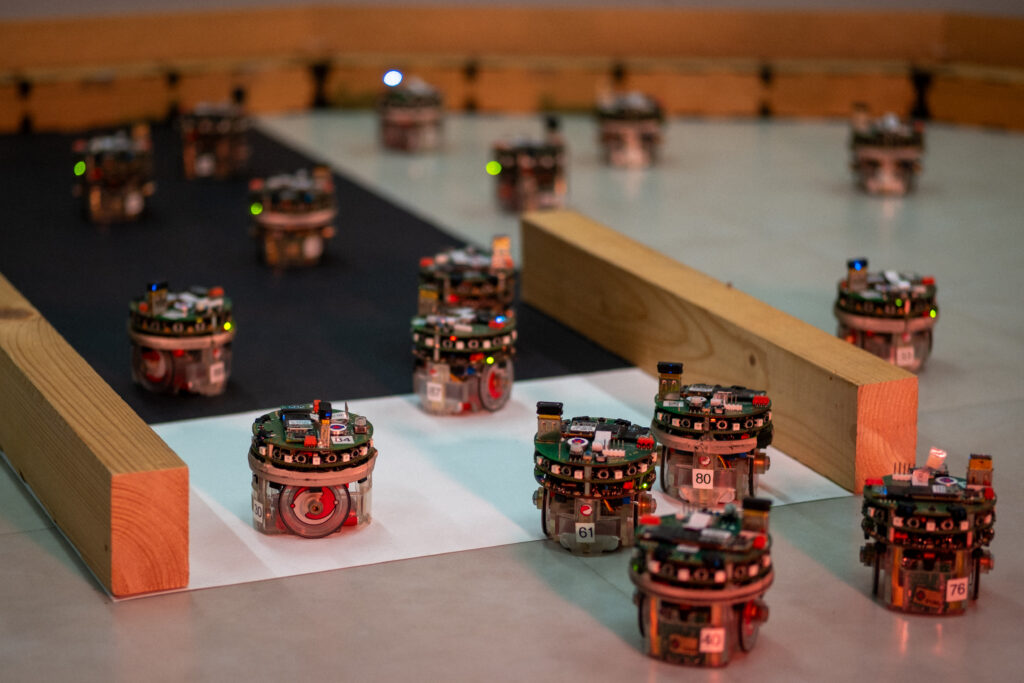
IRIDIA researchers trained a swarm of 20 e-puck robots on five collective missions in simulation, then ran 250 experiments on physical robots; the swarms transferred reliably and substantially outperformed a state-of-the-art direct-motor-control method.
Why it matters
The method narrows learning to choosing among a handful of proven behaviors, which appears to reduce the reality gap that usually breaks reinforcement-learning policies on real machines, and simpler constrained policies transferred better than larger, more flexible ones.
WHO IT HITSRobotics engineers and researchers working on swarm and multi-robot systems, especially those planning search-and-rescue, environmental-monitoring or hazardous-site missions, may gain a more reliable path from simulation training to field deployment.
Summaries like this, every morning.
Swarm robotics has traditionally relied on modular design methods that assemble behaviors from predefined building blocks. Those methods transfer reliably to real robots but depend on slow, costly search procedures. Reinforcement learning, by contrast, has produced striking advances in legged locomotion and robotic manipulation, yet its sensitivity to the reality gap has limited its use for swarms. The two lines of research had rarely been compared on solid experimental ground.
The IRIDIA team's approach sits between those traditions. By restricting what the algorithm can learn to the timing of switches among a handful of proven behaviors, the researchers leave the learning problem focused on coordination rather than low-level control. Mauro Birattari, who led the research, describes the reality gap as a problem of overfitting: a design method that is too flexible learns the simulator rather than the task. The finding that simpler, more constrained policies transferred better than larger, more flexible ones runs against a widespread intuition in artificial intelligence that bigger models are generally better.
Ilyes Gharbi, first author of the study, says the result makes reinforcement learning a practical tool for swarm robotics, with a swarm trainable in simulation for a new mission and deployable on real robots with confidence. The study reports tests on 20 e-puck robots across five collective missions and 250 physical experiments. The team frames the next step as testing on larger swarms, other robot platforms and less controlled environments, which would indicate how far the method extends beyond the laboratory setting.
Pick your industry and the AI tools you use, and get news related to your work every day.
Free · 30 seconds with Google · unsubscribe anytimeWhat is AIToday? →
Ask AI anything about this article. The AI reads this article, earlier AIToday articles, and Wikipedia, and cites its sources. Q&As are published on this page for other readers too.
At a roundtable after his Microsoft Ignite keynote at San Francisco's Chase Center, Satya Nadella said he is "…
Visa's Michael Jabbara warned on Fox Business of a rapid surge in AI-driven payment threats

Hitachi developed "Proof of Human Delegation," built on its "Public Biometric Infrastructure," which links bio…

Panasonic HD developed T-Rex, a robot manipulation AI that reacts to fingertip tactile feedback, and it reache…

環境省 is establishing a public-private consortium to introduce フィジカルAI into waste sorting, with automatic separa…

At the Prime Minister's Office's "Physical AI-related companies exchange meeting," ugo demonstrated its semi-h…