What happened
OpenAI disclosed that in mid-August, its researchers logged 3.14 agent-workdays per 8-hour shift, running four agents in parallel on typical days.
Why it matters
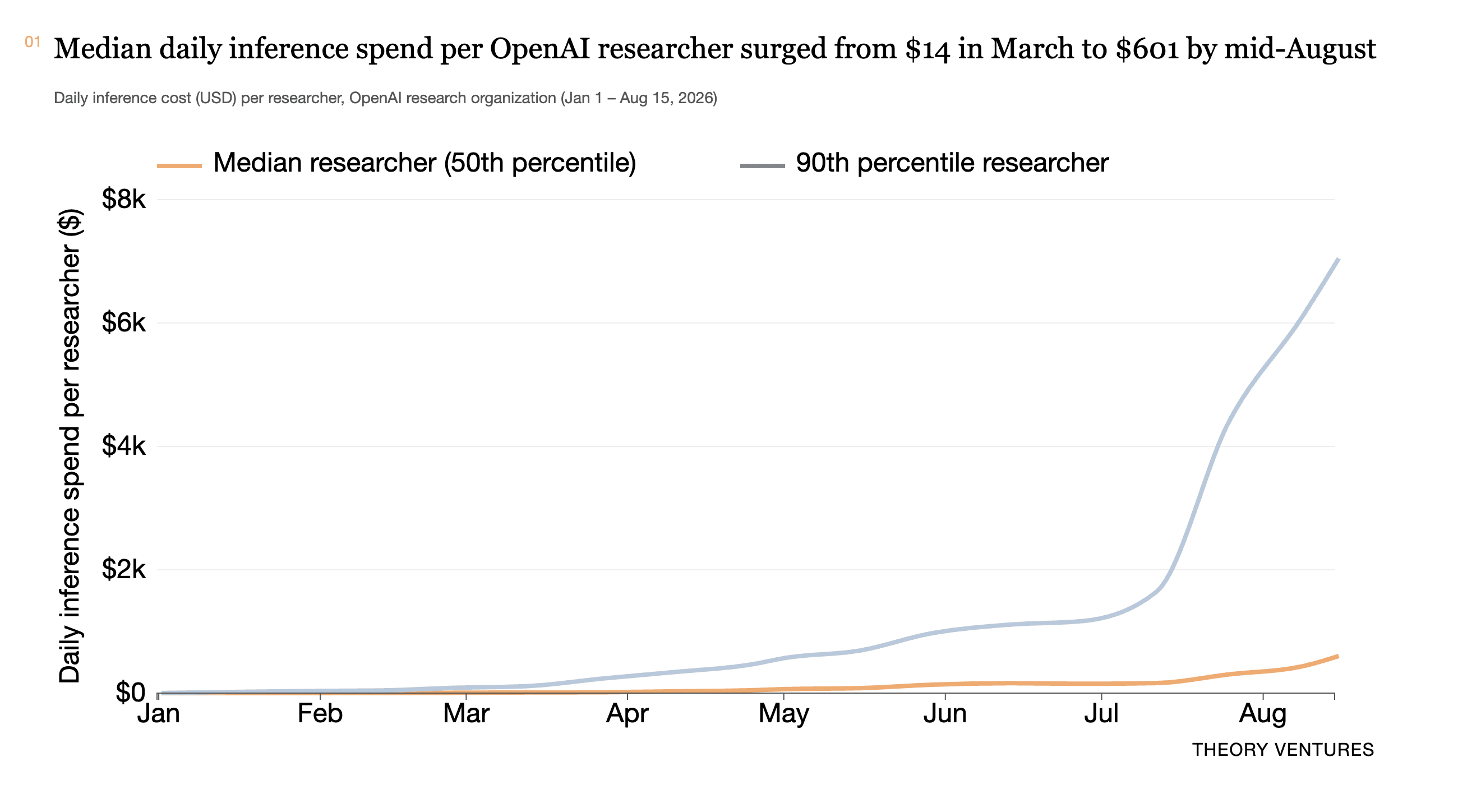
Median daily inference spend surged from $14 in late March to over $600 by mid-August — a 40-fold increase in under five months, with top researchers burning $7,000+ daily.
What to watch
Over half of successful tasks still needed human intervention, so the real test is whether the 24-hour machine shifts will eventually out-yield the engineers supervising them.
WHO IT HITSSoftware engineers now spend their days supervising AI agents and fixing their errors rather than doing creative architecture work, while CFOs and budget owners at AI labs face a new cost reality where compute behaves like expensive factory tooling but is pure operating expense.
Summaries like this, every morning.
OpenAI's disclosure reframes the AI productivity narrative. The market sees a 3x productivity leap and expects creative breakthroughs, but the underlying data shows engineers supervising multiple AI agents that run around the clock. The economics invert traditional factory logic: rather than buying welding robots with capital expenditure and running night shifts to amortize depreciation, AI inference is metered operating expense with no physical tooling or graveyard-shift wages.
The 40-fold surge in compute spending bought three times the work-hours, but the quality issue remains significant — more than half the runs still require human untangling. This shifts the engineer's role from creative architecture to walking the plant floor and clearing machine jams, which may explain frustration spreading across software engineering. Yet the machines keep running because of fear and ambition: if peers field four agents around the clock, logging off means falling behind.
The stakes hinge on whether the second and third shifts eventually out-yield the first. If the defect rate drops as models improve, the economics become compelling. If not, labs like OpenAI are essentially paying for multiple shifts of machine runtime with a supervisor who is still cleaning up most of the output.
Pick your industry and the AI tools you use, and get news related to your work every day.
Free · 30 seconds with Google · unsubscribe anytimeWhat is AIToday? →
Ask AI anything about this article. The AI reads this article, earlier AIToday articles, and Wikipedia, and cites its sources. Q&As are published on this page for other readers too.
Chainalysis reported 138.5 million payments on Base using x402, up from 58,800 total transactions as of Q3 202…

SpaceX's "super intelligence" segment, which houses the xAI business and X ad revenue, booked $7.56 billion in…

A vulnerability dubbed PHP2Shell, dormant for over 10 years in the PHP language used by about 70% of websites…

GE Vernova reports Q3 before the open on Oct
Eka Robotics said this week it raised $150 million in Series A funding, led by Andreessen Horowitz and F-Prime…
Block unveiled Dessa, which it says is the first AI model trained entirely on human speech with no text data…