What happened
Zep built Konig, a graph storage system that keeps hot graphs in RAM, recently used graphs on local NVMe, and idle graphs in object storage. Retrieval holds a p95 under 100ms from a thousand graphs up to tens of millions, with end-to-end latency under 200ms.
Why it matters
A single enterprise customer can run millions of graph instances, most of which are cold at any given moment. Traditional systems like Neo4j are built for one large resident graph, so costs follow provisioned memory rather than reads actually served, and adding hardware stopped helping Zep.
What to watch
Konig runs PageRank inline in milliseconds rather than as a batch job because each query reads a single graph. It also keeps two in-memory layouts of every graph and converts between them on demand.
Summaries like this, in your inbox every morning.
The article explains why Zep moved away from conventional graph databases for its agent memory workload. Traditional systems like Neo4j assume one large graph stays resident in memory, with every request passing through a Cypher parser and query optimizer. But agent memory stored as a knowledge graph produces one graph per user, team, and project, and a single enterprise customer can run millions of them, most cold at any given moment. That makes the cost follow provisioned memory rather than reads actually served.
Konig was built around this access pattern by tiering storage: hot graphs in RAM, recently used graphs on local NVMe, and idle graphs in object storage. Because each query reads exactly one graph, PageRank can run inline in milliseconds rather than as a batch job. The system also attaches encryption keys and retention rules to each graph, and keeps two in-memory layouts of every graph, converting between them on demand.
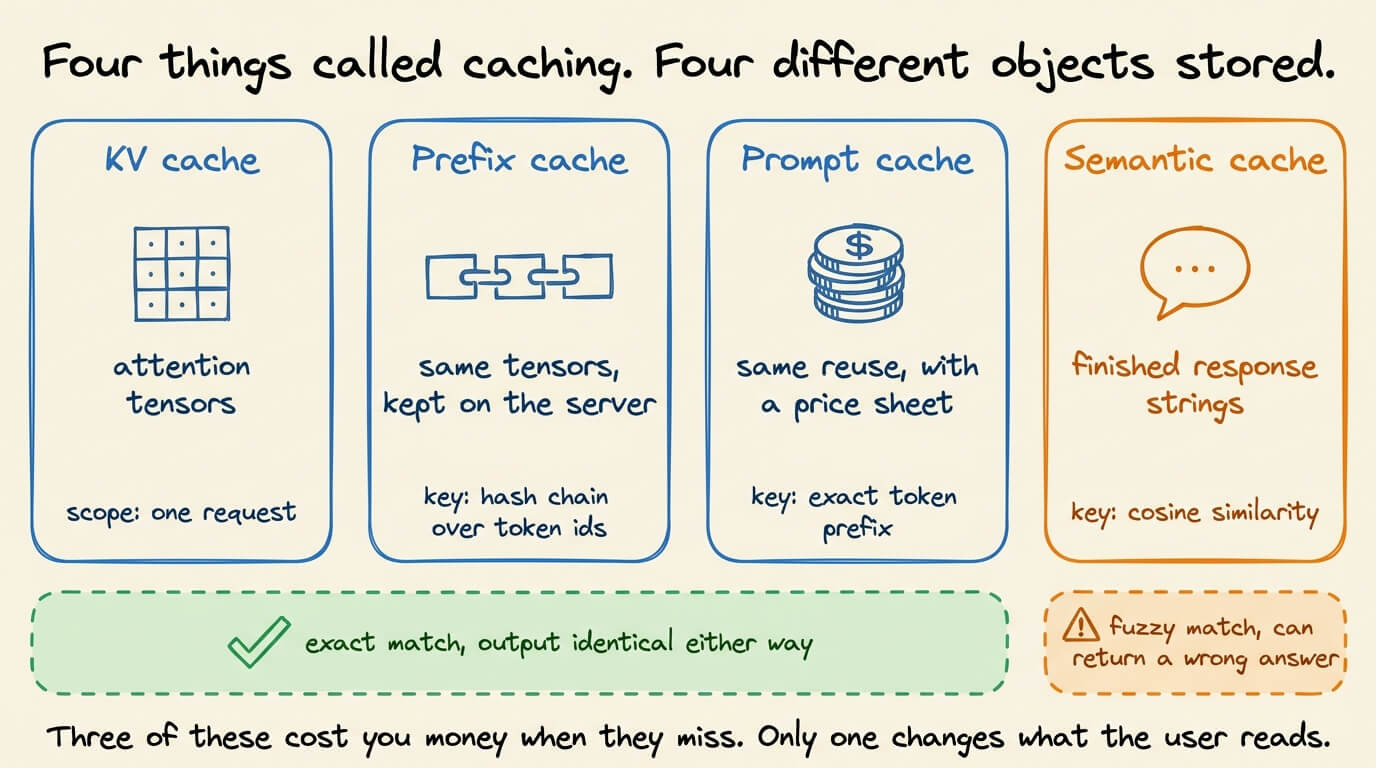
The blog also frames Konig within the wider LLM caching landscape, distinguishing four types: KV cache for attention tensors per request, prefix caching keyed by hash chains over token IDs, prompt caching as the provider's billed version at 0.1x read and 1.25x write rates, and semantic caching storing finished responses by cosine similarity. The first three are exact-match and correctness-neutral, while the semantic cache is fuzzy-match and can return wrong answers with a 200 status.
Pick your industry and the AI tools you use, and get news related to your work every day.
Free · 30 seconds with Google · unsubscribe anytimeWhat is AIToday? →
Ask AI anything about this article. The AI reads this article, earlier AIToday articles, and Wikipedia, and cites its sources. Q&As are published on this page for other readers too.
Circlia started a proof-of-concept for TASTE SIGNAL: visitors to Holland Village Cafe FUKUOKA taste cookies an…
In a webinar hosted by French Mathematical Society president Isabelle Gallagher, Fields Medal winner Hugo Dumi…

NVIDIA released Nemotron 3.5 Super VL, an open-weight model with 120 billion parameters that handles text, ima…

NVIDIA released Nemotron 3.5 Bolt 74B-A9B 24GB, an AI model for local agents that hits over 80 tokens per seco…
NVIDIA published a blog post titled "AI Security Is an Engineering Problem - How to Solve It at Every Layer of…

In the test, Haiku 5.5 on medium setting averaged scores close to Sonnet 5.5 on routine documents at about 1/1…