AIToday

US, China split on humanoid robots: AI smarts vs. supply chain control

Yahoo Finance AI23h ago
US, China split on humanoid robots: AI smarts vs. supply chain control

Key takeaway

The global humanoid robot industry is shifting from proving the technology works to deploying it commercially, but the US and China are taking opposite paths. The US is prioritizing AI smarts through an interconnected ecosystem of large language models, robotics platforms, and simulation tools, believing that environmental understanding and continuous learning will decide winners. China, meanwhile, is focusing on building a complete supply chain to lower costs and achieve scale through high shipment volumes, similar to how it approached electric vehicles. This divergence means the future may split between intelligence-driven robots (US) and cost-optimized, deployable ones (China).

Summaries like this, in your inbox every morning.

Sign up free →

3 Key Points

  • What happened

    The global humanoid robot industry is shifting from technology validation to commercial trials, with the US and China pursuing fundamentally different strategies—the US building AI capability through ecosystem partnerships (NVIDIA's Cosmos and Isaac Lab, Google DeepMind's Gemini Robotics, OpenAI's embodied AI research), while China is integrating its supply chain to localize components like servo motors, reducers, and lithium batteries and lower costs.

  • Why it matters

    The competitive divide reflects a structural difference in how each region believes robots will succeed: the US is betting that intelligence—environmental understanding, multi-step task planning, and continuous learning from real-world data—will set winners apart, while China is betting that cost control and scale deployment through a vertically integrated supply chain will dominate the market. For businesses, this split may mean choosing between paying for smarter robots (US-made) or cheaper, scalable ones (China-made).

  • What to watch

    Tesla's Optimus Gen 3 is undergoing real-world factory validation with a focus on generalization across different work environments, Figure AI is deepening partnerships to collect large volumes of factory training data, and Boston Dynamics is combining motion control with AI for autonomous operation—all signs of how US firms intend to sustain their edge through continuous model refinement.

In Depth

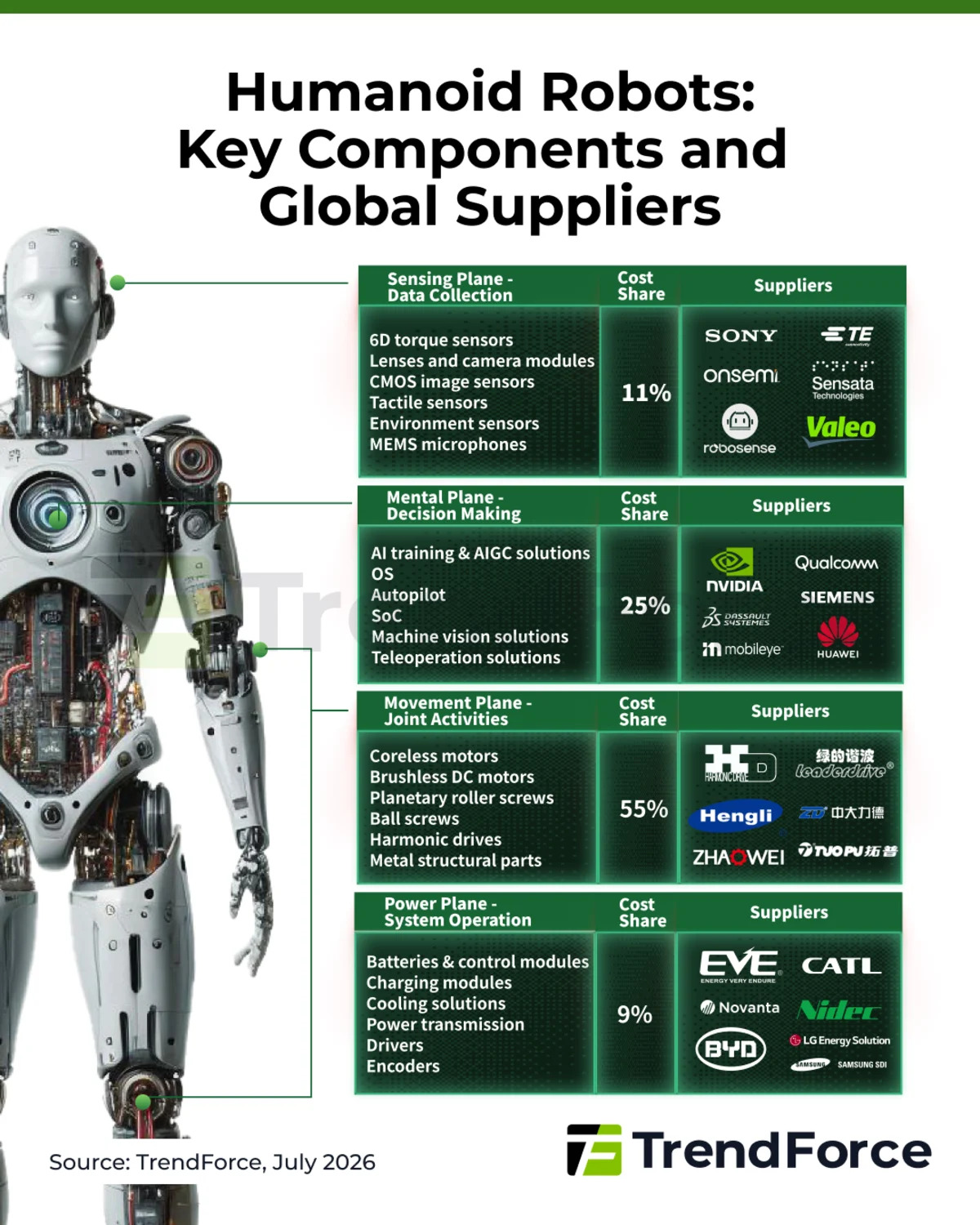
The global humanoid robot market is entering a new phase as companies move from technology validation—proving robots can work—to commercial trials and field deployment. According to TrendForce's analysis published July 20, 2026, the competitive battle is no longer primarily about hardware specifications but about two complementary questions: which companies can build sustainable business models, and which ones will control the supply chain.

The US strategy hinges on AI ecosystem dominance. NVIDIA is advancing Physical AI platforms including Cosmos (a world model), Isaac Lab (a simulation environment), and GR00T (an embodied AI model). Google DeepMind has launched Gemini Robotics to strengthen robotic understanding of complex environments. OpenAI is participating in embodied AI model development through investment and direct research. Together, these firms are creating a complete vertical stack that spans large language models, robotics platforms, simulation environments, and AI chips. The underlying belief is that humanoid robots moving into complex, unstructured environments will succeed based on their ability to understand context, plan multi-step tasks across scenarios, and learn continuously from real-world data. This reflects a shift in competitive focus: from demonstrating that hardware works to building AI that generalizes. Tesla's Optimus Gen 3 exemplifies this approach, undergoing real-world factory validation with the goal of improving generalization so the same AI can quickly adapt to different work environments. Figure AI is deepening partnerships with large enterprises to train its models on large volumes of real factory data. Boston Dynamics combines decades of motion-control expertise with AI to strengthen autonomous operation in complex settings. Apptrovik generates high-quality training data through extensive real-world deployment, feeding that data back into the Gemini Robotics training pipeline to continuously refine models.

China is pursuing a markedly different path, one that mirrors the electric vehicle playbook: building a complete, integrated supply chain and rapidly lowering costs, then achieving economies of scale through high shipment volumes. This strategy prioritizes the localization of core components—servo motors, reducers, and lithium batteries—to cut costs and compress development cycles. By controlling the supply chain end-to-end and shifting manufacturing risk to scale, China aims to deploy humanoid robots at significantly lower unit cost and in far greater numbers than competitors pursuing a premium AI-first strategy. The divergence reflects fundamentally different bets on where competitive advantage will ultimately reside: in the sophistication of the AI (US) or in the cost and reach of deployment (China).

Context & Analysis

The humanoid robot industry has reached an inflection point where the focus has shifted from proving technology works to proving it can work at scale and profitably. The US-China divergence reflects deep structural differences in how each region believes competitive advantage will accrue. The US strategy centers on what it calls the "AI ecosystem"—a tightly integrated stack spanning large language models, robotics-specific platforms (Cosmos, Isaac Lab, GR00T, Gemini Robotics), simulation environments, and AI chips. This ecosystem approach assumes that as robots enter complex, unstructured environments, their value will increasingly depend on their ability to understand context, plan multi-step tasks, generalize across scenarios, and learn continuously from data. Tesla's Optimus Gen 3, Figure AI's factory partnerships, Boston Dynamics' motion-control expertise, and Apptrovik's real-world data collection all point to a shared underlying model: build a data flywheel where real-world experience continuously refines AI models.

China's approach mirrors the playbook it used to dominate electric vehicles: rapid supply-chain integration, cost reduction, and scale deployment. By localizing core components (servo motors, reducers, lithium batteries), China aims to shorten development cycles, compress costs, and achieve economies of scale through high shipment volumes. This strategy trades some near-term AI sophistication for the ability to deploy robots at much lower unit cost and in far greater numbers. For enterprises and governments watching this space, the implication is that the future market may bifurcate—with the US producing higher-capability but more expensive robots tailored to complex, variable tasks, and China producing cost-optimized robots for standardized, high-volume deployment scenarios.

FAQ

What specific AI platforms is the US developing for humanoid robots?
NVIDIA is advancing Physical AI platforms including Cosmos, Isaac Lab, and GR00T; Google DeepMind has launched Gemini Robotics; and OpenAI is participating in embodied AI model development through investment and research.
How is China's approach to humanoid robots different from the US?
China is accelerating supply chain integration and localizing core components such as servo motors, reducers, and lithium batteries to lower costs and achieve economies of scale through high shipment volumes, similar to the early electric vehicle development model. The US, by contrast, is building an AI ecosystem to differentiate through intelligence.
What are US companies doing to improve their robots right now?
Tesla's Optimus Gen 3 is undergoing real-world validation on factory floors with a focus on generalization; Figure AI is deepening partnerships to train models on large volumes of real factory data; Boston Dynamics is combining motion control expertise with AI; and Apptrovik is generating high-quality data through real-world deployment to feed into the Gemini Robotics training pipeline.

Get the latest Robotics news every morning

AI-summarized, only the topics you pick — one digest a day via Email, Slack, or Discord.

Free · takes 30 seconds · unsubscribe anytime

Discussion

No comments yet. Be the first to share your thoughts!

Log in to join the discussion

Related Articles

Stay ahead with AI news

Get curated AI news from 200+ sources delivered daily to your inbox. Free to use.

Get Started Free

Free · takes 30 seconds · unsubscribe anytime

1 minute a day. The AI essentials.

200+ sources · Email / LINE / Slack

Get it free →