What happened
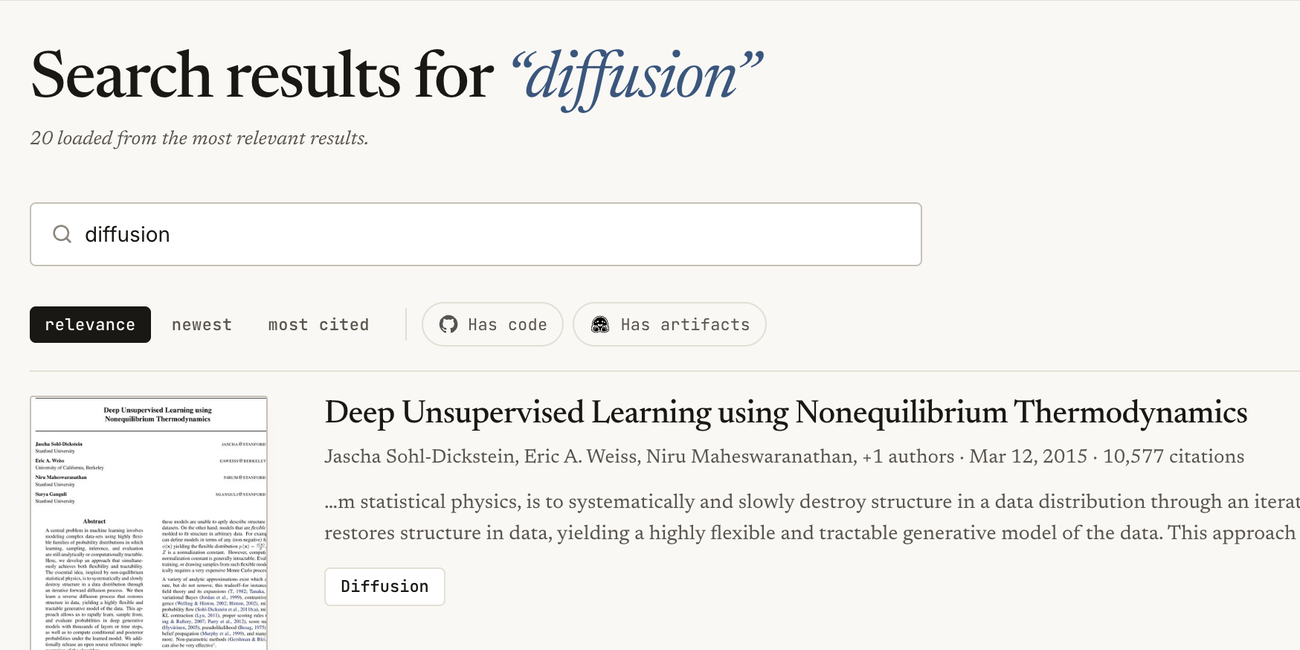
Hugging Face revived Papers with Code with a hybrid search system combining keyword and vector search, using its Jobs, Storage Buckets, and Inference Endpoints to power it.
Why it matters
Hybrid search outperforms keyword- or vector-only approaches, making it easier for researchers and agents to find relevant papers and state-of-the-art results, supporting the next wave of AI research.
What to watch
The system now maintains embeddings for over 110,000 papers from arXiv and Daily Papers, with a design that separates offline batch processing from live query handling for speed and reliability.
Summaries like this, in your inbox every morning.
The revival of Papers with Code is a strategic move by Hugging Face to make open AI research more accessible. By building a hybrid search engine, they address the challenge of finding relevant papers not just by exact matches but also by semantic similarity, which is crucial for navigating the vast and growing body of AI research. Their use of Hugging Face's own infrastructure—Jobs for batch processing, Buckets for durable storage, and Inference Endpoints for low-latency queries—demonstrates the practical application of their platform components.
The system's architecture, splitting offline corpus building from online query serving, ensures efficiency and reliability. The fallback to lexical search when semantic search is unavailable is a pragmatic design choice that prioritizes user experience. This approach, grounded in their experience with RAG systems, highlights the importance of robustness in production AI systems. The measured performance in the pilot phase, with impressive recall and low latency, suggests that the system is well-optimized for its intended purpose.
Looking ahead, the ability to handle over 110,000 papers and the potential for agents to use the search via CLI could significantly enhance how researchers and tools interact with AI literature. The careful attention to versioning and reproducibility in the embedding pipeline also sets a standard for maintaining data integrity over time, which is likely to be crucial as the corpus grows and models evolve.
Pick your industry and the AI tools you use, and get news related to your work every day.
Free · 30 seconds with Google · unsubscribe anytimeWhat is AIToday? →
Ask AI anything about this article. The AI reads this article, earlier AIToday articles, and Wikipedia, and cites its sources. Q&As are published on this page for other readers too.
Circlia started a proof-of-concept for TASTE SIGNAL: visitors to Holland Village Cafe FUKUOKA taste cookies an…

In a webinar hosted by French Mathematical Society president Isabelle Gallagher, Fields Medal winner Hugo Dumi…

NVIDIA released Nemotron 3.5 Super VL, an open-weight model with 120 billion parameters that handles text, ima…

NVIDIA released Nemotron 3.5 Bolt 74B-A9B 24GB, an AI model for local agents that hits over 80 tokens per seco…
NVIDIA published a blog post titled "AI Security Is an Engineering Problem - How to Solve It at Every Layer of…

In the test, Haiku 5.5 on medium setting averaged scores close to Sonnet 5.5 on routine documents at about 1/1…