What happened
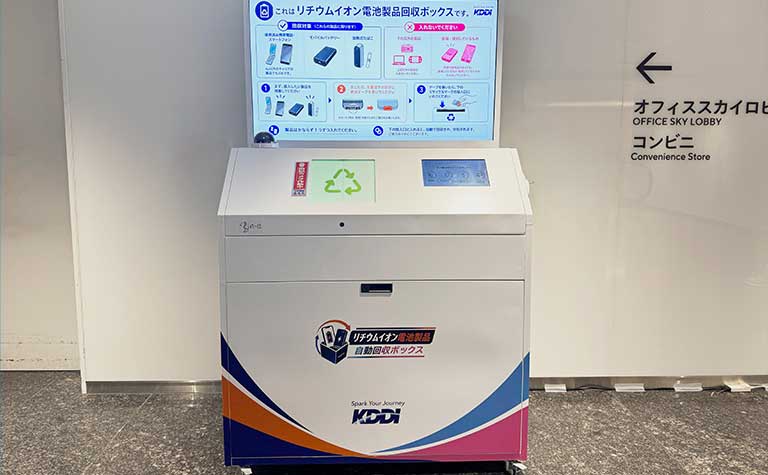
Forcetec said its Bin-e AI sorting recycling box was adopted for KDDI's lithium-ion battery collection effort near Lawson's Takanawa Gateway City store, running September 1 to November 30, 2026.
Why it matters
This is Bin-e's second installation in Japan, after the first at the Tokyo Metropolitan Government Building, moving collection into a spot people pass daily near a convenience store.
What to watch
The effort is a test of how well recycling works when placed where people already shop; the trial ends November 30, 2026, and wider rollout depends on results.
WHO IT HITSRetail and convenience-store operators, building managers, and electronics recyclers evaluating in-store take-back of used phones, mobile batteries and heated-tobacco devices will be watching whether the near-store test produces usable data.
Ask the AI about this article →
Summaries like this, in your inbox every morning.
Bin-e is a recycling box developed and made by Poland's Bine and distributed in Japan by Forcetec. It uses AI image recognition to sort what people drop in, a 50-inch digital screen to explain what goes where, and internal sensors plus connectivity to show fill levels on a dashboard. For this effort, Forcetec is also applying TOPPAN fire-suppression film to the collection inner box, a safety measure it added for lithium-ion recovery and not part of Bin-e's standard specification.
The choice of location is the point. The first Bin-e in Japan went into the Tokyo Metropolitan Government Building under a June 2026 campaign to recover lithium-ion products. Placing the second unit near a Lawson store moves the collection point from a government building into a place people already visit in daily life, which is what the partners want to test. Behind that test sits a safety problem: used lithium-ion products that are not collected properly can catch fire during waste processing, and they also contain resources such as lithium, cobalt and nickel that are worth recovering.
The roles are split across several companies. KDDI runs and publicizes the collection and handles phone collection and recycling; Lawson publicizes the effort; JR East Building provides the space; JX Metals Circular Solutions and Future Ecology handle transport and recycling of the collected items; Forcetec supplies and supports Bin-e. Whether the model spreads may depend on what the partners learn from this near-store test and whether they judge it worth expanding to other areas.
For example, today's edition would include:
AI-summarized, only the topics you pick — one digest a day via Email, Slack, or Discord.
Free · 30 seconds with Google · unsubscribe anytimeWhat is AIToday? →
Ask AI anything about this article. Q&As are published on this page for other readers too.
At its HMG Autonomous Driving Media Day, Hyundai Motor Group said its Data Flywheel is in full operation and s…
Oracle said Thursday that sales in its closely watched cloud infrastructure business jumped 121% to $7.4 billi…
Marvell Technology is targeting $18 billion in FY2028 revenue, raising its combined FY2027 and FY2028 expectat…

Philip Morris International and WSJ Intelligence unveiled The Cognition Index Research Report, a survey of mor…

Lam Research CFO Doug Bettinger said at the Citi Global TMT Conference that the company raised its calendar 20…
Broadcom's fiscal Q3 2026 AI semiconductor revenue rose 221% from a year earlier to $16.7 billion, and CEO Hoc…