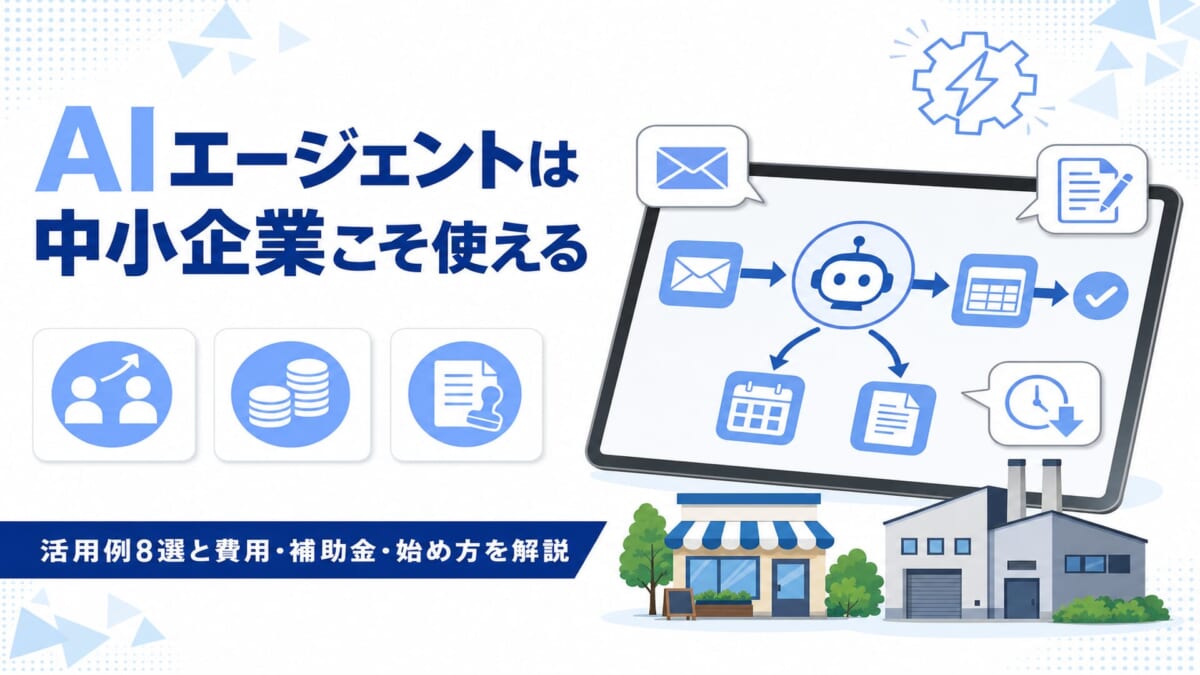
What happened
AINOW cites an SME Support Japan survey showing just 20.4% of small and midsize firms have adopted AI, while 83.2% of those that did reported work-efficiency or time savings.
Why it matters
With fewer than a quarter of SMEs using AI today, firms that move now may pull ahead of peers on productivity, the article argues.
What to watch
The three real-world cases cited — including Theoria House Clinic and REFLAME — are vendor-published Salesforce examples, so results may not transfer; watch the "Digitalization/AI Introduction Subsidy 2026" deadline, which requires a Gbiz ID Prime taking about two weeks.
WHO IT HITSOwners and back-office managers at small and midsize firms with no dedicated IT staff, plus the general affairs or business-improvement staff likely to run a first pilot, are the ones this lands on.
Summaries like this, in your inbox every morning.
The article's starting point is a strain many small firms recognize: hiring is hard, and a handful of people are absorbing inquiries and order entry on top of their real jobs. That is the gap it says AI agents — which plan steps and operate tools rather than just answering questions — are meant to close. The body draws the contrast twice: generative AI leaves the copying and pasting to a person, while RPA stops when a form or a request breaks the pattern, so the exception-heavy work RPA never reached becomes the candidate to hand over. It also notes that Microsoft 365 and Google Workspace already bundle agent-building features that can be instructed in Japanese, meaning a firm does not need to wait for an IT hire to begin.
The middle of the article stacks evidence. SME Support Japan's survey puts adoption at 20.4% and, among adopters, work-efficiency or time savings at 83.2%, with labor-shortage response second at 33.9%. Shinkin Central Bank's survey found the most common use among active generative-AI adopters was drafting and summarizing emails, reports and minutes, at 74.0%. Three named cases follow: Theoria House Clinic, REFLAME and Okada Kenma. Notably, the first two are Salesforce Agentforce case studies, so the figures come from the vendor — useful as internal-proposal material, but worth reading as vendor-published rather than independent.
What the piece ultimately hinges on is discipline rather than technology. Its closing advice is to pick one task, write down the steps, pilot with two or three people, set permission and human-review rules, and measure before broadening. Whether that restraint holds — and whether the Digitalization/AI Introduction Subsidy 2026, the SME Labor-Saving Investment Subsidy and the Human Resources Development Promotion Subsidy actually fit a given firm's setup — is likely to decide which SMEs capture the time savings the survey describes and which simply buy unused licenses.
For example, today's edition would include:
AI-summarized, only the topics you pick: one digest a day via Email, LINE, or Slack.
Free · 30 seconds with Google · unsubscribe anytimeWhat is AIToday? →
Ask AI anything about this article. The AI reads this article, earlier AIToday articles, and Wikipedia, and cites its sources. Q&As are published on this page for other readers too.
Instinct, officially Spear Street Technology Inc., announced a $1 billion Series C joined by Sequoia Capital…

At Okta's Oktane event, Charlotte Wylie, Okta's senior vice president and deputy chief security officer, said…

On theCUBE Pod, Dave Vellante said CoreWeave disclosed that 70% of its revenue came from its top three custome…

Modulate raised $25 million, led by Future Ventures with returning investors Hyperplane and Lakestar, bringing…

Google Cloud revenue hit $24.77 billion, up 82%
MGX, an Abu Dhabi-backed technology investor, is looking for data center assets in the Asia Pacific