What happened
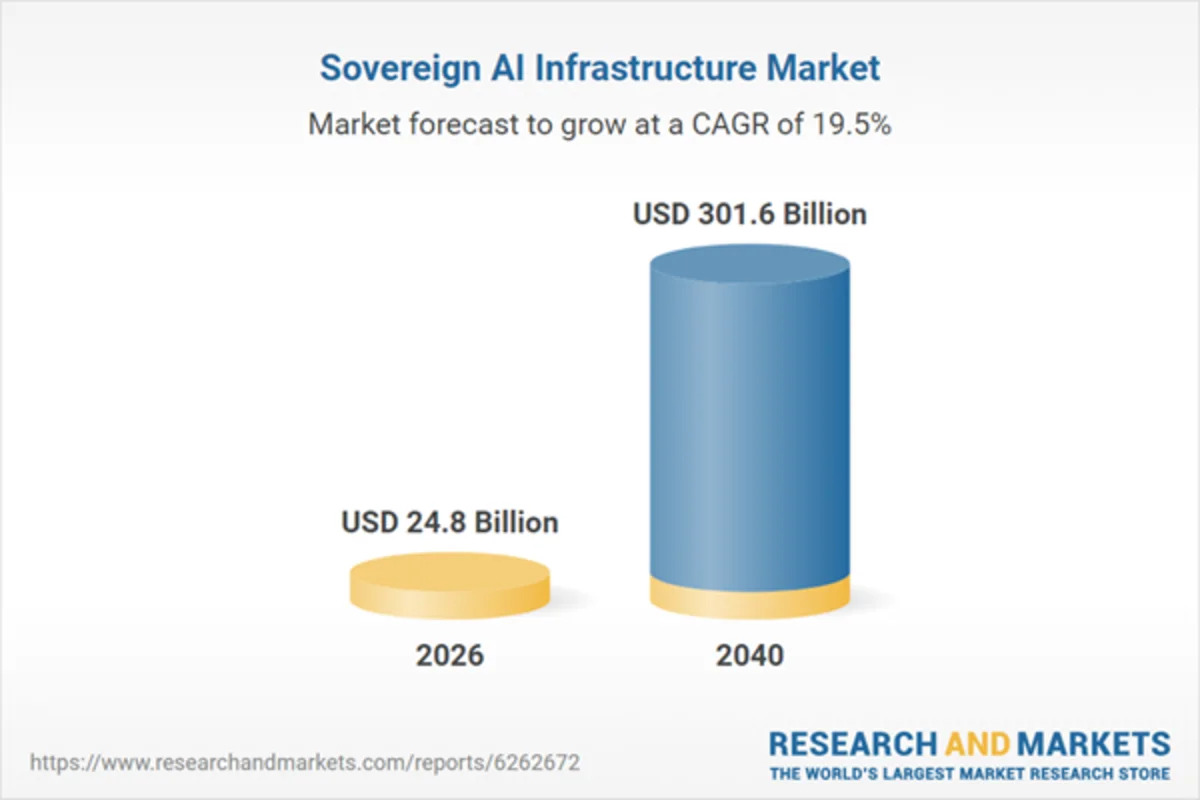
A new market forecast projects the global sovereign AI infrastructure market will grow from $24.8 billion in 2026 to $301.6 billion by 2040, with a compound annual growth rate of 19.54%. The market covers data centers, GPU clusters, cloud platforms, cybersecurity, cooling, and renewable power for domestically controlled AI systems.
Why it matters
Governments are treating AI infrastructure as a strategic national asset to protect sensitive data, maintain control over AI models, and secure high-performance computing resources. Data residency rules, cybersecurity mandates, and national AI programs are driving demand for domestically governed computing environments, making this a key area for businesses working with regulated industries and public-sector clients.
What to watch
Within the market, compute infrastructure is expected to account for nearly 35% in 2026, while security infrastructure is projected to grow at a compound annual growth rate of 24.5% through 2040. GPU-accelerated computing is estimated to capture nearly 30% of the market in 2026, and large language model infrastructure is forecast to record a compound annual growth rate of 25.0% through 2040.
Summaries like this, in your inbox every morning.
The sovereign AI infrastructure market reflects a fundamental shift in how governments approach artificial intelligence as a strategic asset. Rather than relying on multinational cloud providers, nations are investing in domestically controlled systems that maintain control over AI models, sensitive data, and critical computing resources. This shift stems from multiple policy drivers: data residency requirements that mandate where information must physically reside, cybersecurity mandates that enforce compliance standards, and explicit government AI initiatives and national foundation model programs that require domestic infrastructure.
The market's projected expansion from $24.8 billion in 2026 to $301.6 billion by 2040 reveals the scale of this infrastructure buildout. The composition of the market shows distinct priorities: hardware will represent more than 45% of revenue in 2026, reflecting the capital-intensive nature of GPU clusters and data centers; compute infrastructure will account for nearly 35%; and security infrastructure, while smaller initially, will accelerate at a 24.5% compound annual growth rate. GPU-accelerated computing, which is estimated to capture nearly 30% of the market in 2026, will likely remain central as nations develop their own large language model capabilities—a segment itself forecast to grow at 25.0% annually.
Geographically, North America is expected to lead with more than 35% of the global market in 2026, while Asia-Pacific is projected to grow at a 23.1% compound annual growth rate, suggesting rapid infrastructure investment across the region. Investment is accelerating across sovereign cloud platforms, federated computing systems, GPU clusters, advanced networking, secure storage, and energy-efficient data centers, indicating a comprehensive approach to domestic AI self-sufficiency.
For example, today's edition would include:
AI-summarized, only the topics you pick: one digest a day via Email, LINE, or Slack.
Free · 30 seconds with Google · unsubscribe anytimeWhat is AIToday? →
Ask AI anything about this article. The AI reads this article, earlier AIToday articles, and Wikipedia, and cites its sources. Q&As are published on this page for other readers too.
Trump said he and Xi Jinping have no interest in slowing AI, telling his social media platform: "I want to lea…

OpenAI's Head of Applied Research, Boris Power, said 80 to 90 percent of the company's research goes toward GP…

Anthropic CEO Dario Amodei's Sept
University of Warsaw president Alojzy Nowak told Nikkei that guarding against runaway AI needs "a certain leve…

Microsoft folded full Word, Excel, and PowerPoint into Copilot and pushed agent-style features like Home, Chat…

Advanced Micro Devices and Advantech announced a collaboration to accelerate Edge AI workloads using AMD embed…