What happened
Liam Dunne and Ben Moore of Discover Labs said AI search has shifted buyer behavior because people now consume information inside LLMs, so "the LLM is the new website visitor" and websites lose the clicks that humans used to generate.
Why it matters
If chatbots are absorbing the traffic that websites once measured, marketers' conventional traffic and measurement playbooks appear to undercount real visibility, and Dunne and Moore argue brands must be present inside the model's reasoning, not just in the final citation.
What to watch
Moore says the industry is not yet bounding uncertainty on metrics like citation rate and share of voice to, for example, a 5% margin of error. Watch whether more agencies adopt that discipline or keep treating any rising number as a win.
WHO IT HITSMarketing teams and SEO agencies that report on organic traffic are the most directly affected, because the clicks they have historically counted may now be absorbed by chatbots. Brand and content teams also face a new audience — AI agents visiting their sites — that does not behave like a human visitor.
Summaries like this, in your inbox every morning.
The conversation, hosted by Daniel Whitenack and Chris Benson on the Practical AI Podcast, centers on a shift the guests say is already underway: people research and consume information inside AI chat interfaces rather than on websites. Dunne frames this as a change in buyer behavior with a measurable symptom — companies noticing their organic traffic disappearing as the chatbot, in his words, chews up and spits back the information a site used to host.
Moore adds the technical layer behind that shift. He describes the prompt being tokenized and reasoned over, a retrieval engine generating query fan-outs, and a consensus-style algorithm similar to one DeepMind developed filtering candidates before a final answer is written. In his account, citations and mentions in that final output are only the last stage of a longer pipeline, and he points to model weights and the model's internal reasoning as earlier places where a brand's visibility is decided.
Much of the discussion turns on measurement. Moore argues the SEO field has not approached AI visibility with the statistical rigor the problem demands, and he gives the example of treating a stock-index move as alarming without checking it against a year of standard deviation. Whether Discover Labs' four-pillar framing and its push to bound uncertainty become standard practice — or whether agencies keep buying off-the-shelf tools and watching numbers rise and fall — is the open question the episode leaves for marketers to weigh.
For example, today's edition would include:
AI-summarized, only the topics you pick — one digest a day via Email, Slack, or Discord.
Free · 30 seconds with Google · unsubscribe anytimeWhat is AIToday? →
Ask AI anything about this article. Q&As are published on this page for other readers too.
At the China International Optoelectronic Expo (CIOE), German laser and plasma generator maker Trumpf presente…

According to the S&P 500's Shiller Price-to-Earnings (P/E) Ratio, this is the second-priciest stock market in…

Bloomberg reported that Crux AI, Blackstone and Alphabet's cloud venture, is set to receive $22 billion in chi…

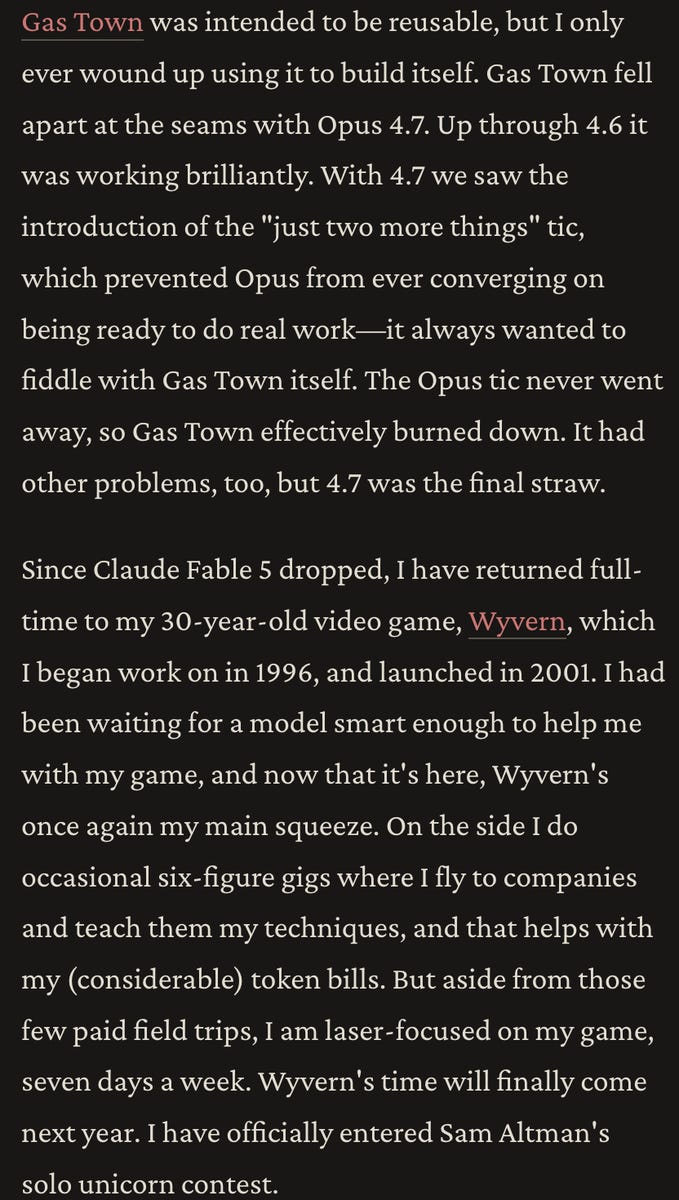
Steve Yegge shut down Gas Town and admitted he never successfully built anything with it, despite spending tho…
Carter Leffen, a product development coach at Bloomberg LP, says OpenAI's GPT-6 Astra worked about ten hours t…

GM CEO Mary Barra said skilled trades may be more AI-proof than some white-collar paths, with technicians earn…