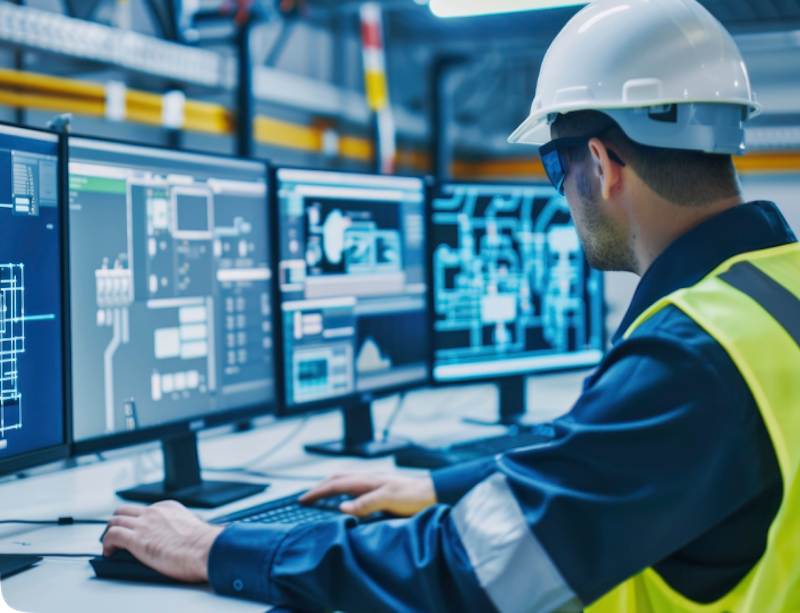
A report from Eclipse Automation found that while automation is now widespread across North American manufacturing, only a small fraction of businesses are achieving meaningful outcomes from it, despite machines moving faster and conveyor systems running around the clock.
Unlike traditional automation rules that trigger alerts, AI agents (software systems that perceive their environment, form goals, and take sequences of actions across multiple tools and databases without explicit programming for each scenario) can detect rising defect rates, trace them to specific material batches, identify alternative suppliers, draft purchase orders, and adjust production schedules—all without human intervention.
Three deployment areas show early traction: quality assurance (agents connected to vision systems monitoring variables and triggering corrective actions in closed loops), dynamic production scheduling (continuously reoptimizing across shifts based on demand, machine availability, and inventory), and supply chain coordination (agents detecting faster-than-forecast component consumption and initiating replenishment automatically).
The critical barrier is not the AI itself but integration—agents require clean, accessible, real-time data spanning machines, manufacturing execution systems, ERP platforms, and supply chain systems; manufacturers seeing the best results start with narrow, high-frequency decisions in supervisory mode before moving to autonomous action.
Summaries like this, in your inbox every morning.
Pick your industry and the AI tools you use, and get news related to your work every day.
Free · 30 seconds with Google · unsubscribe anytimeWhat is AIToday? →
Ask AI anything about this article. The AI reads this article, earlier AIToday articles, and Wikipedia, and cites its sources. Q&As are published on this page for other readers too.
Cammarata reinterprets InceptionV1's cat-car neuron as a V-shape detector, not two unrelated concepts

Google Deepmind's Gemini 4 Argon scored 97.5 percent on ARC-AGI-3 at a cost of $4,800, second only to GPT-6 As…

Microsoft's Surface Laptop Ultra, using Nvidia's RTX Spark platform, starts at $2,599 (up to $5,899)

Meta's new commercial terms, effective October 30th, appear to let it crawl and train AI on content from websi…

Vercel data published Thursday shows TypeSafe AI's Jev, a lightweight decision model for choosing among predet…

Reflection AI introduced Beam, an open-weight model for agentic coding and long-horizon tasks, with 501 billio…


