What happened
Turing CTO Yu Yamaguchi said adding data and GPUs alone did not speed development, so the Tokyo startup rebuilt its compute base around Nvidia and Google chips, claiming roughly 3× speed at the same price.
Why it matters
Turing has already completed test runs in five Japanese cities including Tokyo and Osaka, and faster training may shorten the path toward the level 5 full autonomy it is targeting, which no one has achieved yet.
WHO IT HITSAutonomous-driving engineering teams building their own training infrastructure are the clearest audience: the claim is that data volume and GPU count alone hit a wall, and chip choice alongside the compute setup mattered more.
Summaries like this, in your inbox every morning.
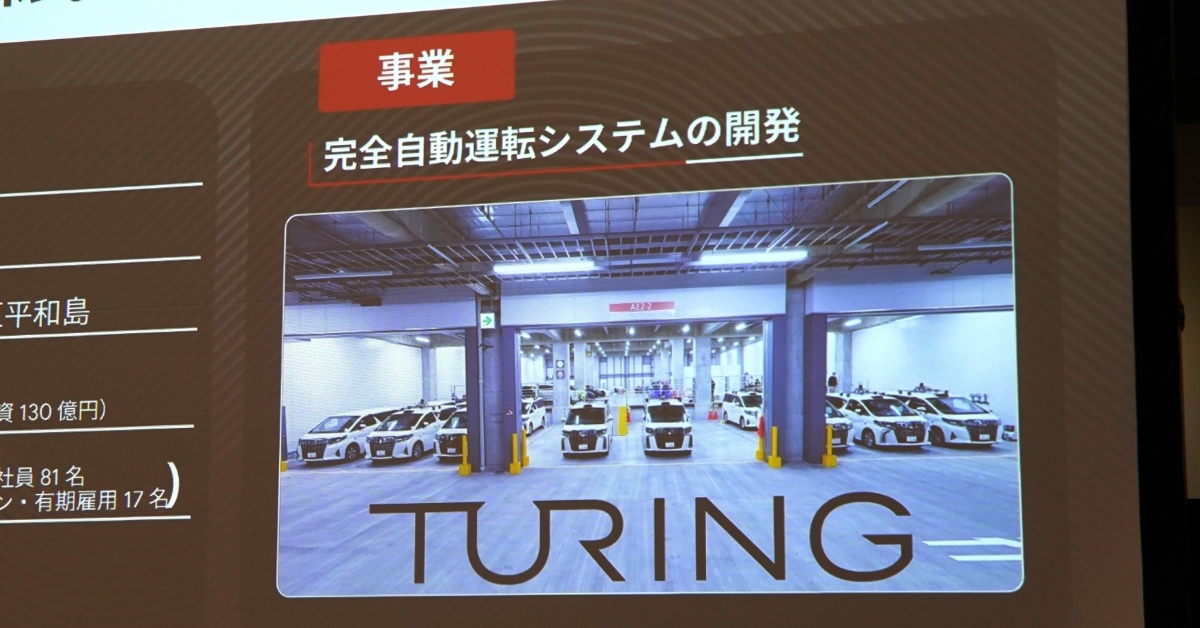
Turing's approach diverges from the usual sensor-heavy recipe. While the industry generally stacks LiDAR, radar and multiple sensors to ensure safety, Turing argues that pushing AI performance hard enough lets a vehicle drive smoothly in city streets with fewer, less capable sensors. Its modified Toyota Alphard carries just seven cameras plus motion sensors, a satellite positioning receiver and an onboard computer — a deliberate bet that software, not hardware, is the bottleneck.
The Osaka run is presented as evidence for that bet. Yamaguchi notes the AI had learned almost entirely from Tokyo data and was driving an unfamiliar road for the first time, yet performed at that level. That matters because generalizing to unseen roads is where camera-only approaches are usually challenged.
Behind the AI is a loop of collecting driving data and retraining on it, and Turing says scaling data and GPU count alone did not accelerate that loop. The rebuild of its compute foundation, and the comparison of Nvidia and Google chips at the same price, is where the 3× claim comes from. The details were shared in a session at Google Cloud Next Tokyo 26, an event hosted by Google Cloud Japan.
Pick your industry and the AI tools you use, and get news related to your work every day.
Free · 30 seconds with Google · unsubscribe anytimeWhat is AIToday? →
Ask AI anything about this article. The AI reads this article, earlier AIToday articles, and Wikipedia, and cites its sources. Q&As are published on this page for other readers too.

