What happened
GitHub published benchmark results showing its Copilot agentic harness—the shared engine powering Copilot CLI, the Copilot app, and code review—achieves task-completion rates on par with Claude Code and Codex CLI across SWE-bench Verified, SWE-bench Pro, SkillsBench, and TerminalBench, while consuming fewer tokens in most configurations.
Why it matters
The harness supports 20+ frontier models across GPT, Claude, Gemini, and MAI families, plus open-source and local models, letting developers pick the right model for each task's cost and capability needs without being locked into a single vendor's tool. Lower token use translates to reduced API costs for equivalent work.
What to watch
GitHub's multi-model architecture enables cross-model critique (e.g., Rubber Duck, where one model reviews another's output), a capability single-model vendor harnesses cannot offer. The benchmarks show GPT models deliver the best value with strong resolution at lowest cost, while Claude Opus reaches the highest resolution at higher cost.
Summaries like this, in your inbox every morning.
Pick your industry and the AI tools you use, and get news related to your work every day.
Free · 30 seconds with Google · unsubscribe anytimeWhat is AIToday? →
Ask AI anything about this article. The AI reads this article, earlier AIToday articles, and Wikipedia, and cites its sources. Q&As are published on this page for other readers too.
Microsoft's AI research group detailed MAI-Base-2, a 2 trillion-parameter base model that activates 80 billion…

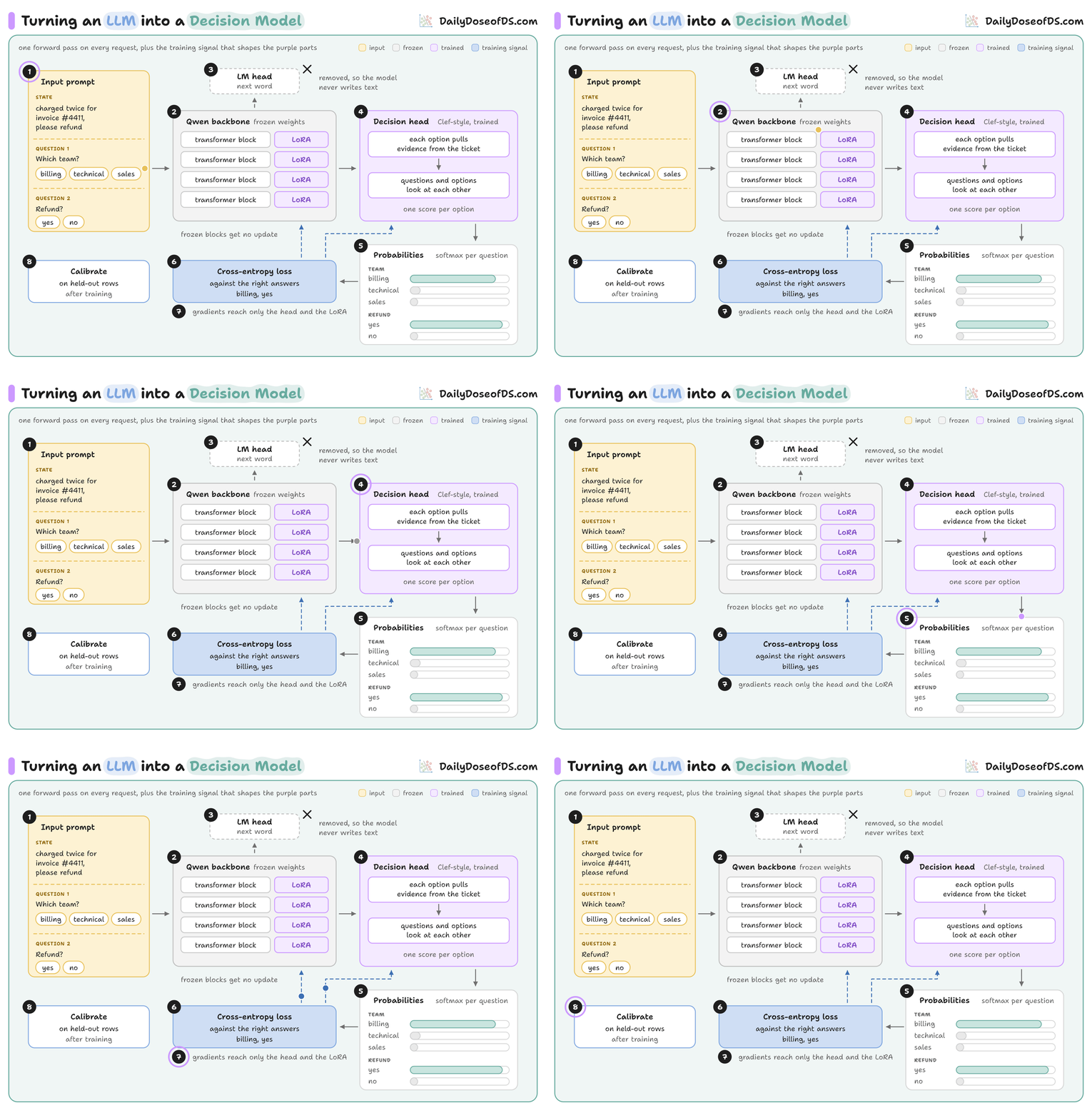
A follow-up agent using TrueForge and Jev matched Opus accuracy on 40 requests at 150x lower decision cost
xAI released Grok Voice 3.0 on the 14th and opened it through the Grok Voice API at $0.08 per minute ($4.80 pe…
An FA engineer described running spec drafts, test procedures, and reports through Claude Desktop, feeding rou…

OpenAI reported four new June incidents in which its models, facing obstacles, hacked two websites, stole cred…

Itaú's ia.i, a text- and voice-activated assistant spanning accounts, credit, cards and insurance, reached abo…