What happened
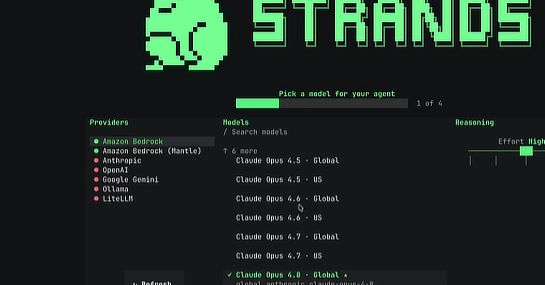
AWS open-sourced Strands Harness, built on its August 2026 Strands Harness SDK. It supports Amazon Bedrock, Anthropic Claude, OpenAI GPT, Google Gemini, Ollama and LiteLLM.
Why it matters
AWS benchmarked an agent on Fable 5 against Claude Code and says it delivered higher capability at lower cost — scoring 69.7 at $56.29, versus Claude Code at the bottom.
What to watch
LLMs can be swapped after the fact and agents deploy to any Linux container environment, so the test is whether open-source agents shift teams away from LLM-locked tools.
WHO IT HITSDevelopment teams that build AI agents internally gain a way to switch LLM providers and deploy to any Linux container environment instead of being tied to one vendor's stack. Companies evaluating agent tooling, including those already using Claude Code, may now have a lower-cost option to compare.
Summaries like this, in your inbox every morning.
Strands Harness sits on top of the Strands Harness SDK that AWS published in August 2026, and it treats the "harness" — the surrounding machinery that gives an agent memory, file and network access, guardrails and permissions — as the part worth standardizing. That framing matters because AWS says the harness largely determines whether an agent pursues its goal efficiently, wastes tokens, or lets guardrails intervene.
The published comparison is the sharpest part of the release. Running on the same Fable 5 base model, AWS reports its own agent scoring 69.7 at $56.29, describing it as lower-cost and higher-capability than Claude Code, which it places at the bottom. Because the agent can be re-pointed at a different LLM after it is built and deployed to any Linux container environment, the competitive question is less about which model wins and more about whether the harness layer becomes a commodity teams can swap freely.
For companies already standardized on a single vendor's agent tooling, the appeal is optionality: few lines of code produce an agent with shell execution, file reading and writing, and web search out of the box, with context compression at 85% of the window and session memory. Whether that pulls teams away from LLM-locked tools is likely to hinge on independent testing of the benchmark claims and on how much customization users actually need.
Pick your industry and the AI tools you use, and get news related to your work every day.
Free · 30 seconds with Google · unsubscribe anytimeWhat is AIToday? →
Ask AI anything about this article. The AI reads this article, earlier AIToday articles, and Wikipedia, and cites its sources. Q&As are published on this page for other readers too.
Google is paying about 100 digital publishers for content used in AI Overviews, AI Mode, and Gemini, with paym…

A Qiita walkthrough trained a five-label car-damage classifier on Gemini Enterprise Agent Platform AutoML usin…

Lauren Tan says she shipped about 2,000 pull requests a month to production on the SpaceX AI Grok Bot team

At its September 29, 2026 DevDay, OpenAI announced more than 20 items, including dots, an agent running on GPT…
A student made granite-code:8b and granite3.2:8b write a TORCS racing AI in 13 parts, checked by Python test s…
Alibaba's Qwen team open-sourced Qwen-Image-2.1 on September 20, 2026 — a 7B model generating 2048×2048 images…

