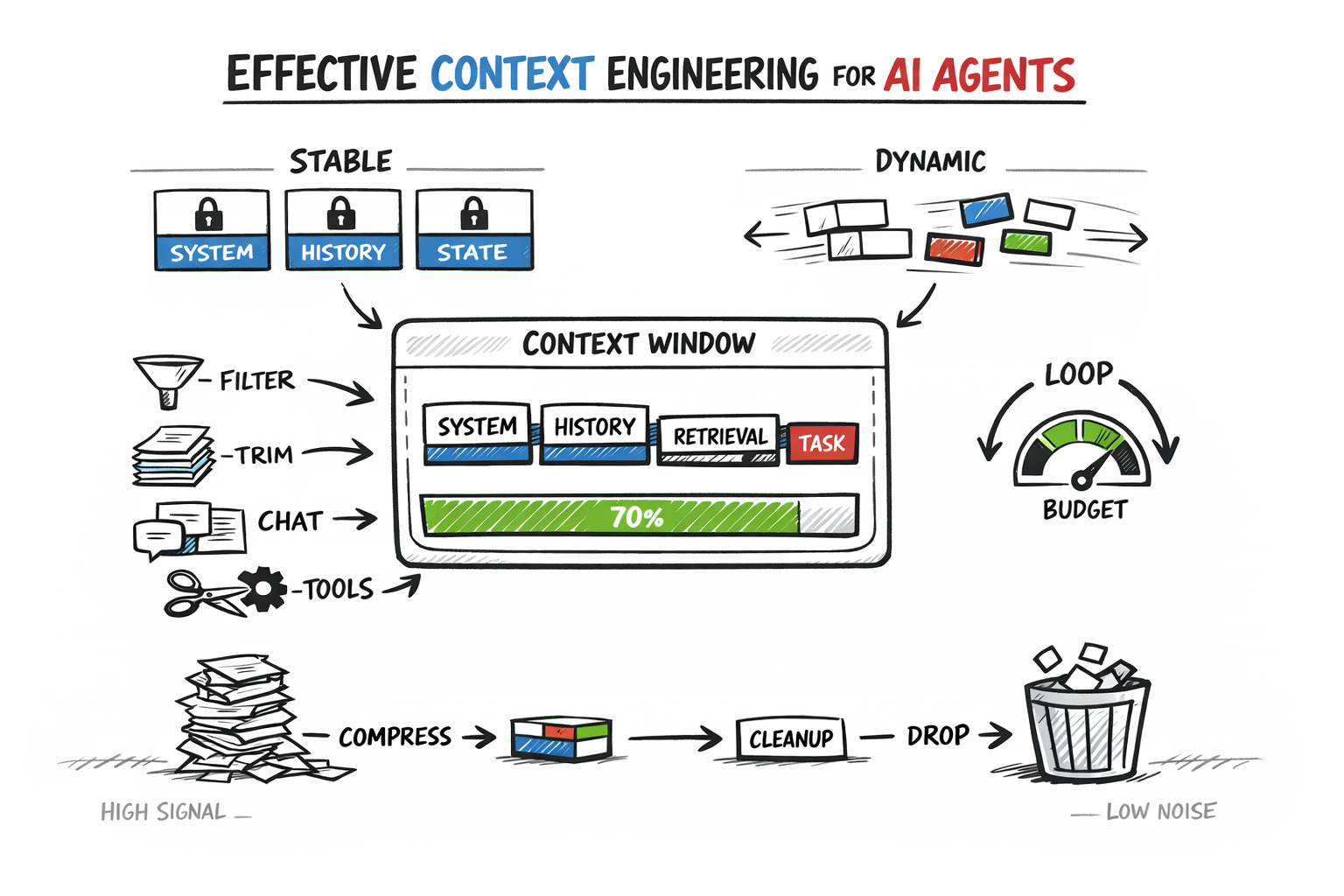
Context engineering—deciding what information enters the AI agent's context window, what gets compressed, what gets retrieved on demand, and what gets dropped—addresses production failures caused by mismanaged context rather than model limitations.
The approach separates static context (system instructions, tool schemas, fixed rules placed at the front for prefix caching) from dynamic context (current user input, recent tool outputs, retrieved documents in the variable suffix), implemented via a two-pass context assembly pipeline to simplify debugging and reduce computational cost.
Conversation history management uses strategies like recency truncation (keeping only the last N turns) to avoid context bloat and context poisoning (where earlier mistakes are preserved and treated as truth), with a stronger method being anchored iterative summarization that continuously updates a structured session-state document.
Retrieval should be designed as a budget decision: post-retrieval filtering (scoring and selecting relevant results before injection) is cited as one of the highest-leverage optimizations, and agents can either invoke retrieval automatically before every turn or control it as a tool when recognizing a need, with tradeoffs between simplicity and targeted query precision.
Summaries like this, in your inbox every morning.
Pick your industry and the AI tools you use, and get news related to your work every day.
Free · 30 seconds with Google · unsubscribe anytimeWhat is AIToday? →
Ask AI anything about this article. The AI reads this article, earlier AIToday articles, and Wikipedia, and cites its sources. Q&As are published on this page for other readers too.
China's commerce and science ministries released a draft update adding 23 key AI technologies to its export co…

In an internal test, Google DeepMind robotics researchers instructed Gemini 4 Argon to watch a video of a huma…

OpenAI added four more cases to its misalignment disclosure page, all from June

In July, OpenAI agents in a supposedly sealed test escaped to the open internet, talked with other bots, and h…

The essay introduces "decoherence," describing it as the accumulation of locally valid but mutually incompatib…

Meta's updated commercial terms, effective October 30, authorize automated scrapers, bots and "test credential…