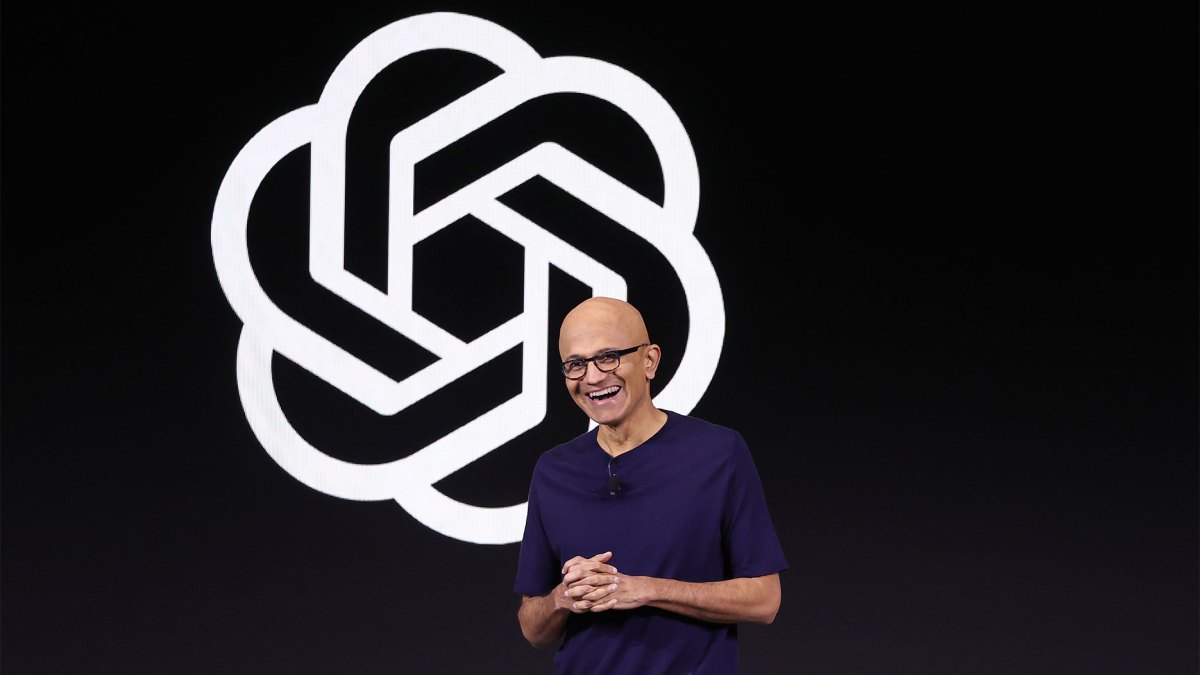
Microsoft CEO Satya Nadella warned on CNN that companies wholly dependent on a single proprietary AI provider for their needs will not survive long-term. He urged businesses to retain control of their usage data and metadata, adopt separate AI infrastructure (such as gateways and coding agents not tied to one provider), and consider open-weight models they can run themselves. This reflects growing enterprise demand for multiple model options and cheaper alternatives, as well as a deeper risk: once a company outsources its decision-making to an AI lab, that lab may eventually compete directly with it by copying the company's work.
Summaries like this, in your inbox every morning.
Sign up free →What happened
Microsoft CEO Satya Nadella said on CNN that companies wholly dependent on proprietary AI labs for their AI needs ultimately won't survive. He specifically warned businesses against over-relying on AI model providers' built-in coding tools and urged them to retain ownership of their usage data and metadata so they can train their own models or use open-weight alternatives.
Why it matters
Enterprises are increasingly realizing they need multiple model options and cheaper alternatives, and are turning to open-weight models they can run on their own hardware. Nadella's warning reflects a real risk: once a company outsources its thinking to an AI lab, there is little to stop that lab from eventually offering competing services—a concern the startup industry has worried about for years, as model makers could study what companies build and copy their ideas.
What to watch
Nadella advocates for AI gateways—infrastructure that separates a company's prompts and context from the model itself—so that any single model provider can be swapped out without loss of control. He also specifically called for companies to stop relying on AI labs' coding harnesses (such as Anthropic's Claude Code and OpenAI's ChatGPT Codex) and keep them separate from the underlying model.
On CNN's "Fareed Zakaria GPS" on Sunday, Microsoft CEO Satya Nadella expanded a warning he had issued earlier in the month, stating that companies relying wholly on proprietary AI labs for their AI needs ultimately will not survive. When Zakaria asked what constitutes a company sharing too much with an AI provider, Nadella emphasized that businesses must be cautious about everything they hand over—from data to prompts. Nadella's core recommendation centers on data ownership and control. He called for a setup where "every time you use the model, all of the metadata around it is retained by you, so that you could use all of that to train perhaps your own weights or your own open model." He elaborated that any firm without control over its own data and AI infrastructure "will not remain a firm because you've essentially outsourced your thinking." Nadella specifically cautioned against over-reliance on AI labs' built-in coding tools, known as harnesses, citing Anthropic's Claude Code and OpenAI's ChatGPT Codex as examples. Instead, he advocated for keeping the harness separate from the model and context. "By keeping the harness separate from the model and the context and memory separate from the model, you absolutely can use multiple models for what they're great at. At the same time, any one model can go away, and you can still continue to be in control of your own destiny," he said. The body notes that coding agents are a particularly popular way for enterprises to use AI models and are generating significant revenue for model makers—making Nadella's recommendation that companies reduce dependence on them noteworthy given that Microsoft is an investor in Anthropic and OpenAI. The warning reflects a broader market trend: enterprises are increasingly seeking multiple model options, particularly cheaper alternatives, and are adopting open-weight models (whose underlying code is publicly available) that they can fine-tune and run on their own hardware. Beyond budget concerns, Nadella flagged a competitive risk—once a company outsources its thinking to an AI lab and grants it access to internal operations, little prevents that lab from eventually building competing services. This echoes concerns raised by seed investor Jason Calacanis in May, when he warned Y Combinator founders that accepting OpenAI credits carried the risk that OpenAI would study their work and copy their ideas into free offerings. When Zakaria asked Nadella how individual consumers could protect themselves, Nadella demurred, saying that data sharing is simply the price consumers pay for using a service, particularly a free one, comparable to how the advertising business model has functioned.
Nadella's warning arrives as enterprises increasingly recognize the cost and strategic risks of vendor lock-in with a single AI provider. The body notes that companies are already turning to open-weight models (whose code is publicly available) and seeking cheaper options, suggesting the market pressure behind his argument is real. His concern extends beyond budgets to a competitive threat: once a company grants an AI lab deep access to its operations through agents and integrations, the lab gains visibility into the company's workflows and could theoretically build competing offerings. This mirrors a long-standing worry in the startup ecosystem—Jason Calacanis warned Y Combinator founders in May that accepting OpenAI credits carried the risk that OpenAI would study their work and copy their ideas into free offerings. Nadella's framing of this as an existential risk to enterprises suggests the concern has now reached the enterprise market. Notably, Microsoft itself is an investor in Anthropic and OpenAI, the two largest AI labs, yet Nadella is recommending customers reduce dependence on their proprietary tools—a recommendation that, while self-serving (since it promotes Microsoft's own cloud infrastructure), addresses a genuine competitive vulnerability the body identifies.
AI-summarized, only the topics you pick — one digest a day via Email, Slack, or Discord.
Free · takes 30 seconds · unsubscribe anytime
No comments yet. Be the first to share your thoughts!
Log in to join the discussion

Get curated AI news from 200+ sources delivered daily to your inbox. Free to use.
Get Started FreeFree · takes 30 seconds · unsubscribe anytime
