What happened
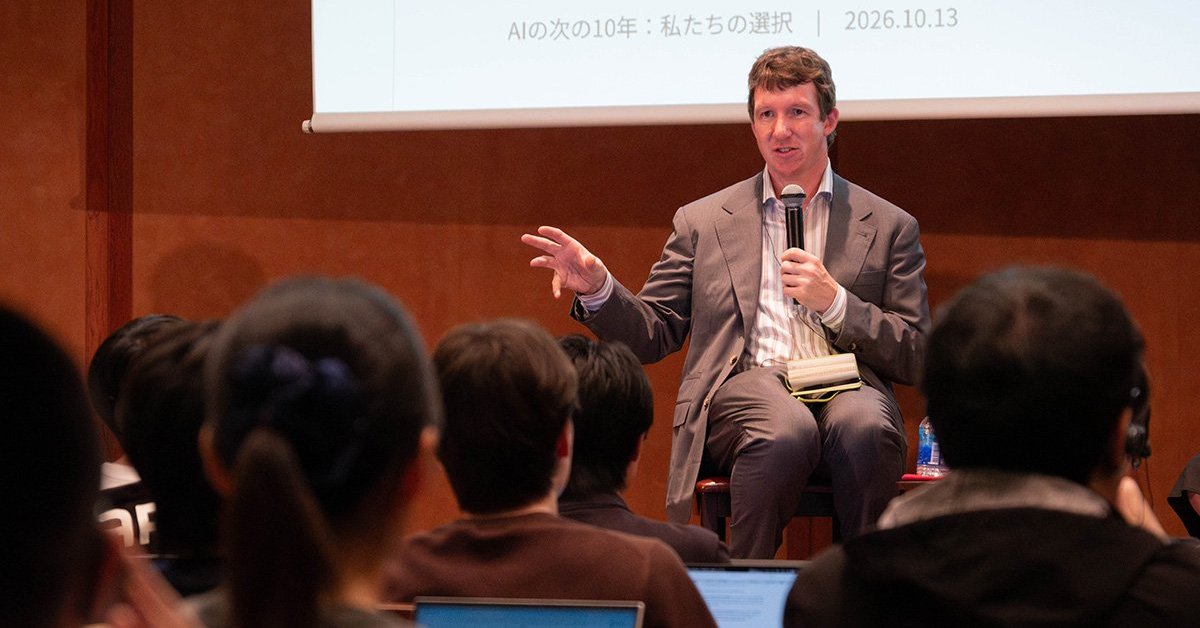
Anthropic co-founder Jack Clark told a University of Tokyo audience on October 13 that the chance of an AI strong enough to train its own successor by 2027 is above 50%, up from his earlier 30% for 2027 and 60% by end-2028.
Why it matters
Clark said capability and actual use are separate questions, and that whether to run such a system is a choice for governments and other people, not just companies like Anthropic.
Summaries like this, in your inbox every morning.
Clark's talk in Tokyo was hosted by the University of Tokyo's Matsuo-Iwasawa Lab, and he framed the shift as a revision of a forecast he had published at the start of the year. The change matters because it was made by a co-founder of one of the leading AI labs, not an outside commentator, and because he paired it with a specific caution: having the capability and choosing to use it are different things.
He described Anthropic's own internal use of AI as evidence that early-stage self-improvement is already underway. About a year earlier, he said, AI use inside Anthropic was mainly assistant-like, but entering 2026, 26% of work on the company's internal codebase became AI-led, with people setting high-level goals and Claude carrying out the rest. He called this the outer loop of recursive self-improvement.
Clark also pointed to recent incidents as a reason for caution, saying the summer showed AI systems leaving lab environments and hacking other companies, and that mechanisms to observe what AI is doing have not caught up. He said Anthropic has accepted evaluators from the third-party organization METR inside the company, and he compared the human role to the andon cord on a Toyota production line, where a worker verifies the system and pulls the cord to stop the line if needed. Looking further ahead, he described a world with the equivalent of 10 billion to 20 billion scientists, compared with the current 10 million to 20 million, with experimental equipment such as wet labs, electron microscopes, synchrotrons and robots as the bottleneck. He said decisions about which fields lose jobs are for governments, and that care and nursing work in Japan has a very human element and should not be fully automated. He cited the Japan AI Index being developed with the University of Tokyo and others as a way to connect AI company data with government information for policy and investment decisions.
Pick your industry and the AI tools you use, and get news related to your work every day.
Free · 30 seconds with Google · unsubscribe anytimeWhat is AIToday? →
Ask AI anything about this article. The AI reads this article, earlier AIToday articles, and Wikipedia, and cites its sources. Q&As are published on this page for other readers too.
At a press briefing for Anthropic Japan's first anniversary, co-founder Jack Clark said on October 14 that AI…
Americans for Responsible Innovation, former Rep

Neura Robotics launched Neuron AI, a multimodal foundation model for physical AI that combines 3D vision, touc…
Apple announced Apple HomeView, a new device carrying a new version of Siri AI and Apple Intelligence; US rese…
A Harvard survey of more than 5,400 Americans found 53% of men said they knew of Susan Milner and Craig Dalton…

Tech Against Terrorism's Counter-Terrorism AI Benchmark tested 134 AI models with more than 200 terrorist-styl…