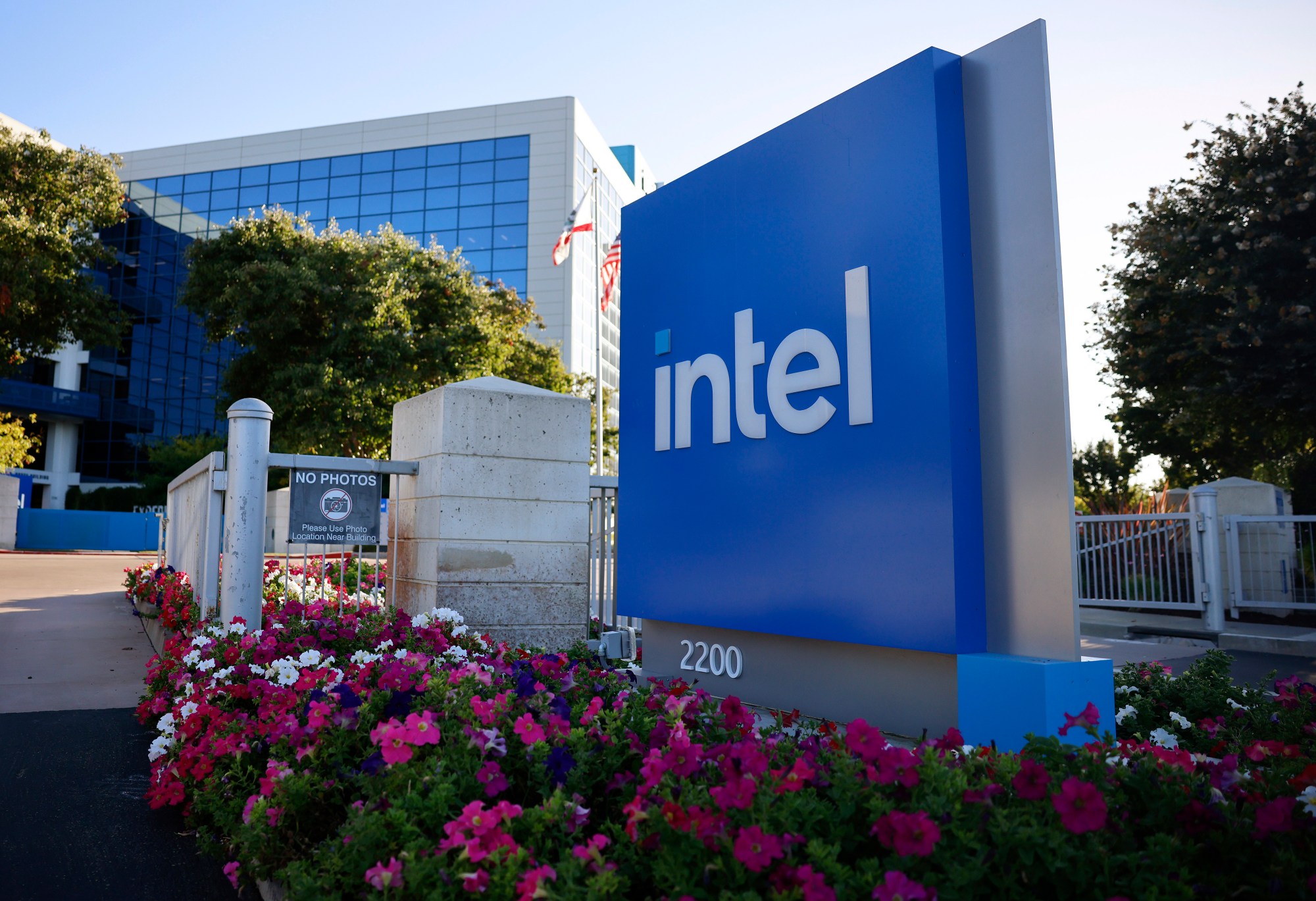
Intel's third-quarter revenue forecast of $15.8 billion(約2.5兆円) to $16.8 billion(約2.7兆円) exceeded Wall Street expectations, driven by a 59% surge in data center sales as customers race to build out AI infrastructure. Under new CEO Lip-Bu Tan, the company is recovering from years of losses by capturing demand for CPUs and foundry services, though profitability remains well below historical peaks and the turnaround depends on delivering on longer-term production and outsourcing plans.
Summaries like this, in your inbox every morning.
Sign up free →What happened
Intel said third-quarter sales will reach $15.8 billion(約2.5兆円) to $16.8 billion(約2.7兆円), well above the $15.1 billion(約2.4兆円) average analyst estimate. Data center revenue jumped 59% last quarter, more than double Intel's overall growth rate, driven by demand for AI computing chips.
Why it matters
Intel is pivoting from years of losses under previous leadership to capture growth in AI infrastructure. CEO Lip-Bu Tan, who took over last year, is positioning the company as a beneficiary of the broader chip buildout beyond just Nvidia's accelerators—specifically Intel's central processing units (CPUs), which are now in high demand in data centers as companies shift focus from training AI models to running them at scale.
What to watch
Intel plans to raise capital spending next year beyond the $20 billion(約3.2兆円) budgeted for this year to meet demand for both its own chips and outsourced manufacturing. The company expects to show progress on external foundry customers by early next year, and its gross margin (adjusted) widened to 40.4% last quarter, though still far below the 60%+ levels when Intel dominated the market.
Intel delivered a revenue forecast on Thursday that exceeded Wall Street expectations by a substantial margin, signaling that the company's long-anticipated turnaround is gaining traction. The company projects third-quarter sales of $15.8 billion(約2.5兆円) to $16.8 billion(約2.7兆円), with even the low end of that range clearing the $15.1 billion(約2.4兆円) average analyst estimate. Intel shares rose about 5.4% in premarket trading on Friday.
The forecast is being driven primarily by soaring demand in data centers, where revenue surged 59% in the most recent quarter—more than double the pace of Intel's overall revenue growth. This surge reflects the explosion in AI infrastructure spending, as customers rush to build out systems for artificial intelligence. Though Nvidia remains the dominant provider of accelerator chips used to develop and run AI models, the industry's broader expansion has created demand across many types of semiconductors, including Intel's central processing units (CPUs). CEO Lip-Bu Tan, who took over last year, noted in an interview that "the CPU is taking off" in data centers. "Demand is outpacing our increasing supply, and so those are good problems to have," he said. Jay Goldberg, an analyst at Seaport Group, observed that "you have the near-term momentum to carry you into the longer-term fundamentals."
To capitalize on this opportunity, Intel is ramping up production investment. Chief Financial Officer Dave Zinsner said the company is reversing an earlier plan to reduce capital spending and is now committed to raising its budget. Spending will amount to about $20 billion(約3.2兆円) this year and will likely increase further next year. Tan also indicated that Intel is pursuing multiple outsourced manufacturing engagements, saying the company should begin showing progress on that front by early next year, though he declined to name specific customers. The Santa Clara-based company's foundry services division posted sales of $5.8 billion(約9300億円) in the second quarter, up 31%, though it currently relies almost exclusively on Intel's own product divisions for orders.
Internal financial performance has improved markedly. In the second quarter, revenue rose 25% to $16.1 billion(約2.6兆円), and profit was 42 cents a share (excluding some items), both substantially exceeding analyst expectations of $14.4 billion(約2.3兆円) in sales and 21 cents in earnings. The company's gross margin (adjusted basis) widened to 40.4% last quarter, up nearly 13 percentage points from a year earlier, though still far below the 60%-plus margins Intel maintained at its peak. The data center segment alone posted $6.3 billion(約1兆円) in sales, while the PC chip division generated $8.9 billion(約1.4兆円). Tan's efforts to rebuild Intel's financial health have also included securing backing from the federal government, Nvidia, and SoftBank under an unconventional August deal brokered by the White House, making the U.S. government one of the company's biggest backers. This support is part of a broader effort to bring chip manufacturing back to American soil, with Intel planning a massive facility in Ohio, though the project has faced repeated delays. Under Tan's predecessors, Intel lost its manufacturing technology leadership and accumulated billions in losses as it failed to capitalize on the AI boom. The shift in industry priorities—away from training new AI models and toward deploying and running existing systems—has inadvertently benefited Intel, since general-purpose microprocessors are now in favor again.
Intel's comeback narrative has been gaining momentum since CEO Lip-Bu Tan took the helm last year, and the latest results suggest that momentum is translating into concrete business gains. The data center segment's 59% growth—more than double the company's overall revenue growth—reflects a fundamental shift in how the AI industry is operating. While Nvidia remains the dominant provider of specialized accelerator chips for AI model development, the broader buildout of AI infrastructure has created demand across the entire semiconductor stack, including Intel's core business of central processing units. This plays directly to Intel's historical strengths: general-purpose processors are now in high demand as companies shift from the training phase to the deployment and inference phase of AI systems.
Tan has also rebuilt Intel's financial foundation through investments from the U.S. federal government, Nvidia, and SoftBank, creating a safety net that previous leadership lacked during the company's years of heavy spending and declining market share. The company's gross margin improved significantly to 40.4% last quarter (adjusted basis), up nearly 13 percentage points year-over-year, though still far removed from the 60%+ margins Intel once commanded. The path forward depends critically on whether Intel can meet the surging demand it is now forecasting—hence the commitment to raise capital spending again next year—and whether it can successfully attract external foundry customers, which would diversify its revenue beyond its own product divisions.
AI-summarized, only the topics you pick — one digest a day via Email, Slack, or Discord.
Free · takes 30 seconds · unsubscribe anytime
No comments yet. Be the first to share your thoughts!
Log in to join the discussion

Get curated AI news from 200+ sources delivered daily to your inbox. Free to use.
Get Started FreeFree · takes 30 seconds · unsubscribe anytime
