What happened
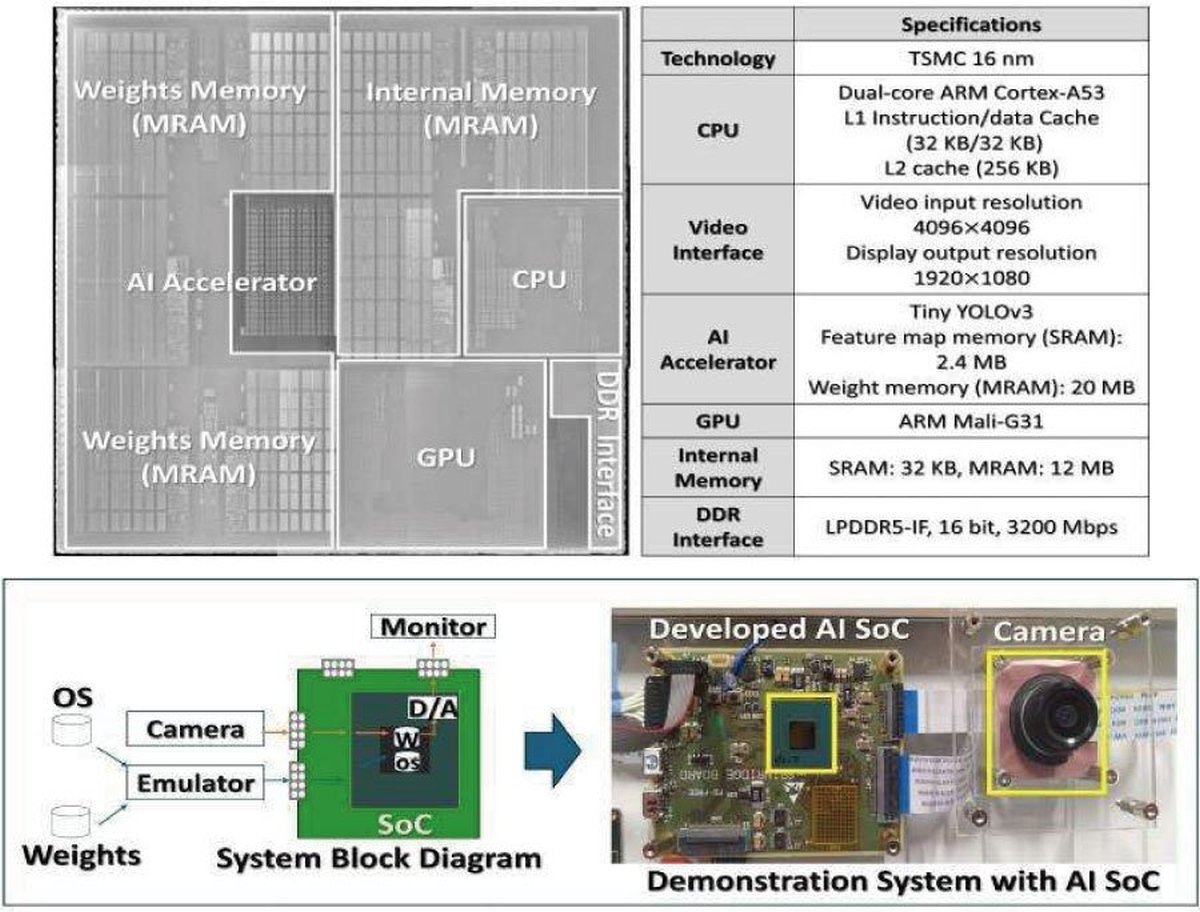
Tohoku University and Aisin said on November 2, 2026 that their near-memory-computing chip boots an OS in 65.7ms versus 2535.3ms before, a 38.59-fold gain.
Why it matters
On-chip 32MB STT-MRAM holding model weights and boot data removes DRAM/SSD transfers, cutting Tiny YOLOv3 inference energy to 50.7mJ per frame versus the conventional method.
What to watch
The results are set to be presented at IEEE A-SSCC 2026, held November 1-4, 2026 in Hsinchu, Taiwan.
WHO IT HITSThis matters to chip designers and embedded-system engineers working on edge AI devices, who may gain a path to faster startup and lower inference energy without external DRAM or SSD. Automotive suppliers such as Aisin's own engineering teams are the most direct audience.
Summaries like this, every morning.
The design targets a known bottleneck: conventional systems must initialize DRAM at power-on and copy bootloader and model data from SSD before any AI work begins. By keeping OS boot data and model weights in on-chip STT-MRAM, the Tohoku and Aisin teams reduce those transfers, which is where the 65.7ms boot figure comes from.
For AI processing, the constraint was capacity. The team's hybrid 8-bit/16-bit multiply scheme and a weight-sharing technique that reuses the same kernel weights across clock cycles within a 4x4 tile let them shrink Tiny YOLOv3 weights by 53% while keeping accuracy nearly flat, with mAP easing from 0.325 to 0.316.
The work was carried out by a team led by Tohoku University CIES professor Tetsuo Endo together with Aisin, and the chip also carries two Arm Cortex-A53 cores and a Mali-G31 GPU. System-level demonstrations showed about a 25-fold speedup and 50.7mJ per frame for Tiny YOLOv3 inference, roughly 1/50 of the conventional method.
Pick your industry and the AI tools you use, and get news related to your work every day.
Free · 30 seconds with Google · unsubscribe anytimeWhat is AIToday? →
Ask AI anything about this article. The AI reads this article, earlier AIToday articles, and Wikipedia, and cites its sources. Q&As are published on this page for other readers too.
Anthropic published Siren on November 24, building 1,700+ scenarios across 26 sandbox setups (bubblewrap, Linu…
Simon Willison marked the one-year anniversary of Claude Opus 4.5 on November 24th 2026, naming it the first m…

ShellBench, built with The OpenClaw Foundation, Hugging Face, Red Hat, and UC Berkeley, tested everyday agent…

Farsight announced that its integration with S&P Capital IQ Pro is now live, available to existing and new Cap…

PhoneArena reports that Verizon's AI customer-service agents are driving away loyal customers, including some…

CEO Marvin Ellison said Lowe's Mylow assistant, built with OpenAI, fields over 1 million questions a month, an…