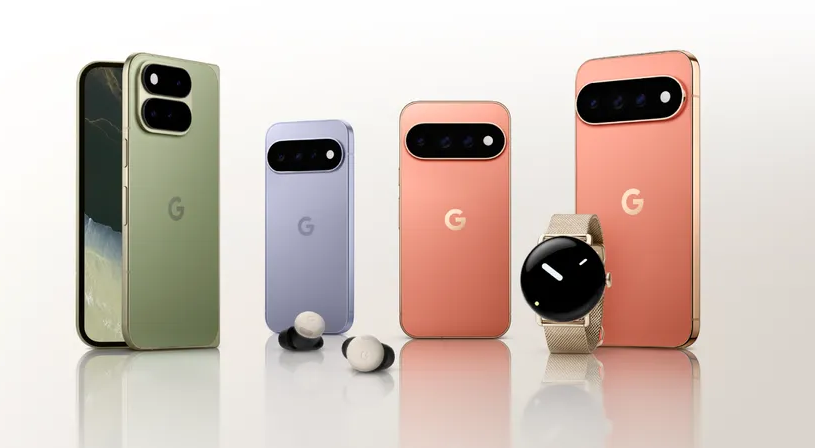
Google has launched five new Pixel devices—three smartphones, one foldable handset, and a smartwatch—all powered by the Tensor G6 chip, which delivers 50% more AI computing power and 3.5× faster on-device inference than its predecessor.
The devices introduce new Gemini Intelligence features including a sign-language-to-text model (SL2T), AI-powered photography zoom up to 120× on Pro models, and location-aware app cards that automate tasks like restaurant reservations.
Pricing ranges from $399 for the watch to $1,899 for the Pro Fold.
What happened
Google launched the Pixel 11, Pixel 11 Pro, Pixel 11 Pro XL, Pixel 11 Pro Fold, and Pixel Watch 5. All handsets feature the custom Tensor G6 chip, which includes an integrated AI accelerator with 50% more computing power than its predecessor and can run on-device AI models up to 3.5 times faster while using less energy.
Why it matters
The new devices ship with upgraded Gemini Intelligence software featuring on-device AI capabilities that do not require cloud processing. Photography gains 30-fold zoom on base models and 120-fold zoom on Pro variants; a new sign-language translation model (SL2T) lets Pixel 11 users control the device via sign language; location-aware cards in apps can auto-fill restaurant reservations. For developers and enterprises, faster on-device inference means more complex AI tasks can run directly on the handset with lower latency.
What to watch
Pixel 11 and Pixel 11 Pro start at $899; Pixel 11 Pro XL reaches $1,299; Pixel 11 Pro Fold costs $1,899. Pixel Watch 5 begins at $399. Sign-language translation is rolling out first to Pixel 11 but will expand to other devices in the future.
Google announced five new devices today: the Pixel 11, Pixel 11 Pro, Pixel 11 Pro XL, Pixel 11 Pro Fold, and Pixel Watch 5, all shipping with an upgraded version of Gemini Intelligence software.
The flagship foldable, the Pixel 11 Pro Fold, features an 8-inch inner display that folds like a book and a 6.5-inch external screen made of what Google describes as "ultra-strong ceramic cover glass." According to Google product manager Justin Savich, the Pro Fold has improved crease performance thanks to a larger bend radius on the hinge and a thicker glass layer on the inner display. Both screens are 20% brighter than last year at 3,600 nits. The Fold pairs with three conventional smartphones: the Pixel 11 and Pixel 11 Pro (both 6.3 inches) and the Pixel 11 Pro XL (6.8 inches). The Pixel 11 and Pro differ in resolution and frame rate; the Pro XL offers a larger screen.
All four handsets use the custom Tensor G6 chip. Google says the integrated AI accelerator contains 50% more computing power than the previous generation, and the central processing unit has been upgraded to run on-device AI models up to 3.5 times faster while using less energy. The camera system includes a primary camera and telephoto lens optimized for distant objects, with the Tensor G6 enabling 30-fold zoom on the Pixel 11 and Pro Fold, and 120-fold zoom on the Pro and Pro XL. A feature called Magic Capture records two-minute videos and automatically saves the best frames as photos. The chip also includes an image signal processor that improves low-light image quality.
Beyond photography, the Pixel 11 includes a heavily upgraded version of Gboard (Google's keyboard app) with an AI model called SL2T that transcribes sign language into text. Pixel 11 owners can use sign language to interact with Gemini, search the web, and perform other tasks; the feature will roll out to additional devices in the future. Google DeepMind researchers reported that SL2T achieves a zero-shot score of 70 BLEURT, significantly higher than any previously reported score on benchmarks like FLEURS-ASL, making it "the most capable sign language translation model to date."
The Gemini app now includes location-specific information retrieval, currently in preview, which displays relevant data on the lock screen—for example, popular menu items at a restaurant where the user is dining. Additionally, Gemini will display "glanceable cards" in some apps at opportune moments, allowing quick actions such as restaurant reservations or saving information to an app with a single tap.
The three Pixel 11 smartphones start with 12 gigabytes of RAM and 256 gigabytes of storage, with higher-priced configurations available. The Pro Fold includes 16 gigabytes of RAM and the same base storage. The Pixel Watch 5, launching alongside the phones, features 50% more memory than its predecessor and a CPU with a 12% performance boost. An AI feature called Gemini Intelligence Proactive Suggestions retrieves app information and displays it on the watch.
Pricing begins at $899 for the Pixel 11, rising to $1,299 for the Pixel 11 Pro XL. The Pixel 11 Pro Fold will retail for $1,899. The Pixel Watch 5 starts at $399.
Google's latest hardware launch centers on accelerating on-device AI inference, a shift reflecting broader industry movement away from cloud-dependent processing. The Tensor G6's 50% boost in AI computing power and 3.5× speed improvement enable complex tasks to run locally on the phone—sign-language recognition, multi-second video analysis for frame extraction, advanced image processing in low light—without requiring round-trip calls to data centers. This approach trades off some flexibility for lower latency, reduced bandwidth consumption, and stronger privacy guarantees, all factors increasingly important to mobile users and enterprises handling sensitive data.
The sign-language-to-text capability (SL2T) represents a notable accessibility step: Google DeepMind reports it achieves a zero-shot score of 70 BLEURT, described as significantly higher than any previously reported score on benchmarks like FLEURS-ASL. The feature's initial exclusivity to the entry-level Pixel 11, with planned rollout to other devices, suggests Google is using it to differentiate the base model while demonstrating a commitment to phased, responsible deployment of emerging AI features.
Pricing positions the Pixel 11 at $899 and the Pro Fold at $1,899, reflecting the premium placed on foldable engineering and advanced telephoto lenses. The Pixel Watch 5's $399 entry point brings Gemini-powered features (including proactive information retrieval from apps) to wearables, indicating Google's intent to bind AI capabilities across its entire consumer ecosystem rather than isolating them to flagship phones.
AI-summarized, only the topics you pick — one digest a day via Email, Slack, or Discord.
Free · takes 30 seconds · unsubscribe anytime
Ask AI anything about this article. Q&As are published on this page for other readers too.
SpaceXAI released Grok 4.6, a large language model built with extended training on AI-generated datasets and r…
Gallium arsenide (GaAs), a semiconductor material, is gaining adoption in short-reach optical links for AI dat…
Meta announced a $1B "Future Is For Everyone Fund" targeting communities affected by its AI infrastructure pro…
Meta is simultaneously launching open-weight AI models like Muse Spark 1.2 and Muse Glimmer, expanding data-ce…

Blackstone, BlackRock, Apollo, Brookfield, Goldman Sachs, and KKR signed MOUs with Nvidia to deploy at least $…
Amazon.com has reportedly emerged as a leading bidder to acquire Decart AI, according to discussions disclosed…

The AI news that matters, in one minute each morning.
Sign up free