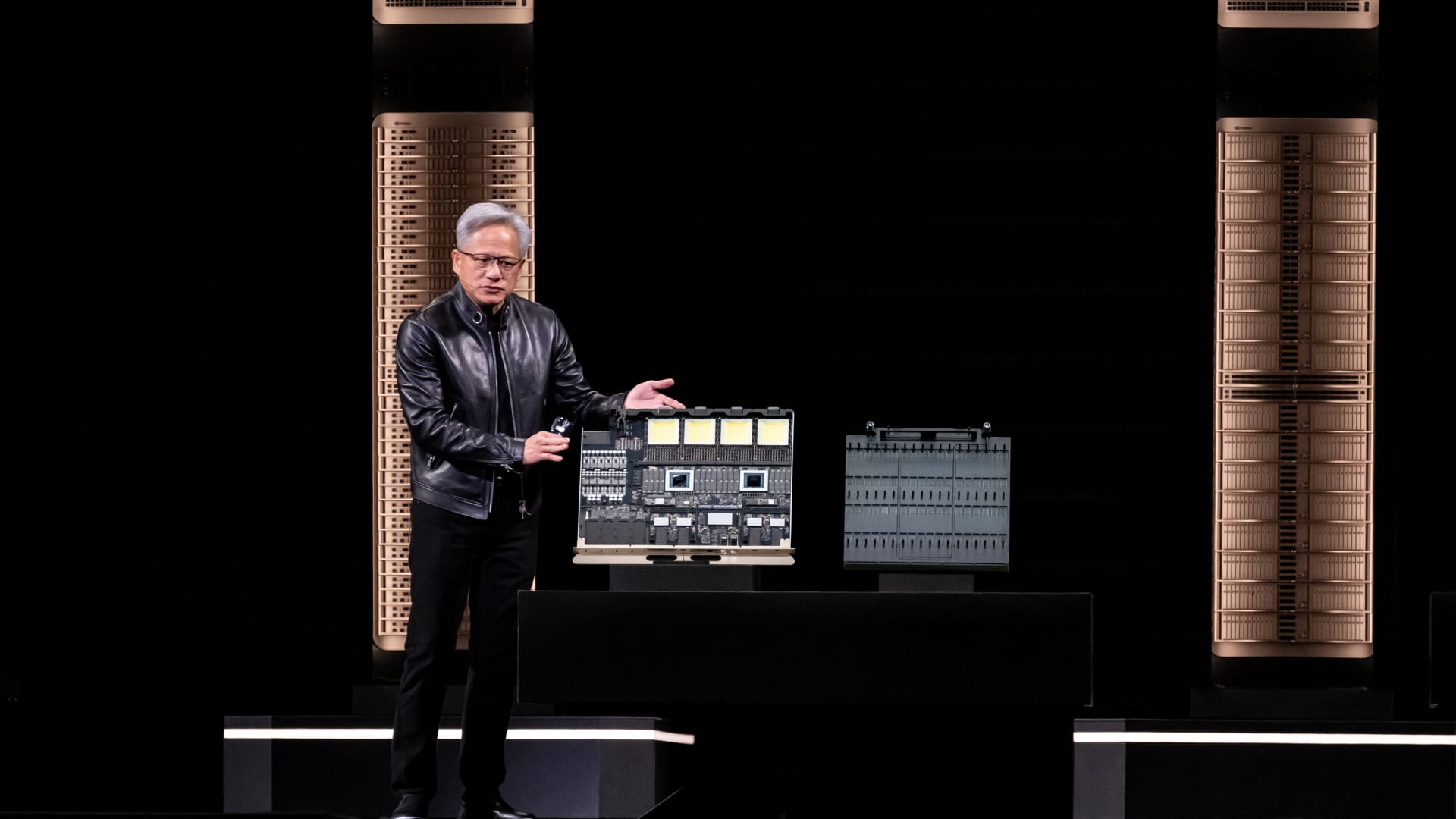
Nvidia has launched Vera, a custom-designed server CPU that the company says delivers 50% better performance for AI agents than competing x86 chips from Intel and AMD. The move marks Nvidia's entry into an established CPU market where it is a challenger, but the company believes agentic AI—which requires fast CPU processing to feed data to agents—justifies a new class of processor. OpenAI, Anthropic, and SpaceX have already received Vera chips, and OpenAI plans large-scale deployment starting this quarter.
Summaries like this, in your inbox every morning.
Sign up free →What happened
Nvidia released detailed specifications for Vera, its first custom-designed server CPU, and said the chip has been delivered to OpenAI, Anthropic, and SpaceX as of June. The Vera uses between 250 watts and 450 watts of power, supports up to 1.5 terabytes of memory per chip, and Nvidia claims it delivers 50% better performance for AI agents than x86 chips from Intel and AMD.
Why it matters
CPUs have become critical as agentic AI—systems that run independently with minimal human input—requires a processor to manage data flow to agents. Nvidia is vertically integrating to sell complete server systems rather than chips alone, a strategy meant to lock in customers and compete as a challenger against Intel (which holds 66.8% of the server CPU market) and AMD (33%), both of which have established relationships with cloud providers.
What to watch
Wolfe Research forecasts Nvidia will ship about 1.3 million Vera chips this year at an average selling price of about $5,000 per chip. The company said OpenAI plans to deploy Vera chips in large quantities starting this quarter, and Vera will be sold standalone, in pairs per server, or in liquid-cooled racks of 256 chips, as well as paired with Nvidia GPUs in a system called Vera Rubin.
On Tuesday, Nvidia released detailed specifications for Vera, its next-generation server CPU, marking the company's entry into a market historically dominated by Intel and AMD. Jensen Huang, Nvidia's chief executive, presented the chip at the Nvidia GTC conference in San Jose on March 16, 2026. Nvidia said Vera chips were delivered to clients OpenAI, Anthropic, and SpaceX starting in June.
Vera is Nvidia's first server CPU designed entirely from scratch rather than built on an off-the-shelf Arm-based design. The chip uses between 250 watts and 450 watts of power and supports up to 1.5 terabytes of low-power memory—the same type used in laptops and phones—per chip. Nvidia claims Vera delivers 50% better performance for AI agents compared to x86 processors from Intel and AMD. According to Hannah Coutand, a Vera product marketer at Nvidia, the chip prioritizes per-core speed, high memory bandwidth, and low latency "so that agents can return to their GPUs as quickly as possible and keep those GPUs, which are a very expensive and a highly valuable asset in the AI factory, as highly utilized as possible." The strategic focus on single-core speed reflects a departure from Intel and AMD's traditional emphasis on core count.
The emergence of agentic AI—software that runs independently with minimal human input—has reinvigorated demand for CPU performance. Ian Buck, Nvidia's vice president of hyperscale, stated that agents have made CPUs "much more integral," particularly "how fast a CPU can answer one question." This shift has reshaped market dynamics: AMD and Intel stock rallied 128% and 149% respectively in 2026 through May, outpacing Nvidia's 8% gain.
Nvidia plans to sell Vera in multiple configurations: as a standalone chip, in pairs within a single server, in liquid-cooled racks of 256 chips, and paired with Nvidia GPUs in a system called Vera Rubin. Wolfe Research forecasted in May that the average selling price would be about $5,000 per Vera chip and that Nvidia would ship about 1.3 million units in 2026; Nvidia declined to comment on pricing. Nvidia said the entire server CPU market could eventually be worth $200 billion(約32兆円), while a Bernstein estimate from earlier in 2026 valued the mature server CPU market at about $37 billion(約5.9兆円) in 2025. Currently, Intel holds 66.8% of the server CPU market and AMD holds about 33%, though AMD is gaining share. OpenAI plans to deploy Vera chips in large quantities starting this quarter, representing the most concrete near-term adoption signal outside of the initial June shipments.
Nvidia's entry into server CPUs represents a significant strategic shift from its traditional role as a GPU specialist. The company has built its dominance on graphics processors, but as agentic AI systems emerge—software agents that operate autonomously in the background—the CPU has regained importance as the component that manages these agents and feeds data to the expensive GPUs. This shift is already visible in stock performance: AMD and Intel were among the best-performing chip stocks in 2026, up 128% and 149% respectively, compared to Nvidia's 8% rise, suggesting investors see CPU upside in the AI era.
Nvidia's vertical integration strategy—designing its own CPUs rather than licensing third-party designs—aims to offer customers a tightly integrated system and reduce reliance on Intel and AMD. However, the company faces established competition: Intel commands 66.8% of the server CPU market and AMD 33%, and both have deep, long-standing relationships with cloud providers and hyperscalers. Nvidia's claimed 50% performance advantage for AI agents, achieved through focus on single-core speed and latency rather than core count, is designed to address a gap the body says incumbents have not yet filled. Analysts suggest the Vera may define a new CPU category reserved for intensive AI workloads rather than traditional server tasks, though broader adoption by cloud providers remains uncertain.
AI-summarized, only the topics you pick — one digest a day via Email, Slack, or Discord.
Free · takes 30 seconds · unsubscribe anytime
No comments yet. Be the first to share your thoughts!
Log in to join the discussion



Get curated AI news from 200+ sources delivered daily to your inbox. Free to use.
Get Started FreeFree · takes 30 seconds · unsubscribe anytime
1 minute a day. The AI essentials.
200+ sources · Email / LINE / Slack
