What happened
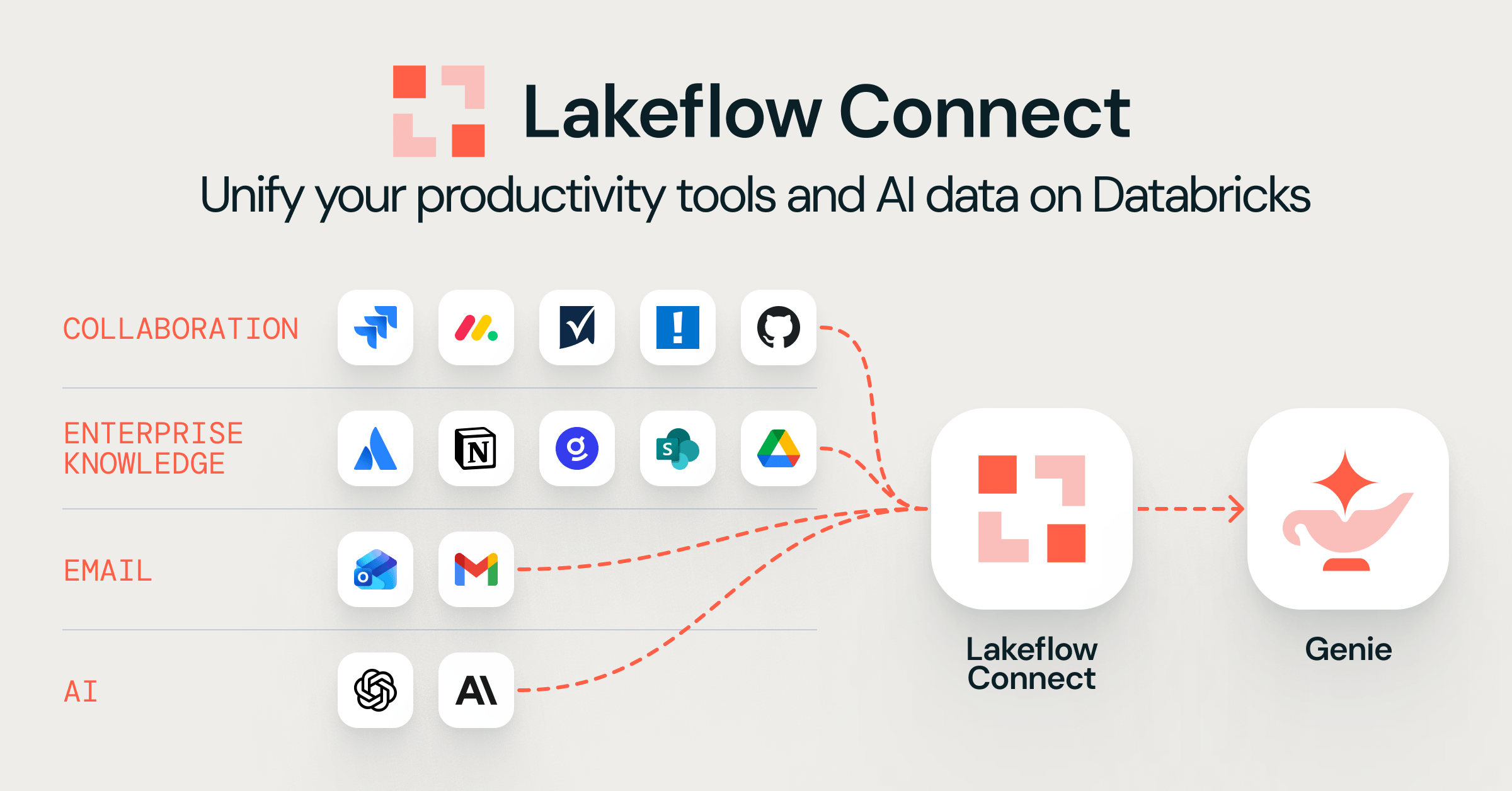
Databricks expanded Lakeflow Connect with native connectors for productivity tools including Jira, Confluence, SharePoint and Gmail, plus OpenAI and Anthropic for AI usage, landing data as governed tables in Unity Catalog.
Why it matters
Teams can feed scattered wikis, project trackers and AI usage logs into one place for AI agents and cost tracking, replacing custom pipelines that the post describes as slow to build and painful to maintain.
WHO IT HITSData engineering and platform teams at companies using Databricks gain prebuilt pipelines for productivity and AI-usage data, which may reduce the custom integration work they maintain today.
Summaries like this, every morning.
The post frames the problem plainly: a typical company's productivity stack is spread across project trackers, wikis, document stores, inboxes and AI tools, and extracting that data has meant custom pipelines that are slow to build and hard to maintain. Databricks positions Lakeflow Connect as the alternative, with each connector set up through a point-and-click UI or a simple API and data incrementally ingested as managed tables in Unity Catalog, with no infrastructure for the customer to provision. The breadth matters because the post ties it to two use cases that otherwise stay out of reach: AI agents grounded in internal knowledge, and visibility into operational analytics.
Customer examples in the post point at how the connectors are being used. Toyota Finance Australia uses the Jira connector as a fully managed pipeline that the company says handles API complexity and schema changes automatically. VaxCare feeds its Confluence knowledge base into Databricks to ground a chatbot. M3 Accounting reports the GitHub connector was up in minutes and saves about an hour a week, while its SharePoint-fed knowledge assistant was pulling live content within a week. Orizon moved one million tickets from 168 projects with daily syncs it describes as 100% successful.
The AI-usage angle is a separate thread: as generative tools spread across teams, the post says questions arise about spending, adoption and compliance. The OpenAI connector brings in usage, costs, API keys, projects, users and audit logs for attributing spend by team, and the Anthropic connector brings in audit logs, users and roles plus claude.ai chat content. Databricks says this supports a single view of AI usage trends and return on AI investments. The post also notes new connectors are still rolling out.
Pick your industry and the AI tools you use, and get news related to your work every day.
Free · 30 seconds with Google · unsubscribe anytimeWhat is AIToday? →
Ask AI anything about this article. The AI reads this article, earlier AIToday articles, and Wikipedia, and cites its sources. Q&As are published on this page for other readers too.
Paul Gillin said at EVOLVE26 that Cloudera is positioning itself as an "anywhere cloud for AI," extending clou…

At the Bloomberg Invest conference in Dallas, Crusoe CEO Chase Lochmiller called the market angst over neoclou…

On Latent Space, Anthropic's Katelyn Lesse and Angela Jiang detailed the Claude Platform's architecture, inclu…

Google Deepmind introduced Genie 4, a real-time world model that generates sound directly, including backgroun…

Oracle said it will deploy Google TPU AI chips in Oracle Cloud Infrastructure, providing the power, cooling an…

OpenAI released GPT-6.1 Terra, pitched at image and screen understanding, PC operation, and natural writing, a…