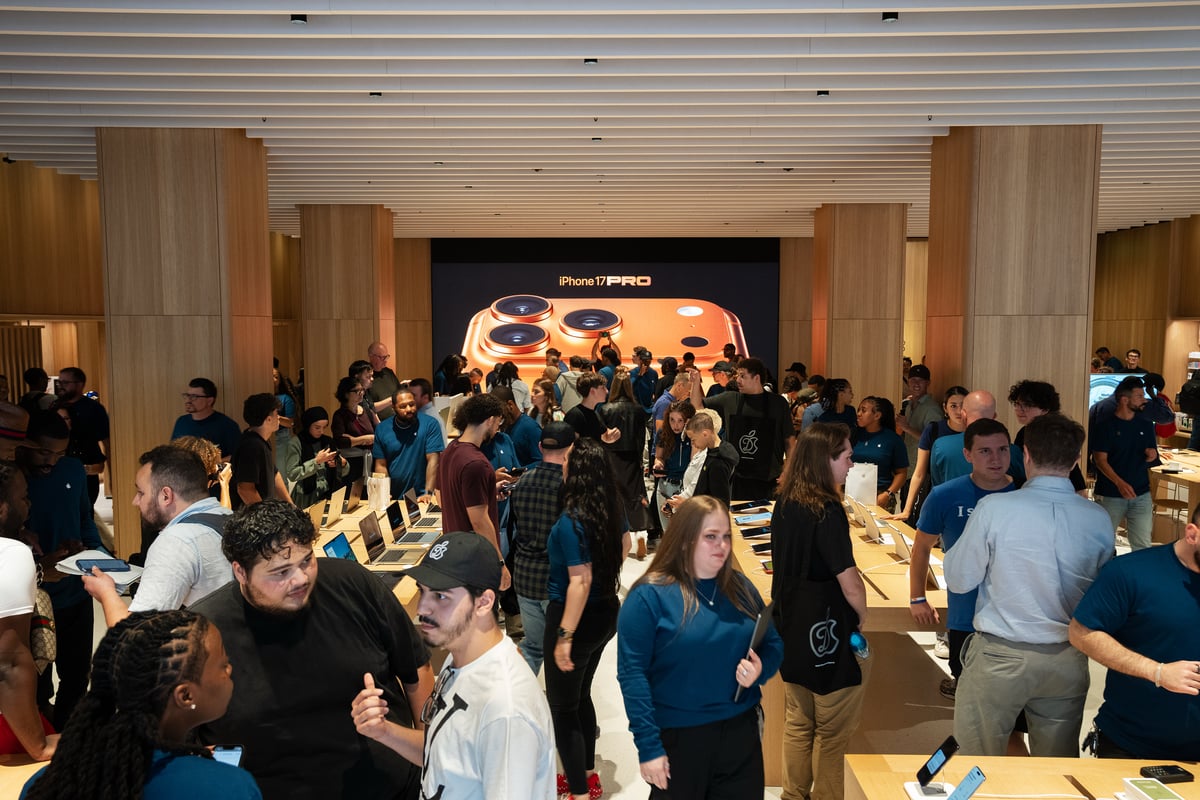
The PHLX Semiconductor Index fell into a bear market on Friday, down more than 20% from its June peak, as global chip stocks have shed about $3.3 trillion(約530兆円) in value since June 22. Apple, however, hit a record intraday high of $334.98 and briefly reclaimed the title of world's most valuable company at about $4.9 trillion(約780兆円), because it spent just $12.7 billion(約2兆円) on capital expenditures in fiscal 2025 while rivals committed hundreds of billions to AI infrastructure. Investors are rotating money into Apple's lower-risk business model as they reassess the costs and profits of the AI build-out.
Summaries like this, in your inbox every morning.
Sign up free →What happened
The PHLX Semiconductor Index closed in a bear market on Friday, finishing more than 20% below its June peak. Apple touched a record intraday high of $334.98 and briefly surpassed Nvidia to reclaim its position as the world's most valuable company, valued at about $4.9 trillion(約780兆円).
Why it matters
Global chip stocks have erased about $3.3 trillion(約530兆円) in market value since June 22 as investors reassess AI infrastructure costs and profitability. Apple's light spending on AI—just $12.7 billion(約2兆円) in capital expenditures in fiscal 2025—shields it from the downturn that is hitting rivals like Microsoft and Amazon, who have committed hundreds of billions to AI infrastructure. Apple's revenue rose 17% year over year to $111.2 billion(約18兆円) in its fiscal second quarter, and the stock has gained nearly 59% over the past year.
What to watch
Apple trades at roughly 40 times earnings, a steep multiple for a company growing revenue 17%. The premium investors are paying for safety could expand if chip sell-offs deepen, but leaves little room for disappointment if iPhone momentum cools.
The PHLX Semiconductor Index closed in a bear market on Friday, finishing more than 20% below its June peak. On the same day, Apple touched a record intraday high of $334.98 and for a moment surpassed Nvidia to reclaim its position as the world's most valuable company, valued at about $4.9 trillion(約780兆円). This divergence stems from a broader repricing of the AI infrastructure narrative. Global chip stocks have erased about $3.3 trillion(約530兆円) in market value since June 22 as investors rethink the costs of the AI build-out and who will ultimately profit from it. Memory chipmakers, which had been among the biggest recent winners, have been leading the declines. Apple, however, has taken a fundamentally different path. While rivals like Microsoft and Amazon committed hundreds of billions of dollars to AI infrastructure, Apple spent just $12.7 billion(約2兆円) on capital expenditures in fiscal 2025 while generating $98.8 billion(約16兆円) in free cash flow—a strategy that leaves the company's profits far less dependent on the AI spending boom continuing.
Apple's underlying business performance has remained strong. In its fiscal second quarter, the period ended March 28, Apple's revenue rose 17% year over year to $111.2 billion(約18兆円), with earnings per share up 22% and iPhone revenue setting a March-quarter record. Shares have gained nearly 59% over the past year, and the stock now sits more than 60% above its 52-week low of $201.50. On Friday, as the broader market punished companies whose earnings lean on ever-rising AI capital spending, money crowded into the megacap whose earnings do not, pushing Apple back to the top of the market on the very day the chip index broke down.
The premium investors are paying for Apple's safety comes at a price. At about $332 per share, Apple trades at roughly 40 times earnings, a steep multiple for a company growing revenue 17%. Investors are no longer simply paying for iPhone sales and services growth; they are paying for insulation from infrastructure spending uncertainty. That premium could continue to expand if the chip sell-off deepens and Apple's light spending model avoids the wave of depreciation that may weigh on competitors' future earnings. However, a multiple this high leaves little room for disappointment if iPhone momentum cools. The analyst commentary notes that Friday's divergence says more about the chip trade than about Apple itself, and investors chasing the safety should recognize they are buying a strong business at a valuation that arguably already reflects its quality.
The divergence between the chip sector's collapse and Apple's all-time highs reflects a fundamental reappraisal of the AI build-out narrative. Since June 22, global chip stocks have erased about $3.3 trillion(約530兆円) in market value as investors question both the cost of AI infrastructure and which companies will actually benefit. Memory chipmakers, which had been among the biggest recent winners in the AI build-out, have led the declines. Apple stands apart because it never signed up to pay for this infrastructure spend in the first place. While Microsoft and Amazon committed hundreds of billions to AI infrastructure, Apple generated $98.8 billion(約16兆円) in free cash flow on just $12.7 billion(約2兆円) in capital expenditures in fiscal 2025—a fundamentally different strategy. This has made Apple's earnings far less dependent on the AI spending boom continuing, positioning it as a beneficiary of investor risk-off rotation on the very day the semiconductor index broke into bear market territory.
The question for investors is whether Apple's current valuation reflects this shelter value or overstates it. At roughly 40 times earnings, the stock commands a steep multiple for a company growing revenue 17%. The article notes that investors are no longer simply paying for iPhone sales and services growth; they are paying a premium for safety. That premium could deepen if the chip sell-off accelerates and capital discipline becomes more attractive relative to the spend-heavy AI strategies of competitors. However, the multiple also leaves little room for disappointment, particularly if iPhone momentum slows. The shelf life of this divergence ultimately depends on how long the chip sector's weakness persists and whether Apple's operational model—low capex, strong cash generation, established user base—continues to appeal relative to the uncertainty surrounding infrastructure-heavy AI plays.
AI-summarized, only the topics you pick — one digest a day via Email, Slack, or Discord.
Free · takes 30 seconds · unsubscribe anytime
No comments yet. Be the first to share your thoughts!
Log in to join the discussion


Get curated AI news from 200+ sources delivered daily to your inbox. Free to use.
Get Started FreeFree · takes 30 seconds · unsubscribe anytime
1 minute a day. The AI essentials.
200+ sources · Email / LINE / Slack
