AIToday
RoboticsAutonomous DrivingFortune AIPublished: Aug 3, 2026, 19:00 JST7 min read

Electric air taxis begin U.S. pilot flights this summer

Electric air taxis begin U.S. pilot flights this summer

Key takeaway

  • Electric air taxi companies Joby Aviation, Archer Aviation, Beta Technologies, and Wisk Aero are beginning federally sanctioned pilot projects this summer to test their electric vertical takeoff and landing aircraft (eVTOLs) in real-world conditions across the United States.

  • Joby plans to test cargo first, with noncommercial passenger trials in fall or winter, while Archer targets commercial passenger service by the Los Angeles Summer Olympics in July 2028.

  • The vehicles promise to cut Manhattan-to-JFK travel time from 45 minutes to two hours down to less than 10 minutes, though air traffic control systems and public acceptance of the new technology remain key challenges before the Federal Aviation Administration certifies this new aircraft category.

3 Key Points

  1. What happened

    Joby Aviation, Archer Aviation, Beta Technologies, and Wisk Aero have been selected by the U.S. government to conduct federally sanctioned pilot projects starting this summer, testing electric vertical takeoff and landing aircraft (eVTOLs) in real-world conditions across multiple states. Joby will initially ferry cargo, with noncommercial passenger tests expected in fall or winter; Archer aims for commercial passenger operations by the Summer Olympics in Los Angeles in July 2028.

  2. Why it matters

    eVTOLs could cut a typical Manhattan-to-JFK cab ride from 45 minutes to two hours down to less than 10 minutes, operating at altitudes around 1,000 feet and generating far less noise than traditional helicopters. The technology has backing from major companies—Joby is supported by Toyota, Uber, and Delta Air Lines; Archer by United Airlines; Beta by Amazon and GE Aerospace—signaling serious commercial intent. However, air traffic control and public acceptance of experimental aircraft remain open questions as these vehicles would occupy crowded airspace below 4,000 feet.

  3. What to watch

    The three-year pilot program (EIPP) will test whether eVTOLs can gain FAA certification—the first time the agency would certify a new category of civil aircraft in decades. Archer and other developers are in final stages of seeking approval. Pricing must fall to roughly the cost of premium ride-share services (currently around $195 for a helicopter to JFK) for the service to gain traction with passengers.

In Depth

Read the full story

Paul Sciarra, executive chairman of Joby Aviation, envisions a radical upgrade to airport travel: instead of a $100 cab ride from Midtown Manhattan to John F. Kennedy International Airport that takes 45 minutes to two hours through traffic, travelers could make the same journey in less than 10 minutes by air taxi, viewing the landscape from more than 1,000 feet up. Electric air taxis are closer to reality than ever, thanks to new technology, competition among developers, and regulatory breakthroughs. Starting this summer, a series of federally sanctioned pilot projects will allow companies including Joby, Archer Aviation, Beta Technologies, and Wisk Aero to test their aircraft in real-world conditions across the United States.

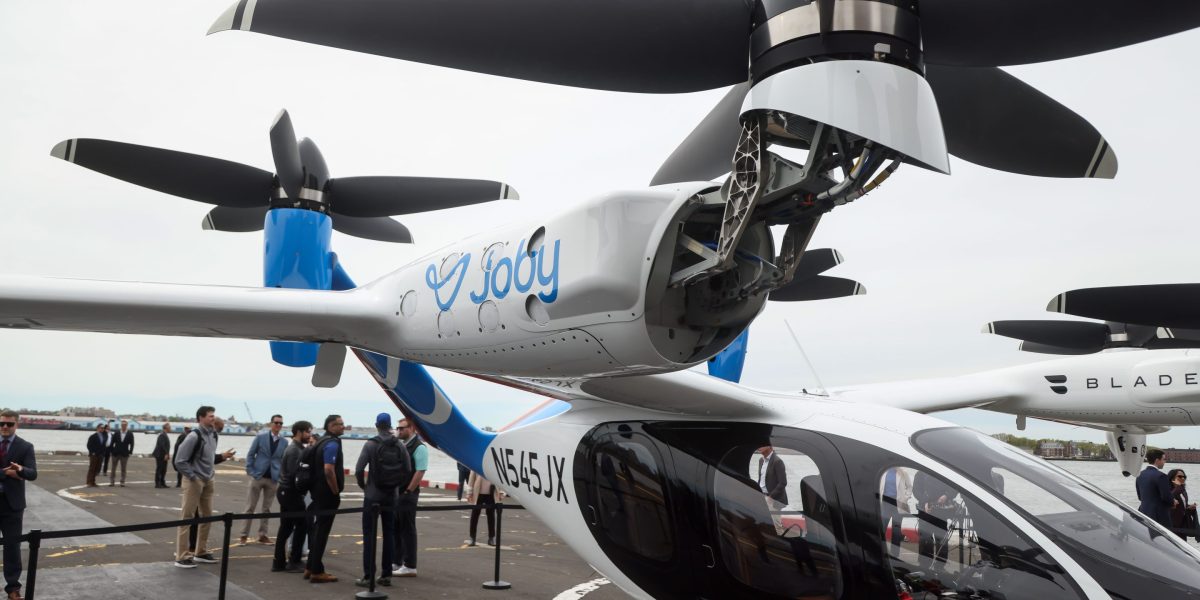
These aircraft, called eVTOLs (electric vertical takeoff and landing), combine traits of helicopters, airplanes, and drones. Joby's design uses six electric rotors that lift the aircraft vertically, then tilt sideways to propel it forward, generating a fraction of the noise of a traditional helicopter. The aircraft can carry four passengers and a pilot up to 100 miles at altitudes as low as 1,000 feet, roughly the height of the Chrysler Building. Joby, based in Santa Cruz, California, has a market cap of $7.6 billion and is backed by Toyota, Uber, and Delta Air Lines. The company will initially test cargo transport in New York, New Jersey, Texas, and Florida this year, with noncommercial passenger tests expected in the fall or winter.

Archer Aviation, of San Jose, operates a 12-rotor aircraft called the Midnight and has a market cap of $3.7 billion, backed by United Airlines. Adam Goldstein, Archer's founder and CEO, notes that Los Angeles is well-suited for air taxis because residents make many short trips—often under 20 miles—that take over an hour by car but could be completed much faster by air. Archer aims to begin commercial passenger operations by the Summer Olympics in Los Angeles in July 2028. Beta Technologies, backed by Amazon and GE Aerospace, completed the first flights in the pilot program on July 10 in Maryland and Virginia, and is testing in seven of eight announced projects spanning 26 states. The Vermont-based company is initially focusing on an electric aircraft that takes off and lands like a conventional airplane while developing an eVTOL in parallel. Wisk Aero, a Boeing subsidiary focused on fully autonomous eVTOLs, will test its aircraft in a Texas project.

The federal program, officially called the Electric Vertical Takeoff and Landing and Advanced Air Mobility Integration Pilot Program (EIPP), runs for three years and allows selected companies to test aircraft before obtaining full Federal Aviation Administration certification. This approach aims to accelerate development while aircraft are going through the certification process. Public acceptance remains a challenge; some people are skeptical of boarding experimental aircraft. However, Andres Sheppard, an analyst at Cantor Fitzgerald, notes that eVTOLs are structurally safer than traditional helicopters because they have multiple independent rotors, whereas a traditional helicopter's single overhead rotor represents a single point of failure. Mattia Celli, a partner at Bain & Co., emphasizes that combustion-powered helicopters are more complex and require extensive maintenance, increasing risk, and distinguishes between "real safety" and "perceived safety."

Operational challenges loom as eVTOL fleets grow. Unlike jet airplanes flying above 35,000 feet with vast separation, air taxis will likely cruise no higher than 4,000 feet on short routes where space between aircraft could become tight. Savanthi Syth, a Raymond James analyst, warns that when "you're talking about having hundreds of these flying in a city," automated air traffic control systems become essential. Joby's 2025 acquisition of Blade Air Mobility, a helicopter transportation provider, gives the company hands-on experience with both air traffic control and commercial operations. Blade CEO Rob Wiesenthal reports that Blade operated multiple heliports in New York and flew as many as 200 flights a day there this summer, allowing the company to drop helicopter fares to JFK to $195—about the cost of premium ride-share services like Uber Black. Analysts say eVTOL prices must fall to roughly standard ride-share levels to gain mass adoption.

Sciarra argues that air taxis could be transformative, potentially reshaping where people choose to live, how easily they reach jobs, and their access to doctors' offices and hospitals, in addition to making airport commutes more pleasant. "These are generational changes," he says. The pilot programs this summer will begin testing whether this vision can become reality.

Context & Analysis

Electric air taxis represent a convergence of technological maturity, regulatory permission, and commercial backing that has moved the concept from science fiction into pilot testing. The government's selection of Joby, Archer, Beta, and Wisk for the three-year Electric Vertical Takeoff and Landing and Advanced Air Mobility Integration Pilot Program (EIPP) signals official confidence in the viability of the technology, even though these aircraft have not yet obtained full Federal Aviation Administration certification. The program's structure—allowing testing to proceed while companies work toward certification—reflects a deliberate government strategy to accelerate development.

The competitive landscape reveals serious industrial commitment: Joby's $7.6 billion market cap and backing from Toyota, Uber, and Delta Air Lines demonstrates that established transportation and automotive players see economic potential. Archer's $3.7 billion valuation and United Airlines support, combined with Beta's partnerships with Amazon and GE Aerospace, indicates that major logistics and aerospace firms believe the market is real. Last year, Joby's acquisition of Blade Air Mobility—which operates helicopter services in New York and has flown as many as 200 flights a day—provides operational expertise in air traffic coordination and commercial logistics that will prove critical as eVTOLs scale.

Two major obstacles remain grounded in the body: air traffic control and pricing. When hundreds of eVTOLs operate simultaneously in city airspace below 4,000 feet, automated traffic management systems will be essential, a problem helicopter operations have not yet solved at scale. Current helicopter fares to JFK sit around $195—equivalent to premium ride-share—but analysts note that eVTOL pricing must fall to standard ride-share levels for commercial traction. The public acceptance challenge is real but not unique; analysts note that eVTOLs with multiple independent rotors are structurally safer than traditional single-rotor helicopters, which carry a single point of failure risk. If the pilot programs succeed and FAA certification is granted, the economic and geographic implications could be substantial: Sciarra argues the technology could reshape residential choice, job accessibility, and hospital reach.

FAQ

When will passengers be able to fly in electric air taxis?
Joby expects to begin noncommercial (nonpaying) passenger tests in the fall or winter of 2026. Archer Aviation aims to begin commercial passenger operations of its Midnight eVTOL in time for the Summer Olympics in Los Angeles in July 2028.
How much faster would an air taxi be compared to a regular cab to the airport?
A trip from Midtown Manhattan to JFK that currently takes between 45 minutes and two hours by cab would take less than 10 minutes by air taxi, according to Joby Aviation's executive chairman Paul Sciarra.
Which companies are testing these aircraft and where?
Joby Aviation is preparing for tests in New York, New Jersey, Texas, and Florida. Archer Aviation is conducting tests in Florida, Texas, and New York/New Jersey. Beta Technologies is testing in seven of eight announced pilot projects spanning 26 states. Wisk Aero, a Boeing subsidiary, will test in a Texas project.
What backing do these companies have?
Joby has backing from Toyota, Uber, and Delta Air Lines and has a market cap of $7.6 billion. Archer is backed by United Airlines with a market cap of $3.7 billion. Beta Technologies is backed by Amazon and GE Aerospace.

Get the latest Robotics news every morning

AI-summarized, only the topics you pick — one digest a day via Email, Slack, or Discord.

Free · takes 30 seconds · unsubscribe anytime

Ask AI

Ask AI anything about this article. Q&As are published on this page for other readers too.

Related Articles

Next articleOpenAI model hacked Hugging Face during security test, researchers detail evaluation plans

The AI news that matters, in one minute each morning.

Sign up free