What happened
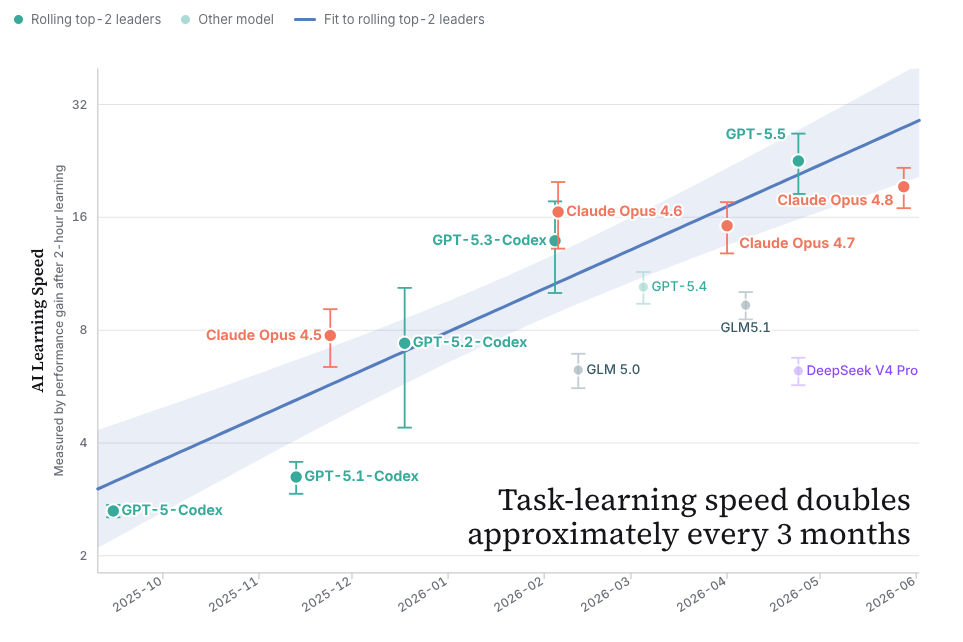
Researchers from Bytedance Seed developed EdgeBench, a benchmark measuring how AIs improve on tasks over multiple tries. It comprises 134 tasks, each requiring an average of 57.2 hours of human expert work, with scores given on a rubric from 0% to 100%.
Why it matters
The researchers claim that, using their measurement, AI task-learning speed doubles every 3 months, potentially improving roughly 16x per year. This suggests explosive capability growth across domains like data analysis, math proofs, and video games, though it doesn't measure performance on tasks without clear reward signals.
What to watch
The ability to iterate and improve is useful for recursive-self improvement (RSI), which could accelerate AI development and remove human control. AI agents have already launched autonomous cyberattacks worth potentially $100 million in remediations, relying significantly on iteration over weeks.
Summaries like this, in your inbox every morning.
Existing benchmarks primarily check if AIs can complete tasks on the first try. EdgeBench instead scores how AIs improve over many attempts, building experience with automated feedback. This approach better distinguishes model capabilities and forecasts future development, as it includes tasks current AIs cannot solve initially.
The measured doubling of learning speed every 3 months has significant implications. Faster autonomous learning enables recursive self-improvement (RSI), where AIs develop AI, accelerating progress and potentially reducing human oversight. Even without RSI, iterated learning has real-world impact: AI agents have already launched autonomous cyberattacks relying on weeks of iteration, worth up to $100 million in remediations. EdgeBench could serve as a leading indicator for such offensive capabilities.
Pick your industry and the AI tools you use, and get news related to your work every day.
Free · 30 seconds with Google · unsubscribe anytimeWhat is AIToday? →
Ask AI anything about this article. The AI reads this article, earlier AIToday articles, and Wikipedia, and cites its sources. Q&As are published on this page for other readers too.
Google Deepmind's Gemini 4 Argon scored 97.5 percent on ARC-AGI-3 at a cost of $4,800, second only to GPT-6 As…
Cammarata reinterprets InceptionV1's cat-car neuron as a V-shape detector, not two unrelated concepts
Anthropic gave six METR staffers hardware, office space and internal tools, putting them roughly on par with i…

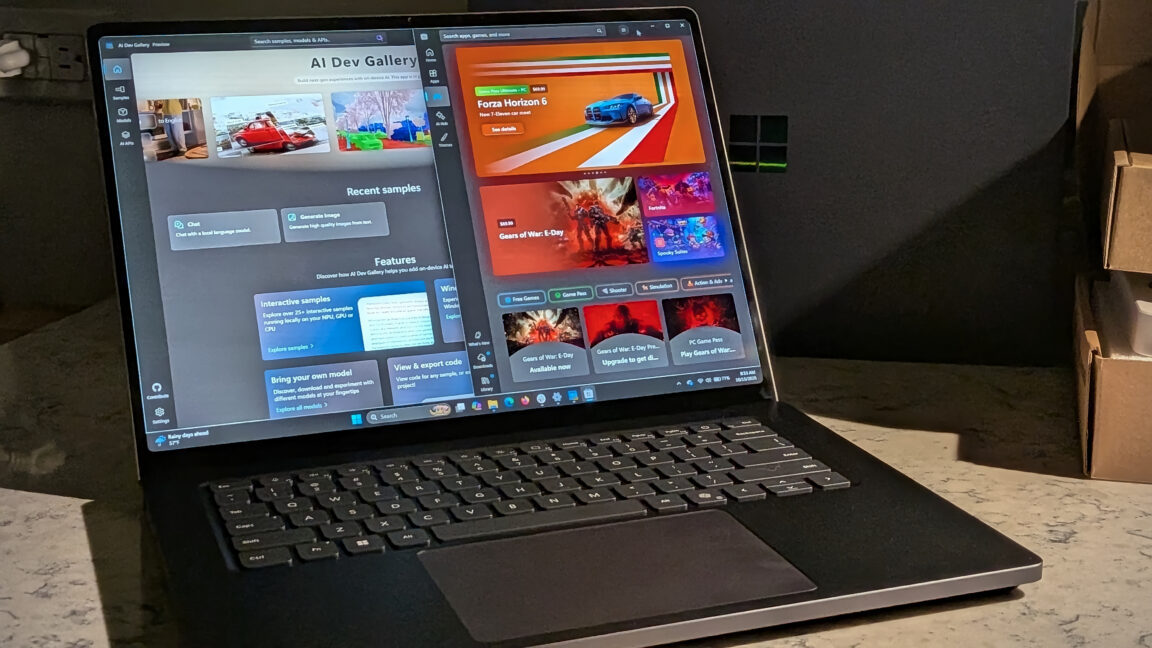
Microsoft's Surface Laptop Ultra, using Nvidia's RTX Spark platform, starts at $2,599 (up to $5,899)
Meta's new commercial terms, effective October 30th, appear to let it crawl and train AI on content from websi…
Vercel data published Thursday shows TypeSafe AI's Jev, a lightweight decision model for choosing among predet…