What happened
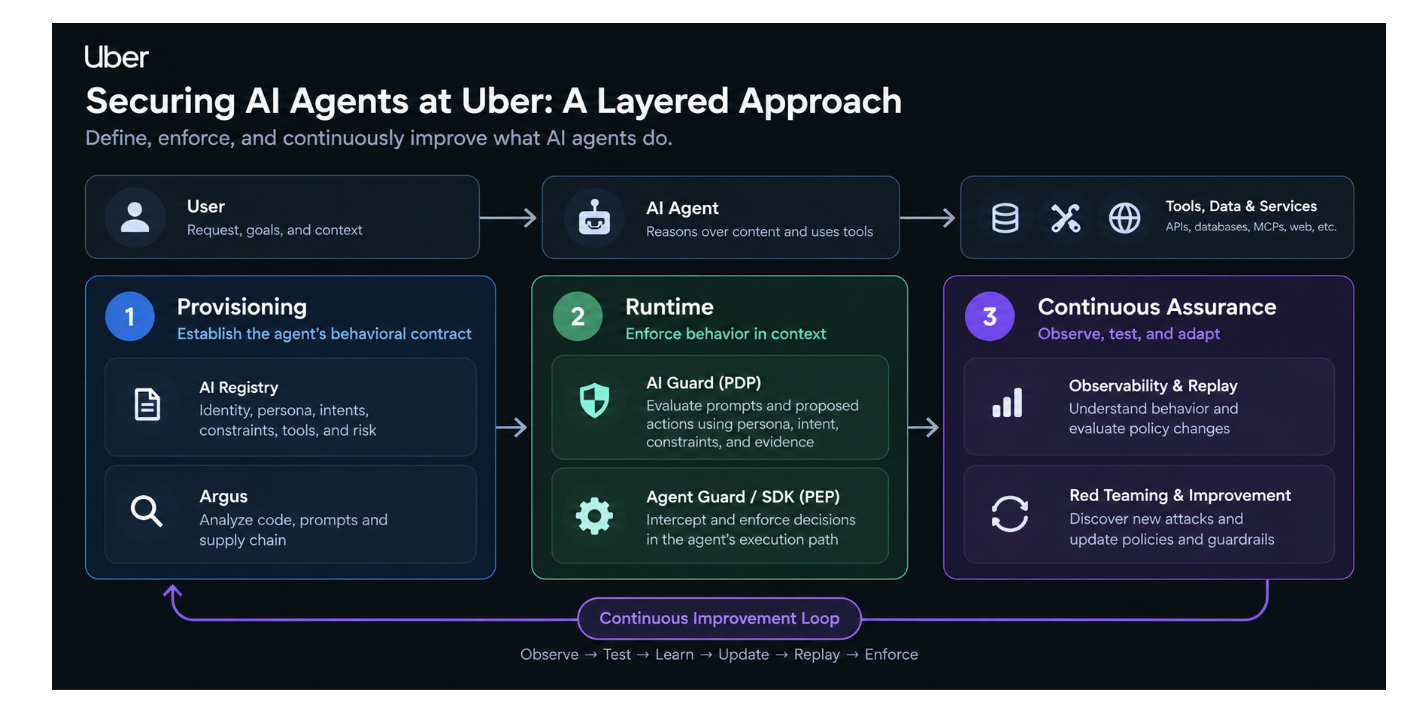
Uber detailed Uber Secure AI, a defense-in-depth framework with three integrated layers — provisioning-time validation via its AI Registry, runtime enforcement through AI Guard, and continuous assurance with observability and replay.
Why it matters
Uber said its most effective mitigation was restricting agents to explicit intents and constraints, which cut the ability to act on manipulated instructions at the cost of some flexibility.
WHO IT HITSSecurity and platform engineering teams deploying AI agents with access to production tools and sensitive data are the intended audience for Uber's framework and its tradeoffs.
Summaries like this, every morning.
Uber's post frames agentic AI as a shift in the attack surface: instead of executing predefined logic, agents reason over content from users, webpages, documents, tools, and other agents, and can turn that reasoning into real-world actions. That moves part of the security problem from identity and API controls into what Uber calls the semantic layer, creating risks such as prompt injection, tool and memory poisoning, goal hijacking, behavioral drift, and hallucination-driven actions. Uber says traditional authorization can determine who is allowed to act, but cannot determine whether an action is consistent with what the user requested and the agent's defined purpose and session context.
The framework is built on an AI Registry that records an agent's identity, ownership, persona, permitted intents, constraints, dependencies, and risk tier, with an automated platform called Argus analyzing source code, prompts, and tool-invocation paths to derive structured intents. Uber says it evaluated commercial AI security and guardrail platforms and traditional policy engines, but none fully addressed the threat model it was targeting. The company also describes practical tradeoffs: stronger enforcement can increase false blocks, runtime evaluation adds latency and inference costs, and onboarding complexity can push teams to bypass controls.
Uber positions the work as an engineering problem as much as a security one, with controls embedded at common infrastructure points so agents inherit protections as they are created and deployed. It says the next phase will expand defenses against indirect prompt injection and further automate agent discovery and red teaming, and that the post is the first in a series on individual controls.
Pick your industry and the AI tools you use, and get news related to your work every day.
Free · 30 seconds with Google · unsubscribe anytimeWhat is AIToday? →
Ask AI anything about this article. The AI reads this article, earlier AIToday articles, and Wikipedia, and cites its sources. Q&As are published on this page for other readers too.
Mastercard joined a $15m Series A round for firmly, an AI shopping agent firm, becoming a payments partner as…

Broadcom's AI chip sales soared 65% to $20 billion in fiscal 2025, and it expects $58 billion in fiscal 2026 a…

Berkshire Hathaway shares rose more than 5% this week while the S&P 500 fell almost 2.7%, lifting its B shares…

Isomorphic Labs president Max Jaderberg said at Bloomberg Tech in London on Nov

Newly elected Democratic officials in Texas have publicly pledged to pause approvals for large-scale data cent…
Tesla unveiled a chip roadmap under 'SI' (Super Intelligence) branding, saying its SI6 inference accelerator w…