What happened
Survival LLM is a free AI assistant that downloads its model and library locally, then answers emergency questions offline — food safety in a power outage, bleeding control, water purification — listing the source article for each answer.
Why it matters
Because the model and roughly 930,000 Wikipedia articles plus FEMA, CDC and military manuals stay on the machine, answers work when the internet does not, and no question leaves the computer.
WHO IT HITSPeople preparing for disasters and outages — and anyone whose home internet is unreliable — can run a self-contained reference on a Mac or PC, with the lighter 3GB library option suited to machines with less disk space.
Summaries like this, every morning.
Survival LLM is built around a simple trade-off: it gives up the reach of a cloud AI service in exchange for working when nothing else does. The setup step is the only online moment — the installer pulls down the AI engine, the model and the library, which takes 20 minutes to two and a half hours depending on the machine and connection speed, though the actual hands-on part is about five minutes.
The library is deliberately limited to openly licensed or public-domain material, which is what makes it distributable and instantly searchable. Alongside Wikipedia it bundles WikiMed, MedlinePlus, UK Medicines A to Z, WikEM emergency medicine, Ready.gov and CDC travel guidance, US military medical and survival manuals, wikiHow, iFixit repair guides, Appropedia and Stack Exchange Q&A on home repair, cooking, gardening, outdoors and amateur radio. Users can also load their own PDFs, Word documents, ebooks and notes into the search set, and those files stay local too.
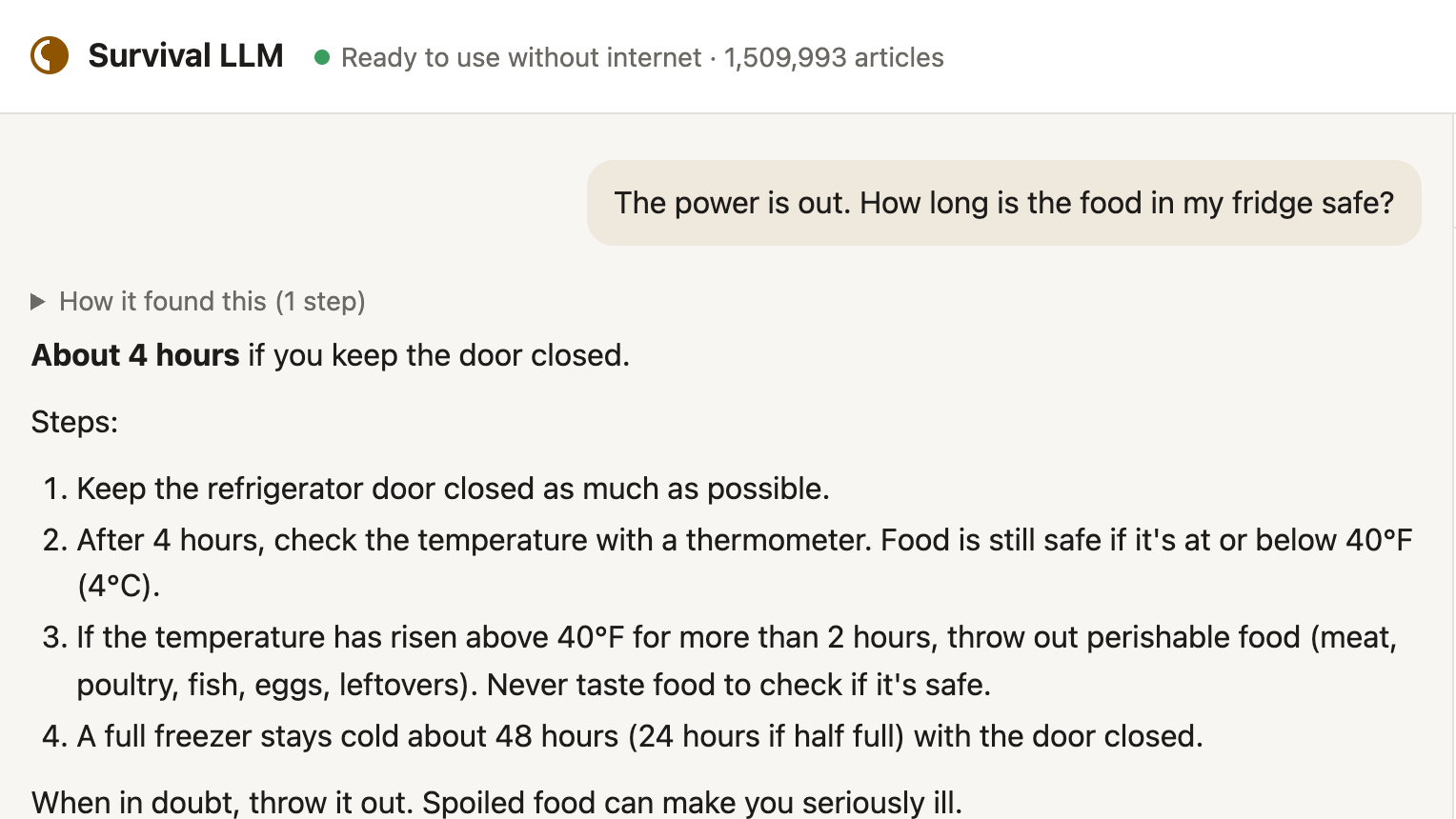
The sample answers show the register the tool aims for. On refrigerator food during an outage it says a closed door keeps food safe about four hours, that a thermometer reading of 40°F(4℃) or below is still safe, and that anything above that for two hours should be thrown out — with an explicit warning never to taste food to check it. A full freezer holds about 48 hours, a half-full one about 24. On severe bleeding it walks through direct pressure, elevating the leg, adding gauze rather than peeling wet gauze away, watching for signs of shock, and a tourniquet with the time recorded as a last resort.
Power draw is modest: about 100W while generating an answer on a MacBook Pro, at 5 to 40 seconds per question, which the project says works out to roughly 100 to 300 questions on a full charge — enough to run from a small generator or portable power station. A built-in update button refreshes the app while keeping models, libraries and added files in place.
Pick your industry and the AI tools you use, and get news related to your work every day.
Free · 30 seconds with Google · unsubscribe anytimeWhat is AIToday? →
Ask AI anything about this article. The AI reads this article, earlier AIToday articles, and Wikipedia, and cites its sources. Q&As are published on this page for other readers too.
SORACOM's Shibata tested whether Meta's Muse agent, in its Linux VM, could reach IoT devices via SORACOM Arc a…

The Digital Agency started offering the prototype "国会答弁作成支援AIアプリ" on Government AI Genai to about 180,000 gove…

Meta's Muse AI agent is now available in Japan via smartphone and web apps, logging in with a Meta account; it…

Amazon CEO Andy Jassy told analysts that few customers buy through outside shopping agents because the experie…

Charles Schwab is expanding AI tools for registered investment advisors, integrating Claude for Financial Advi…

Octus says it routes more than 20 billion tokens a year through its data science models, using what it calls a…