AIToday
RoboticsAutonomous DrivingThe Robot ReportPublished: Aug 13, 2026, 06:00 JST5 min read

Celona launches unified wireless platform for robots and autonomous vehicles

Celona launches unified wireless platform for robots and autonomous vehicles

Key takeaway

  • Celona announced Celona Orion, a unified wireless platform that consolidates private 5G, Wi-Fi, public cellular, and satellite networks into a single managed system designed for physical AI applications like autonomous vehicles and robots.

  • Rather than forcing robots to choose between separate Wi-Fi or private 5G networks, Orion allows a single SIM identity to authenticate on both and seamlessly switch between networks based on performance demands.

  • The platform will launch in the fourth quarter of 2026.

3 Key Points

  1. What happened

    Celona announced Celona Orion, a unified wireless platform that merges private 5G, Wi-Fi, public cellular, and satellite connectivity into a single network. The platform includes Wi-Fi 7 access points at no additional cost and introduces Celona AerConnect, an open-source agent that allows robots to intelligently switch between available networks based on performance needs.

  2. Why it matters

    Physical AI systems like autonomous vehicles and warehouse robots currently must choose between separate Wi-Fi or private 5G networks from different vendors and cannot seamlessly move between them. Orion enables a single SIM identity on robots to authenticate on both networks while maintaining identity when switching, simplifying enterprise operations and removing the need for wireless expertise from roboticists managing deployments.

  3. What to watch

    Celona Orion will be available beginning in the fourth quarter of 2026, with key capabilities introduced on a phased basis. The platform also integrates Starlink satellite connectivity, allowing enterprises to extend wireless coverage to remote locations and bring new sites online in hours rather than weeks or months.

In Depth

Read the full story

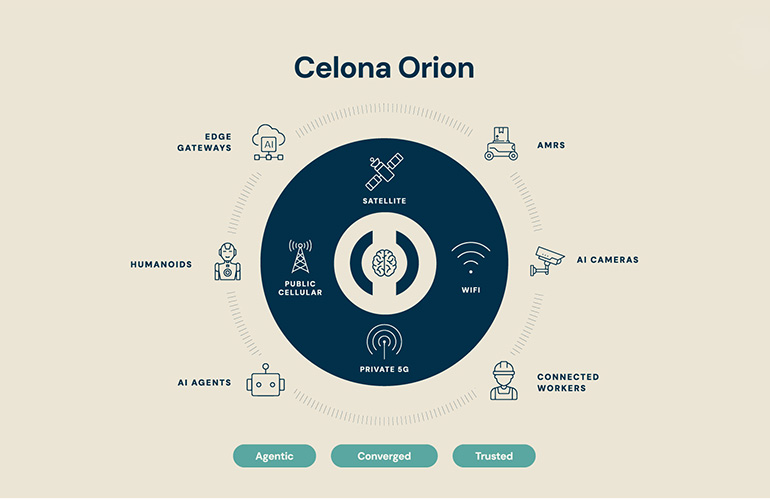
Celona, a Campbell, California-based private wireless provider, announced Celona Orion, designed as a unified agentic converged wireless platform. The platform merges private 5G, Wi-Fi, public cellular, and satellite connectivity into a single, deterministic network fabric engineered to support the connectivity demands of physical AI, specifically autonomous vehicles, autonomous mobile robots, computer vision systems, and edge software agents.

At its core, Orion addresses a critical limitation of current robot deployments. Traditionally, autonomous vehicles and warehouse robots must "pick a side" between Wi-Fi or private 5G, often from different vendors, and cannot seamlessly move between networks. Wi-Fi may struggle with mobile robots, and private 5G can be capacity-constrained for large overnight data transfers. Orion solves this by enabling a single SIM identity on a robot to authenticate on both Celona Wi-Fi and Celona private 5G while maintaining the robot's identity when moving between networks. Celona introduced Celona AerConnect, an open-source agent for robotics OEMs, that is aware of all available wireless interfaces and handles visibility, monitoring, and traffic steering among them. The agent allows a robotic system to decide which network to use based on quality thresholds and to switch networks when performance or reliability issues arise.

The platform includes Celona Wi-Fi 7 access points at no additional cost and offers private 5G and Wi-Fi access points under a single subscription model. Factory and warehouse customers can deploy overlapping canopies of Celona private 5G and Wi-Fi access points, with the entire network managed by Orion Orchestrator as a "single pane of glass." Luca Chichiarelli, head of IT operations at tile vendor Del Conca USA, stated: "As we expand automation, we're connecting more devices, systems, workflows, and workers in more places than ever before. Bringing those networks together under a common platform can simplify operations while maintaining the security, reliability, and control our business requires."

Security is architected into the platform through SIM-based identity, micro-segmentation for operational technology, and IT/OT (information technology/operational technology) separation, all delivered through an in-house software stack and a single trusted supply chain. Orion also integrates the management of Starlink satellite connectivity, enabling enterprises to extend their wireless fabric to remote and previously unconnected locations. New sites can be brought online in hours rather than weeks or months using the same operating model everywhere. Rajeev Shah, co-founder and CEO of Celona, said: "As AI moves into physical operations, those networks must begin to operate as one system. Orion brings these technologies together into a unified fabric, elevating wireless connectivity from a supporting technology to critical infrastructure for modern enterprise operations."

Celona is moving from traditional AI-ops toward agentic network operations, where AI agents function as virtual members of the IT/OT team. Celona Brain, a model trained on the company's internal documents and code, acts as a digital twin of a Celona engineer, intended to bridge the connectivity skill gap for roboticists who are not wireless experts. Orchestrator AI exposes network capabilities through open, standards-based interfaces and an extensible library of skills built by Celona. Brandon Butler, senior research manager for network infrastructure and services at IDC, noted: "In an AI-driven era where connectivity is foundational to business innovation, platforms that converge Wi-Fi and private 5G management, coupled with AI-driven orchestration and insights, address a real operational challenge."

Celona Orion will be available beginning in the fourth quarter of 2026, with key capabilities introduced on a phased basis.

Context & Analysis

Celona's announcement reflects a fundamental shift in how enterprises approach wireless infrastructure for automated operations. Historically, robots and autonomous systems have faced a connectivity dilemma: Wi-Fi offers high-speed data transfer but struggles with mobile coverage, while private 5G provides reliable mobility but can be capacity-constrained for large overnight data uploads. By converging both technologies under unified management, Orion removes the need for enterprises to choose one technology and forces roboticists to become wireless experts—a significant operational friction point in scaling physical AI deployments.

The platform's integration of satellite connectivity through Starlink extends its utility to remote and previously unconnected sites, a capability that addresses a concrete pain point for operations like mining. Rather than requiring weeks or months to establish connectivity at new locations, teams can deploy the same operating model in hours. Celona's introduction of AI-driven troubleshooting through agents like Celona Brain—described as a digital twin of a Celona engineer—targets the connectivity skill gap that roboticists and enterprises face, effectively embedding wireless expertise into the platform itself rather than requiring it from end users.

FAQ

How does Celona Orion let robots switch between networks?
Orion enables a single SIM identity on a robot to authenticate on both Celona Wi-Fi and Celona private 5G while maintaining the robot's identity when moving between networks. Celona AerConnect, an open-source agent, allows the robotic system to decide which network to use based on quality thresholds and to switch due to performance or reliability issues.
When will Celona Orion be available?
Celona Orion will be available beginning in the fourth quarter of 2026, with key capabilities introduced on a phased basis.
What wireless technologies does Orion integrate?
Orion unifies private 5G, Wi-Fi, public cellular, and satellite connectivity (including Starlink) into a single network fabric, along with an AI-driven orchestration platform called Orion Orchestrator.
The Robot ReportRead Original Article

Get the latest Robotics news every morning

AI-summarized, only the topics you pick — one digest a day via Email, Slack, or Discord.

Free · takes 30 seconds · unsubscribe anytime

Ask AI

Ask AI anything about this article. Q&As are published on this page for other readers too.

Related Articles

Next articleMusk says AI will make money irrelevant; Saylor disagrees: status drives spending

The AI news that matters, in one minute each morning.

Sign up free