What happened
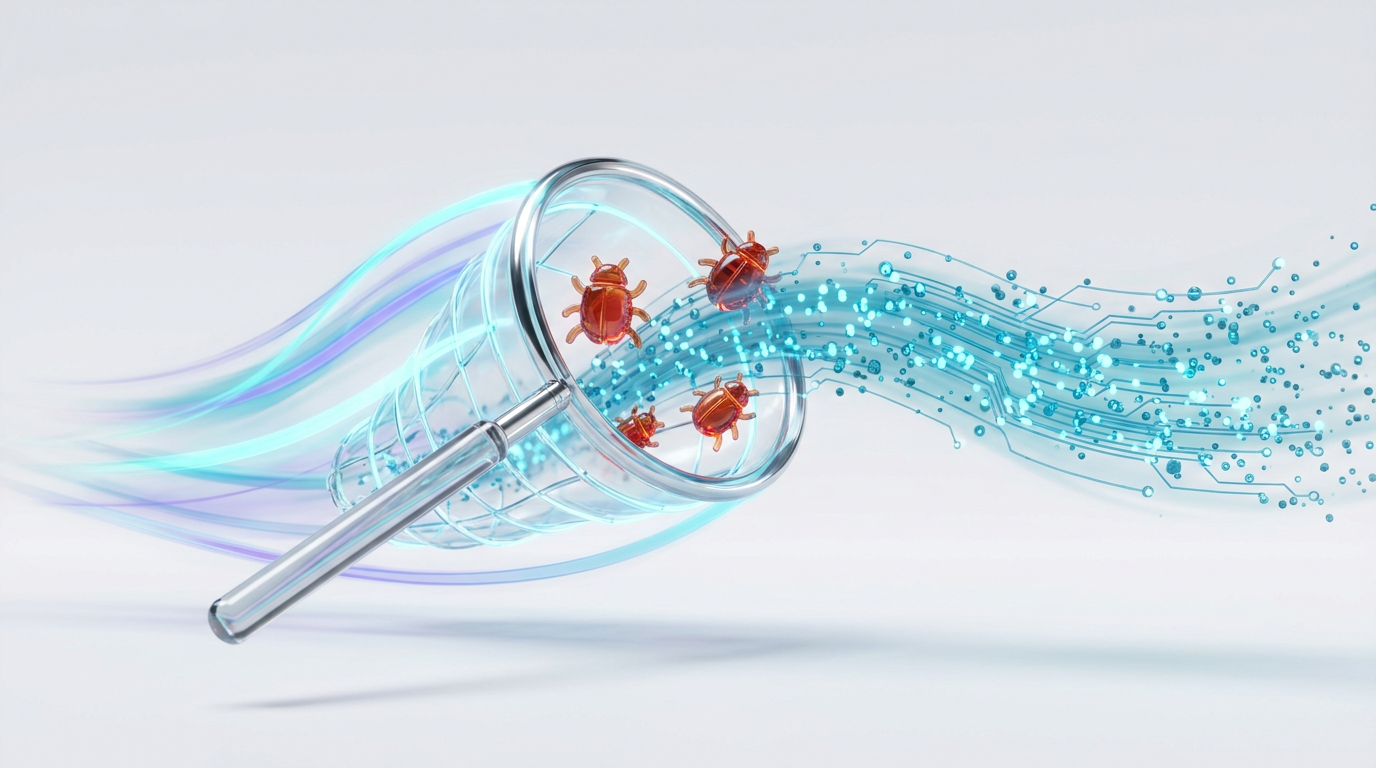
Meta deployed Catching JiTTests — LLM-generated tests designed to fail on buggy code — and says they caught 74 serious (SEV) privacy bugs at the diff stage in the first half of 2026, with a 60% true-positive rate.
Why it matters
The results indicate AI-generated tests can serve as a safety layer that catches bug classes traditional tests and LLM-based code review may miss, with human engineers only confirming whether a behavior change was intended rather than reviewing every output.
WHO IT HITSEngineering teams at large codebases — particularly those adopting agentic software development that speeds up code shipping — may see AI-generated tests as a way to catch bugs before production without adding per-output review load, though whether the true-positive rate holds outside Meta's environment remains to be seen.
Summaries like this, every morning.
Meta's disclosure caps roughly a year of public research updates on applying large language models to software testing. The company first unveiled the JiTTests approach, then spent five months deploying Catching JiTTests to test scalability and applicability beyond a research setting. The system now runs as part of Meta's infrastructure rather than as a prototype.
The deployment addresses a problem specific to Meta's scale: hundreds of millions of lines of code are constantly evolving, and traditional testing struggles to keep pace. Catching JiTTests approach that problem from two directions at once — an intent-aware workflow that infers what a code change is trying to do and targets likely failure points, and a dodgy diff workflow that treats every change as a potential bug and generates tests to expose behavioral differences. False positives are filtered through RubFake and the LLM-as-Judge ensemble before engineers are asked to weigh in.
The reported outcome is that 589 engineers engaged with the system, and those who did reported it surfaces genuinely actionable findings at a 60% true-positive rate. Meta also reports that Catching JiTTests helped lower the overall occurrence of privacy SEVs by 20% during the first half of 2026, framing the system as a scalable safety layer for AI-generated testing rather than a replacement for human judgment.
Pick your industry and the AI tools you use, and get news related to your work every day.
Free · 30 seconds with Google · unsubscribe anytimeWhat is AIToday? →
Ask AI anything about this article. The AI reads this article, earlier AIToday articles, and Wikipedia, and cites its sources. Q&As are published on this page for other readers too.
GIGAZINE installed Ollama on a Windows PC with an Intel Arc Pro B70 32GB and ran Qwen3.8-27B, confirming via '…

Ben Tossell wrote that he has felt stuck for about 10 months, circling on business ideas, and will spend the n…
Anthropic filed its S-1 to list on the Nasdaq, targeting a valuation of $1.5 trillion to $2 trillion, and disc…

Anthropic's S-1 discloses revenue grew fourteen times to $16.3 billion between the first half of 2026 and the…

Wabi, now describing itself as a 'personal agent,' said it raised $55 million at a $1.25 billion valuation, in…
Crux Labs launched with over $6 million in funding led by Benchstrength and Misneach, with Analog Ventures and…