What happened
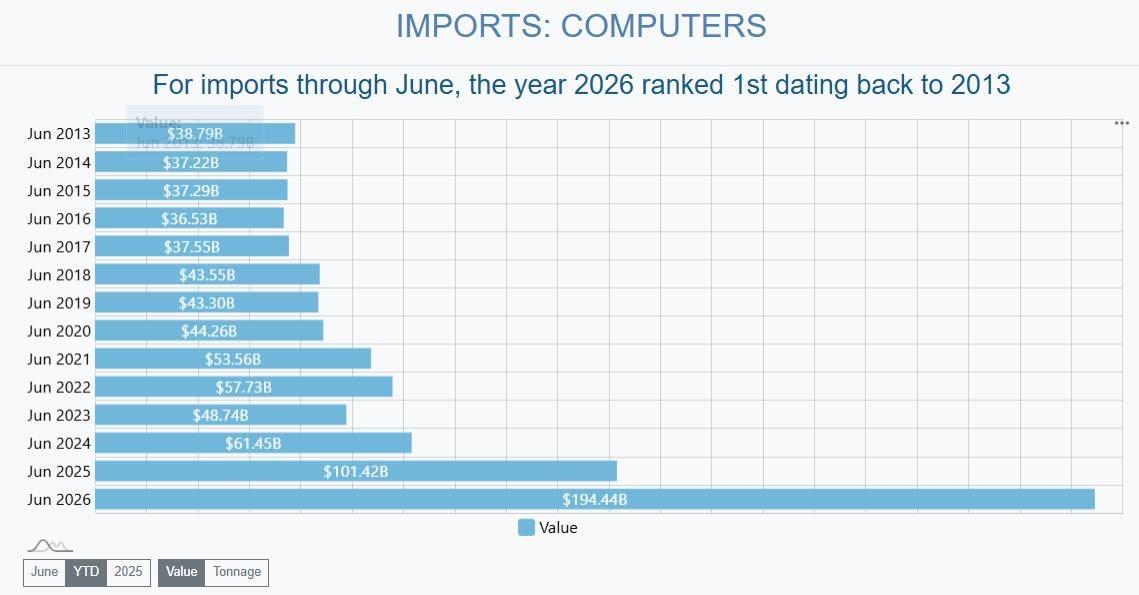
The U.S. trade deficit reached $109.26 billion in June, marking the fourth consecutive month of growth and the second straight month above $100 billion. Computer imports for AI data centers grew 91.72% in the first six months of 2026 compared with the same period in 2025, rising from $101.42 billion to $194.44 billion.
Why it matters
President Trump has made reducing the trade deficit central to his economic agenda, including tariffs declared unconstitutional by the Supreme Court. Yet the massive investment by Alphabet, Meta, Microsoft, Amazon, Oracle and others in AI infrastructure is now the primary driver of the deficit—computer imports are now more valuable than cars or oil—making the deficit harder to address through traditional trade-war tactics against a single country.
What to watch
Taiwan, Mexico, and Vietnam now account for 83.03% of U.S. computer imports through June. The deficit with China, once five times larger than with any other country, now ranks fourth; Mexico and Canada are now America's top two trade partners, displacing China from the #1 position.
Summaries like this, in your inbox every morning.
The U.S. trade deficit, long a focus of President Trump's economic policy, has proven resistant to his tariff-based approach. Despite the April 2, 2025 Liberation Day tariffs (later declared unconstitutional by the Supreme Court) and earlier tariffs on Chinese imports, the deficit has continued to grow. The body suggests a structural reason: U.S. tech companies—Alphabet, Meta, Microsoft, Amazon, Oracle and others—are engaged in a massive, multibillion-dollar race to build AI data center infrastructure, importing computer servers and related equipment at unprecedented rates. This investment is itself a response to competitive pressure: companies and policymakers perceive AI as the most disruptive technology the world has ever seen, and fear that China or other nations might overtake the United States in AI development.
The geography of the deficit has shifted dramatically as a result. China, which once accounted for a trade deficit five times larger than any other country and ranked as the nation's #1 trade partner, now ranks third behind Mexico and Canada, with its deficit ranking only fourth. Taiwan, Mexico, and Vietnam are now the primary sources of computer imports, collectively accounting for 83.03% of the category. This diffusion means that traditional trade-war tactics—targeting one country—no longer work. The body notes that the increase in computer imports alone would have reduced the June deficit by roughly $14 billion, bringing it below $100 billion, had imports merely matched the prior year's level.
Pick your industry and the AI tools you use, and get news related to your work every day.
Free · 30 seconds with Google · unsubscribe anytimeWhat is AIToday? →
Ask AI anything about this article. The AI reads this article, earlier AIToday articles, and Wikipedia, and cites its sources. Q&As are published on this page for other readers too.
An investor gave AI agents $500 each and the same daily prompt—'Make as much money as you can'—and they bought…

Palantir partnered with Armada to expand its sovereign AI strategy from software into physical computing infra…

Nvidia is this analyst's top AI stock pick for October

SoftBank shares posted their first monthly gain in four months in September, rising 24% in four weeks, after O…

Prime Capital Financial's Will McGough urged investors to look past NVDA's market cap and focus instead on its…

Broadcom plans to lend Anthropic up to $42 billion to lease its chips, Reuters reported, a chipmaker financing…