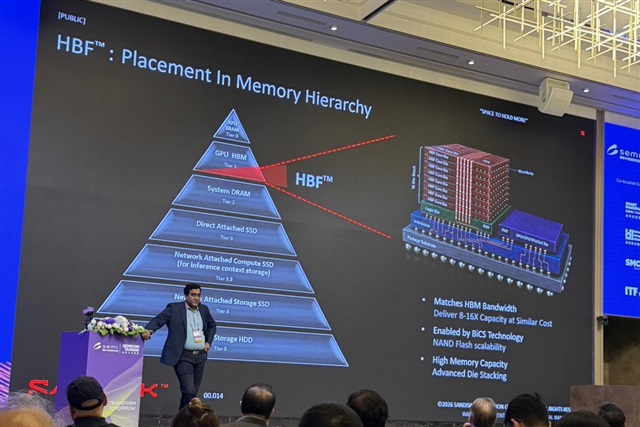
Sandisk claims its HBF matches HBM bandwidth.
It offers eight to 16 times capacity at similar cost.
Flash memory moves closer to processors for AI inference.
What happened
Sandisk says its NAND-based High Bandwidth Flash (HBF) technology can match HBM bandwidth while providing eight to 16 times the capacity at a similar cost.
Why it matters
This positions flash memory closer to processors as inference workloads strain conventional memory systems, potentially offering a cost-effective alternative for AI workloads.
What to watch
The claimed capacity advantage of eight to 16 times and cost parity with HBM are the key figures to track, though actual performance and adoption remain unverified.
Ask the AI about this article →
Sandisk's announcement targets the growing pressure on memory systems from AI inference, where conventional DRAM-based HBM may be limited by capacity and cost. By proposing a NAND-based alternative, Sandisk highlights a trade-off: bandwidth parity with HBM, but with a capacity advantage that could better suit workloads requiring large memory footprints. The claim of similar cost is significant because it addresses the primary barrier to deploying high-capacity memory in AI systems. However, these figures are Sandisk's own assertions, not independently verified, and actual performance in real-world inference scenarios remains to be seen. The positioning of flash closer to processors suggests a potential shift in memory architecture, but whether it will displace or complement HBM in practice is yet to be determined.
For example, today's edition would include:
AI-summarized, only the topics you pick — one digest a day via Email, Slack, or Discord.
Free · takes 30 seconds · unsubscribe anytimeWhat is AIToday? →
Ask AI anything about this article. Q&As are published on this page for other readers too.
World Labs unveiled Atlas, an omni-model trained on text, images, video, and 3D data that anchors every input…

Saudi Arabia's LEAP tech conference opened with $15 billion in planned technology investments

Nvidia invested $3.5 billion in MediaTek, a Taiwanese chipmaker, to help customers build custom AI chips that…

Semafor and Riddance AI uncovered a network of about a dozen YouTube channels using real actors with AI-genera…

At a recent ICRA panel, robotics researchers discussed how to handle the overwhelming number of publications

Anthropic released Claude Fable 5.1 and Claude Mythos 5.1 as its new flagship models