What happened
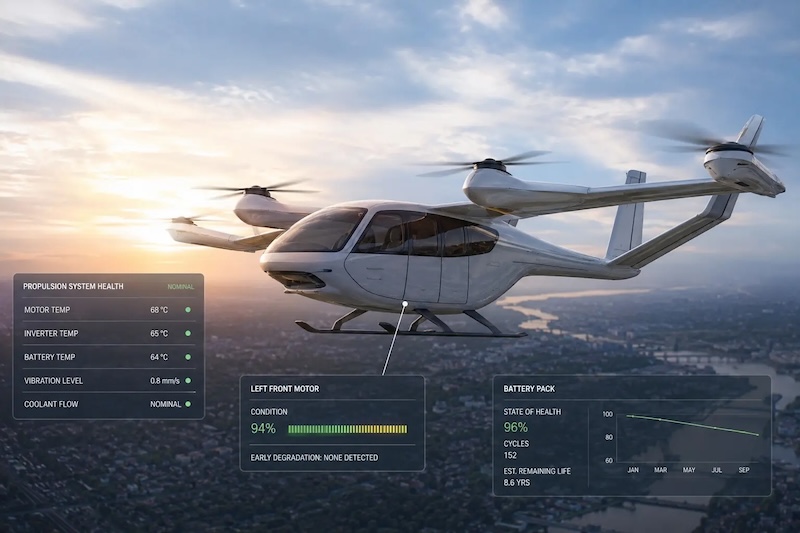
NASA awarded AstraQua a $1,274,990 Phase II contract to advance AstraSense, its Agentic Physical AI for electric and hybrid-electric aircraft, including advanced air mobility, after Phase I real-time diagnostics demos.
Why it matters
The work pushes autonomous systems toward health-informed reasoning — deciding to continue, adapt or stop — which AstraQua says is needed as autonomous vehicles increasingly fly over populated areas.
WHO IT HITSThis lands on teams building and certifying electric and hybrid-electric aircraft and advanced air mobility, who would need autonomous systems to reason about their own health for safety-critical operation, and on robotics groups coordinating mixed fleets.
Summaries like this, every morning.
AstraQua's Phase II award follows a Phase I in which it demonstrated real-time diagnostics and predictive-health capabilities to NASA. The new phase moves from demonstration toward aircraft integration and health-informed reasoning, with verification and validation for safety-critical applications — a step aimed at helping machines use their own health information to decide whether to continue a task, adapt or stop.
The company frames this as "teaching robots to feel pain": a robot should know when to slow down, not just when it has broken down, as CEO Loay Elbasyouni put it. Beyond a single machine, AstraSense is designed to share health information across teams, so a robot that is limited can have its unfinished tasks reassigned to another capable machine — for example, ground robots inspecting equipment while drones survey a site.
AstraQua's broader approach emphasizes low-power onboard intelligence and reduced dependence on continuous cloud connectivity. Elbasyouni's background includes electrical and power-electronics work supporting NASA's Ingenuity Mars Helicopter and rocket-engine avionics at Blue Origin, experience the company is applying to physical AI for autonomous machines.
Pick your industry and the AI tools you use, and get news related to your work every day.
Free · 30 seconds with Google · unsubscribe anytimeWhat is AIToday? →
Ask AI anything about this article. The AI reads this article, earlier AIToday articles, and Wikipedia, and cites its sources. Q&As are published on this page for other readers too.
The S&P 500 closed at 7,580.07 versus 7,623.68 a week earlier, and the Nasdaq fell to about 25,436.99, as Alph…

Schaeffler formed a technology partnership with Wandelbots to develop the Wandelbots NOVA open platform for AI…
Gabriel Ocana-Santero says a Claude Sonnet 5 agent chose among 19 possible gene therapies, set brain target an…
At Newsreel's "Midterm Mania" panel in Greenpoint, about 300 attendees heard Aryan Ranjan of campaign-software…
Databricks published a blueprint for wealth management client onboarding, arguing faster task-level AI does no…

At SAP TechEd, Databricks and SAP said the expanded Databricks platform — Genie, Lakeflow, Unity Gateway and L…