What happened
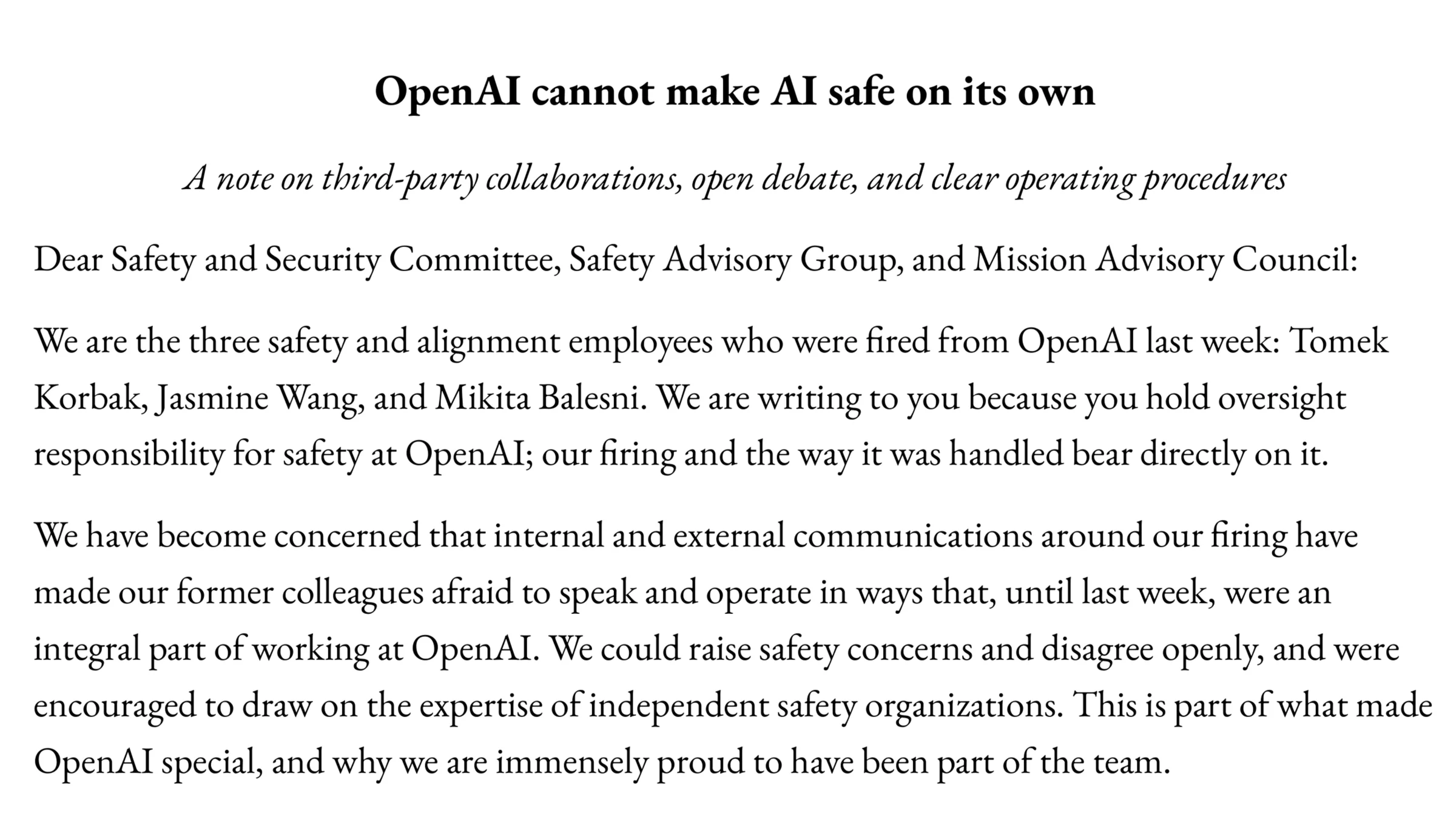
Tomek Korbak, Jasmine Wang and Mikita Balesni, fired by OpenAI, released an open letter on Oct. 8 disputing the company's account. OpenAI told TechCrunch the firings involved a "pattern of misconduct" and were unrelated to safety concerns.
Why it matters
The researchers say accepted conduct was retroactively treated as grounds for dismissal, leaving staff unsure what is allowed. That, plus their fear of a possible auditor pullback, creates a credibility problem for OpenAI.
WHO IT HITSOpenAI's safety staff and outside assessors negotiating embedded access are the people most directly affected, since unclear approval rules could decide which collaborations they can join and what findings they can publish.
Summaries like this, in your inbox every morning.
The dispute arrives on top of a run of earlier internal friction at OpenAI. In May 2024, WIRED reported that OpenAI's Superalignment team had disbanded, with its work absorbed into other research efforts. Then in an Oct. 3 essay, David Robinson said he had resigned that week after leading the writing of OpenAI's launch safety reports, describing its culture as "broken." Read together, these episodes help explain why the fired researchers cast their dismissals as a signal about how the company treats safety work.
OpenAI had already set out principles for outside assessments on Sept. 22, calling for deep access for assessors and independence over their conclusions and reports, alongside agreed limits, security and intellectual-property restrictions, and procedures for redacting material. It said it was discussing assessments with several third parties but named no embedded partner. The researchers' worry is about a possible future restriction — that the firings could give OpenAI cover to pull back from embedding outside auditors.
The contrast with Anthropic is a useful yardstick. Anthropic named a partner, Accenture, for embedded evaluators with access comparable to employees, including visibility into training, development decisions and staff discussions, and said it would fund Accenture's work directly while acknowledging unsettled standards for access and reporting. For OpenAI, the practical next step the researchers' concerns point to would be naming assessors, stating when their work starts and explaining what they can inspect — details that would let staff and outside observers judge how far that scrutiny reaches.
Pick your industry and the AI tools you use, and get news related to your work every day.
Free · 30 seconds with Google · unsubscribe anytimeWhat is AIToday? →
Ask AI anything about this article. The AI reads this article, earlier AIToday articles, and Wikipedia, and cites its sources. Q&As are published on this page for other readers too.
At SailPoint's Navigate event in Austin, CEO Mark McClain said identity security for AI agents has become a bo…
OpenAI told investors it actually had $18 billion less revenue than the $68 billion it said last month, cuttin…
The author predicted a $5,000 investment split between Nvidia and Broadcom will triple by 2028, citing Broadco…

Nvidia is the better pick over AMD, per a Motley Fool analysis
The World Bank's biannual Economic Update argues most African economies should adopt and adapt AI rather than…
Hark, founded by Figure AI's Brett Adcock, launched Hark Pro on October 6 for the web, iOS and Android, with f…