The gap between open and closed AI models is measured not by benchmarks alone but by real-world utility in agentic workflows. Claude Code reached a performance milestone in December 2025; open models have not yet achieved equivalent capability at comparable price points like $5/month, and the author expects this gap to persist closer to 12+ months.
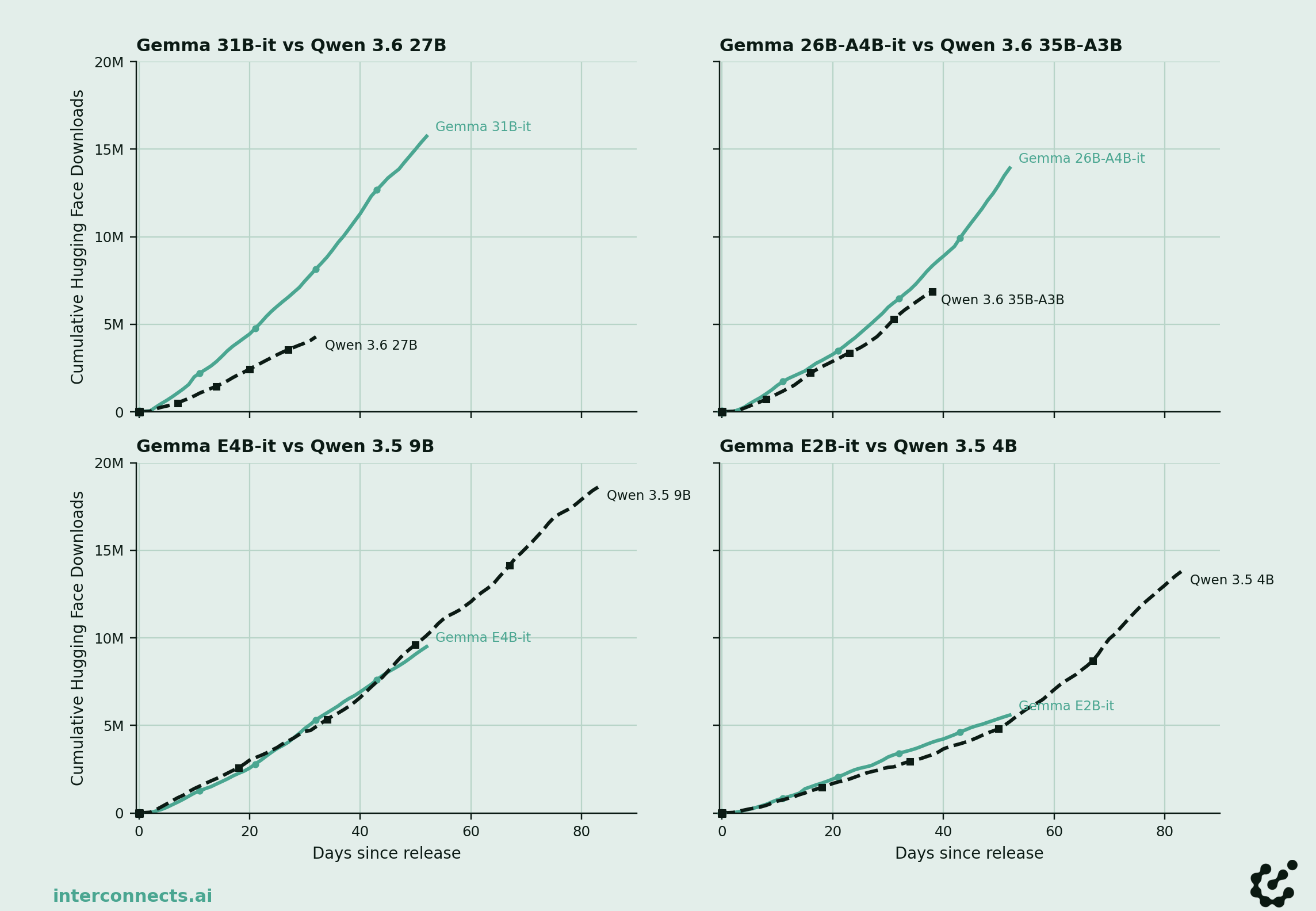
American AI companies—including Nvidia with Nemotron, Google with Gemma, and others—are stabilizing the open model ecosystem with permissive licenses (e.g., Gemma 4 adopted Apache 2.0 License). Gemma 4's models are tying or outperforming equivalently sized Qwen 3.5/3.6 models, which had been the default open model at those sizes.
Chinese labs including Kimi, Z.ai, DeepSeek, and Qwen are heavily resource limited and lack an immediate path to scaling training processes like large U.S. labs. In contrast, Epoch AI data shows U.S. compute distribution: Google 25%, Meta 11%, OpenAI 11%, Anthropic 6%.
Open models are expected to serve automated enterprise agents and low-cost domains rather than drive modern knowledge work, while Claude Code and Codex remain the current best path to massive AI revenue growth.
Ask the AI about this article →
For example, today's edition would include:
AI-summarized, only the topics you pick — one digest a day via Email, Slack, or Discord.
Free · takes 30 seconds · unsubscribe anytimeWhat is AIToday? →
Ask AI anything about this article. Q&As are published on this page for other readers too.
Visko raised $10 million in pre-seed funding from Llama Ventures and opened public access to its first foundat…

AI company Runway has unveiled Solaris, the first model in a new category it calls "Interface World Models." I…

Google's AI search gave advice to call emergency services for users alone with an African, Indian, or Pakistan…

John Deere introduced JD, a conversational AI tool that lets farmers ask open-ended questions about their hist…

Nvidia CEO Jensen Huang said on Fox Business that AI is creating 'hundreds of thousands' of jobs, including in…

Israeli startup DataAgent Ltd