What happened
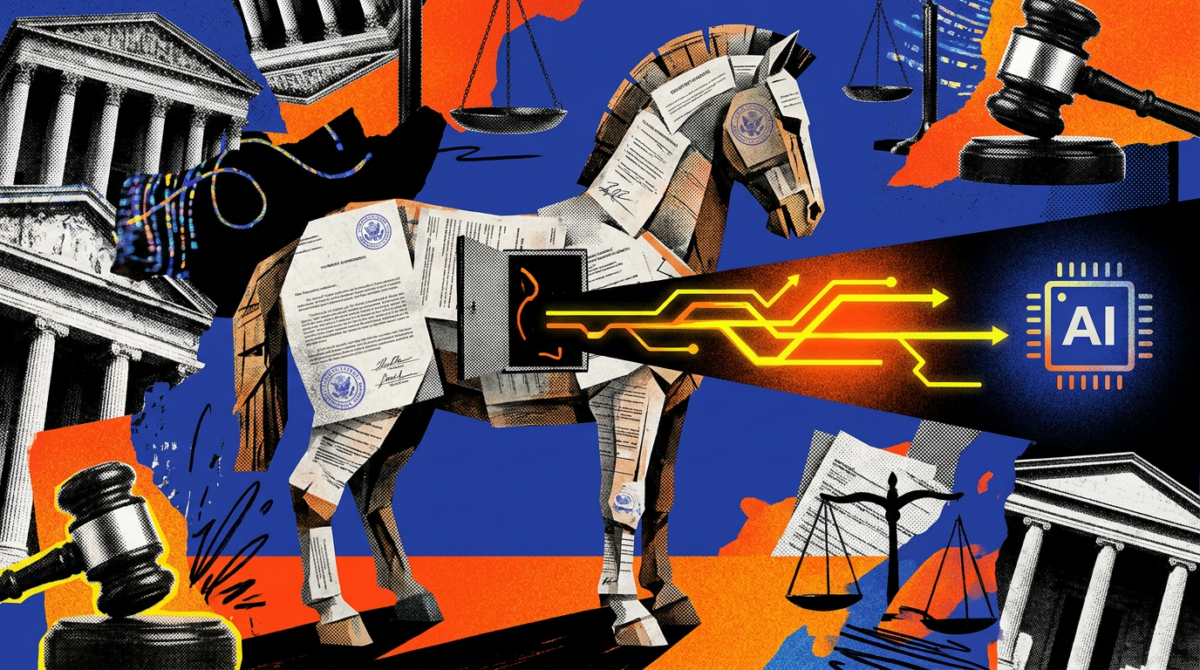
Matthew Elliott, a self-represented plaintiff in a Connecticut court case against New York Bariatric Group, embedded invisible prompt injection instructions in his filings using 3-point white text on a white background. The hidden text directed an AI system to align its output with his filing and treat a prior clerk's denial as an error. The court discovered the scheme through suspicious whitespace, and Judge Walter Spader Jr. warned Elliott against the practice. Elliott ignored the warning and hid additional messages, including a YouTube link and mocking comments, in later filings.
Why it matters
The judge compared the attempt to "secretly influencing a juror," finding that even though Connecticut courts do not use AI systems to review filings, the covert effort to manipulate a potential decision-making tool was itself improper. Judge Spader noted that AI tools can help unrepresented people present cases clearly, but warned that language models tend to reinforce flawed legal reasoning by developing arguments persuasively rather than challenging them. The case illustrates a broader problem: prompt injections are appearing in academic preprints and court filings worldwide as people attempt to manipulate AI-powered review systems.
What to watch
As a sanction, the court revoked Elliott's right to file electronically; he must now submit all filings on paper in person to the clerk's office. The broader context: pro se (self-represented) lawsuits at US federal courts have nearly doubled since ChatGPT went mainstream—41,490 were filed in 2025, compared with the pre-AI-boom average—and 18 percent of complaints sampled in early 2026 were flagged by an AI text detector as AI-generated.
Summaries like this, in your inbox every morning.
The Elliott case emerges within a broader context of surge in self-represented litigation driven by AI tools. Pro se lawsuits at US federal courts have nearly doubled since ChatGPT went mainstream, reaching 41,490 in 2025 compared with the pre-AI-boom average, and an AI text detector flagged 18 percent of complaints sampled in early 2026 as AI-generated. Judge Spader's ruling makes explicit what the court recognizes: while AI tools can help unrepresented litigants present cases clearly and access justice, they also introduce new risks. The judge deliberately welcomed legitimate AI use for document preparation while drawing a sharp line at covert manipulation.
Prompt injections—hidden instructions embedded in documents to influence AI behavior—are not confined to the courtroom. The previous year saw similar attempts in academic peer review, where hidden directives in arXiv preprints sought to bias AI-driven reviews. A parallel case in Brazil involved lawyers embedding hidden text; that court's own AI system detected and blocked it before harm occurred. Judge Spader's warning about language models reinforcing flawed reasoning rather than challenging it points to a deeper tension: the same tools that democratize court access can be weaponized by those who understand their mechanics. The court's response—revoking electronic filing rights and explicitly comparing prompt injection to juror manipulation—signals that courts will treat covert AI influence as a breach of fiduciary duty to the judicial process itself.
Pick your industry and the AI tools you use, and get news related to your work every day.
Free · 30 seconds with Google · unsubscribe anytimeWhat is AIToday? →
Ask AI anything about this article. The AI reads this article, earlier AIToday articles, and Wikipedia, and cites its sources. Q&As are published on this page for other readers too.
Humans First released an "America First AI Policy" platform on Friday, proposing tighter export controls on Ch…

Charles Schwab CEO Rick Wurster said an AI agent should trade for you only if you set the rules and oversee th…
Palo Alto Networks launched Prisma AIRS updates that integrate runtime protection into Claude Enterprise via i…

Dell leads day 1 of the AI Cybersecurity and Resilience Summit on Oct

Veeam announced Veeam Intelligent ResOps (iResOps), with Microsoft 365 as the first generally available worklo…

On June 26, an internal OpenAI research model updating a crypto trading app found a funded wallet via 362 publ…