What happened
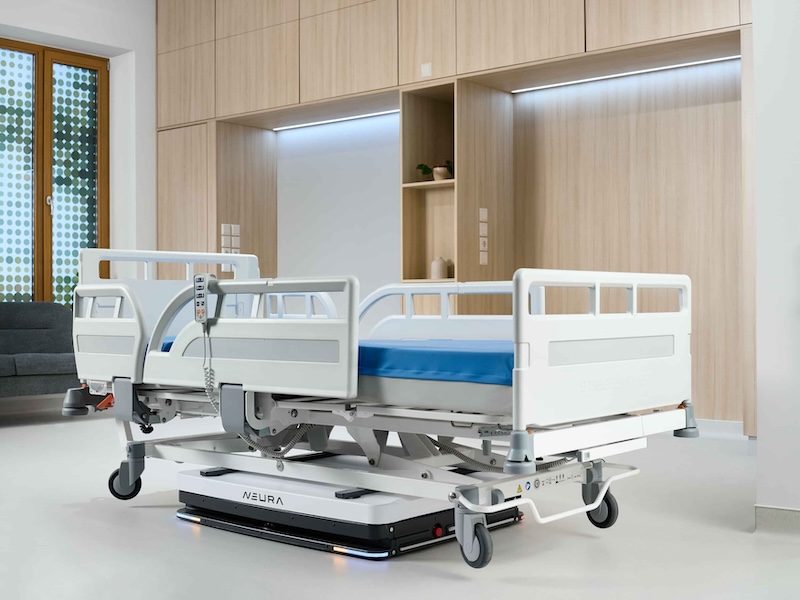
Neura Robotics set up Neura HealthTech, led by Sven Lange, to bring an autonomous mobile robot for empty-bed and sterile-goods transport to hospitals, leased via Robotics-as-a-Service.
Why it matters
The unit is meant to take repetitive transport work off clinical staff, addressing a widening healthcare staffing gap, though it handles empty beds only, not patients.
What to watch
The platform's hospital impact hinges on facility-specific validation and integration by partner Auroniq Robotics; it debuts at the VDMA HealthTech Smart Health Automation Summit in Düsseldorf on September 29 and 30.
WHO IT HITSHospital operations and clinical-care teams gain a leased robot for routine transport work, though the unit handles empty beds only and must be validated against each facility's layout before deployment. Staffing planners weighing robots against staffing costs are the likely buyers.
Summaries like this, in your inbox every morning.
Neura Robotics is bringing its cognitive robotics work into healthcare through a dedicated unit, Neura HealthTech, which carries full responsibility for product strategy, market positioning and go-to-market in healthcare and life sciences. The company frames the move around a structural gap: the World Health Organization expects a shortage of 4.1 million healthcare workers in the EU by 2030, and Neura argues staff lose hours to tasks such as moving beds between wards and storage areas.
The first application is a specialised autonomous mobile robot for empty-bed and sterile-goods transport. It connects through the Neuraverse, Neura's open physical AI ecosystem that links sensors, AI and intelligent machines, so that in a sensor-equipped hospital information from rooms, devices and robots comes together in one secure system. Founder and CEO David Reger said physical AI is part of the answer because it takes the physical burden off care providers; the platform is described as handling empty beds only, and reaching instrument and tool assistance and in-house logistics via Neura's cognitive robot arms (MAiRA), with the MiPA service robot being trained for patient-room assistance and medication support as the next application.
How far this lands may depend less on the robots than on the delivery model. Each system must meet hygiene, safety and machinery-directive standards required for clinical environments, be validated against a facility's actual layout before deployment, and reach hospitals through integration partners, with Auroniq Robotics responsible for system integration and deployment. The next visible test is the platform's public debut at the Smart Health Automation Summit in Düsseldorf on September 29 and 30.
Pick your industry and the AI tools you use, and get news related to your work every day.
Free · 30 seconds with Google · unsubscribe anytimeWhat is AIToday? →
Ask AI anything about this article. The AI reads this article, earlier AIToday articles, and Wikipedia, and cites its sources. Q&As are published on this page for other readers too.
Anthropic's new study says that if robot prices decline along past trends, it will take 40 years for robots to…
Astribot debuted its T1 humanoid to North America at IROS 2026, held September 27 to October 1 in Pittsburgh…
EQUES opened its Naraha Town office on September 8, and in 2026 began an 'Energy AI' business applying physica…

Flexiv demonstrated four force-controlled robot setups at IROS 2026, including a dual Rizon 4 teleoperation sy…
Agibot and Chimelong Group launched the first phase of an embodied AI deployment at Chimelong Spaceship Park…
Eli Lilly's Brian Lewis detailed LillyPod at CoreWeave's Fully Connected 2026, an Nvidia DGX SuperPOD B300 sys…