What happened
Daily Dose of Data Science published a walkthrough showing modern fine-tuning with GRPO (Group Relative Policy Optimization) and RULER (Relative Universal LLM-Elicited Rewards) is redefining the process.
Why it matters
The piece argues developers can now train agents that improve through experience without writing a single reward function or collecting a single labeled example, which it says is a break from typical fine-tuning setup.
What to watch
The claim hinges on whether teams adopt frameworks like ART, a 100% open-source framework bringing GRPO to any Python application; the body also notes a 3B model notebook trains on any MCP server URL.
WHO IT HITSMachine-learning engineers and developers building agents that search, call APIs, and reason across multiple steps are the audience — the piece says they can train with GRPO and RULER instead of curating datasets, labeling outputs, and hand-crafting reward functions.
Ask the AI about this article →
Summaries like this, in your inbox every morning.
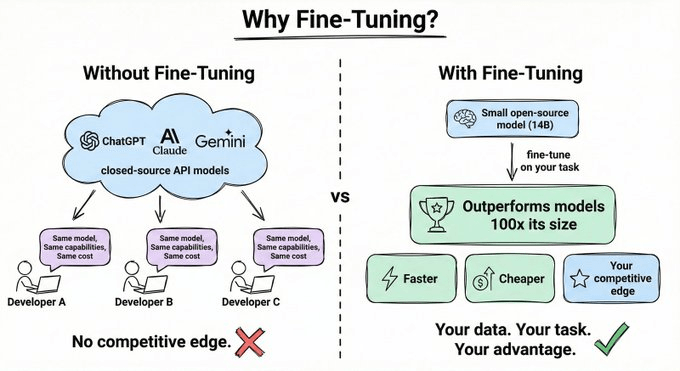
The piece frames its argument around a contrast: if you use GPT or Claude, you get the same model as everyone else with the same capabilities, cost, and no competitive edge, whereas a small open-source model fine-tuned on a specific task can outperform a model 100x its size. That claim rests on a shift the article says has already happened — that fine-tuning no longer requires curating datasets, labeling outputs, or hand-crafting reward functions.
The technical hinge is how GRPO and RULER work together. GRPO generates multiple completions per prompt and grades them relative to each other, so it only needs relative rankings rather than absolute scores. RULER supplies those rankings by having an LLM judge compare several agent trajectories — the piece argues this is more reliable than asking a model to rate a single attempt on a 0-10 scale. ART is positioned as the delivery mechanism, splitting into a Client that records each agent run as a Trajectory and a Backend that handles inference and training, loading a fresh LoRA checkpoint after every step.
The separate architecture item — grouped-query attention, where Llama 3 70B shares one KV head across every eight query heads — is offered as a reminder that cost control also lives in model design, not only training. Whether the reward-free fine-tuning approach delivers on its promise hinges on teams adopting frameworks like ART, and on the 3B model notebook the article describes for training against any MCP server URL.
For example, today's edition would include:
AI-summarized, only the topics you pick — one digest a day via Email, Slack, or Discord.
Free · 30 seconds with Google · unsubscribe anytimeWhat is AIToday? →
Ask AI anything about this article. Q&As are published on this page for other readers too.
On the same Xeon 6980P silicon and socket count as MLPerf v6.0, Intel reported a 2.4x rise in Llama 3.1 8B Ser…

In a post on X and other social platforms, Meta CEO Mark Zuckerberg said labs that fail to "focus on alignment…

Apple finally built a smarter version of Siri, according to the WSJ

Charles Schwab is partnering with Anthropic to roll out the Claude for Financial Advisors tool to its RIA netw…

On Sept. 1, Deere introduced JD, an AI assistant built into its operations center, letting farmers ask about f…

CrowdStrike unveiled SafeMind, built with Nvidia, at its Fal.Con event