
What happened
GitHub created Qubot, an internal analytics agent accessible via Slack, VS Code, and the Copilot CLI, that allows employees to query the company's data warehouse by asking questions in plain English rather than writing SQL. The tool connects to Kusto and Trino query engines and automatically switches between them based on what the question requires.
Why it matters
Hundreds of GitHub employees are now using Qubot to explore data autonomously, which has reduced the volume of questions in the data and analytics Slack channels dramatically. This solves a long-standing problem: product teams previously struggled to access insights without dedicated analytics support. The shift means data teams can focus on complicated questions while broader teams gain self-serve access to decision-making data.
What to watch
The context layer—structured documentation about data models, query examples, and metric definitions—proved critical to accuracy and speed; GitHub found that well-curated context makes Qubot three times faster at returning the right answer. This suggests that investing in clear, organized data documentation has become a first-class priority for analytics engineering, not an afterthought.
Summaries like this, in your inbox every morning.
Pick your industry and the AI tools you use, and get news related to your work every day.
Free · 30 seconds with Google · unsubscribe anytimeWhat is AIToday? →
Ask AI anything about this article. The AI reads this article, earlier AIToday articles, and Wikipedia, and cites its sources. Q&As are published on this page for other readers too.
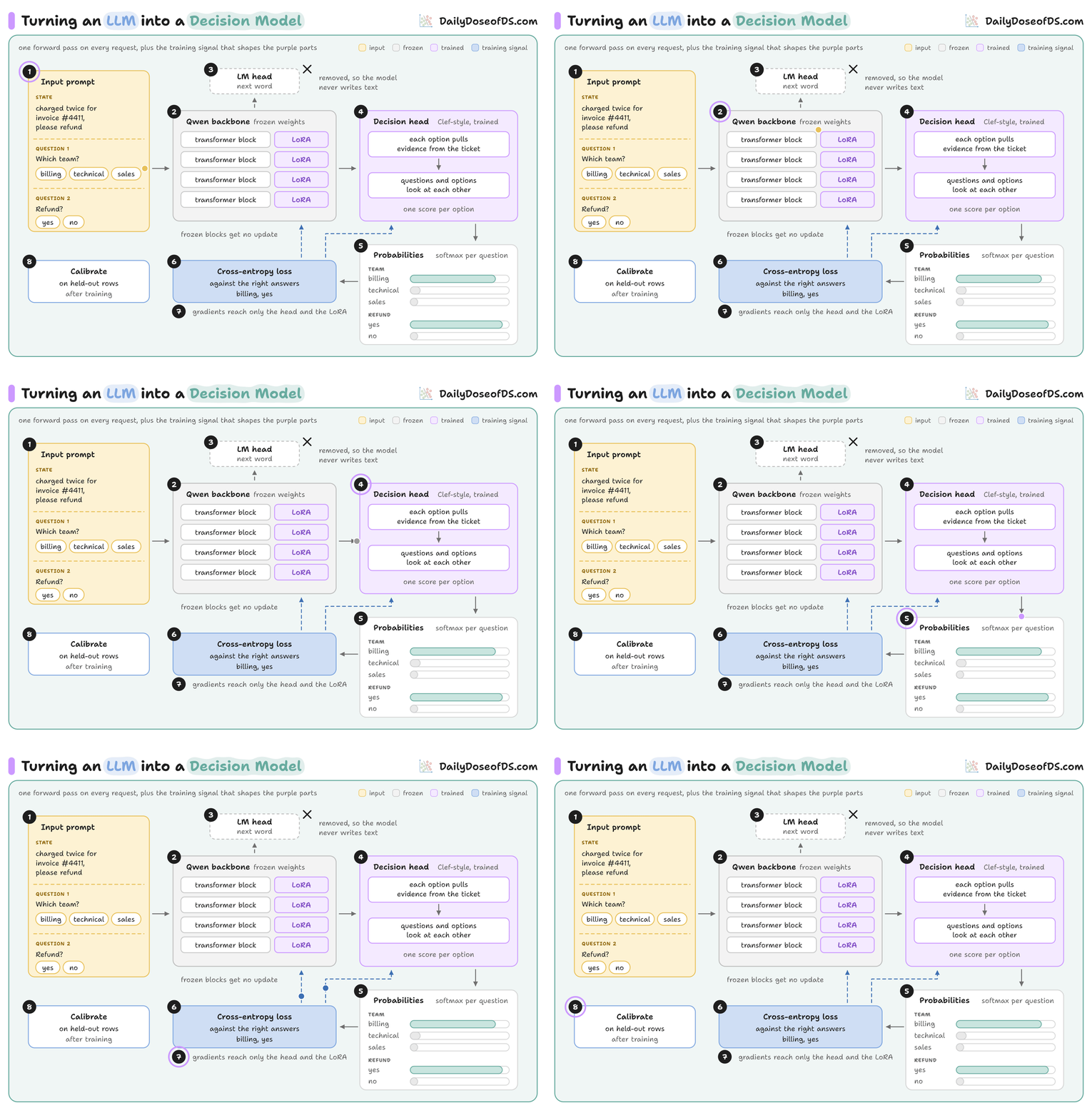
A follow-up agent using TrueForge and Jev matched Opus accuracy on 40 requests at 150x lower decision cost
An FA engineer described running spec drafts, test procedures, and reports through Claude Desktop, feeding rou…

Aparna Nair, IBM's chief talent, leadership, and culture officer, said generalists alone "will cut it" in the…
Vinci4D provides chip-design simulation software that trains on physics equations instead of customer data, an…

Reflection AI introduced Beam, an open-weight model for agentic coding and long-horizon tasks, with 501 billio…
A developer released agent-guardrails, a one-script Python standard-library plugin that guards Bash, Write, Ed…

