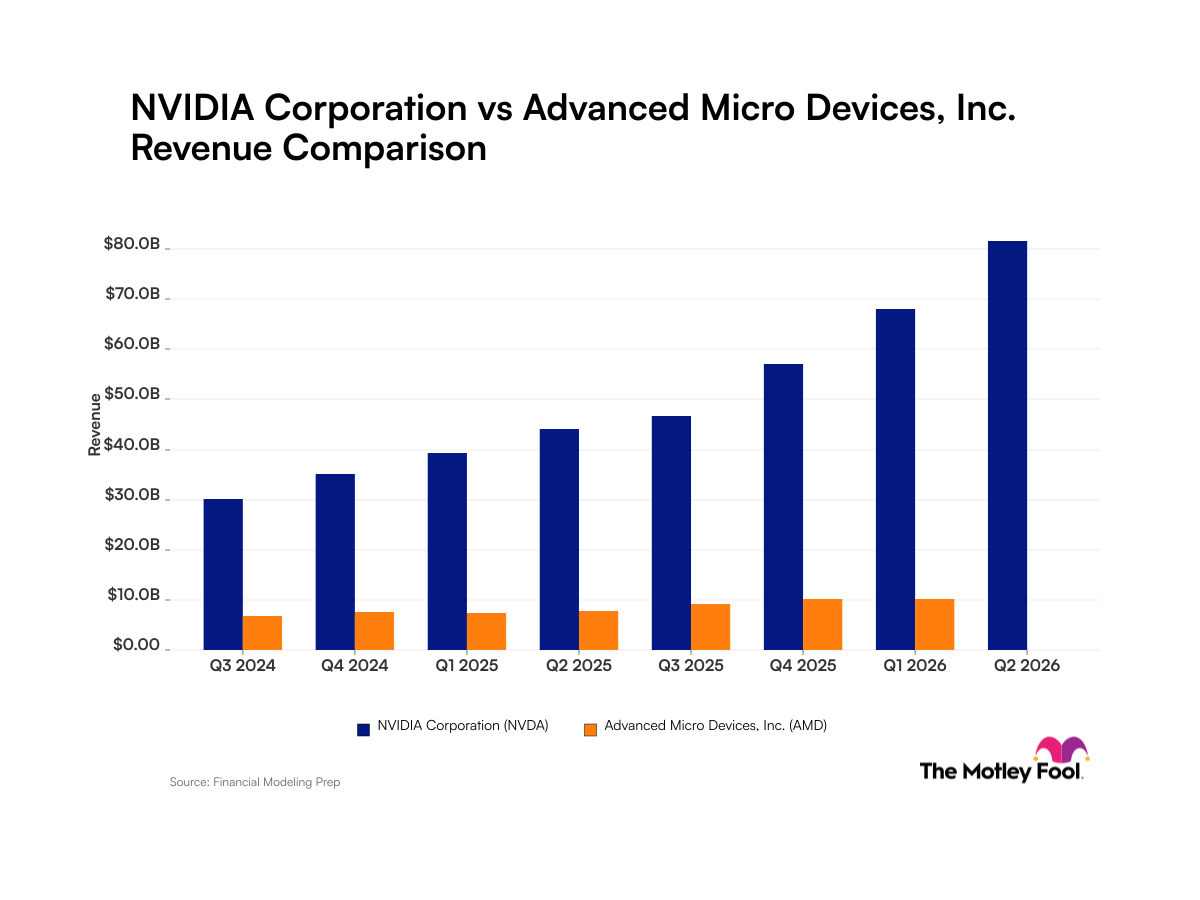
Nvidia's revenue reached $81.6 billion in Q2 2026 with a 72% net income margin, far outpacing Advanced Micro Devices' $10.3 billion revenue and 14% margin in Q1 2026.
While Nvidia dominates the semiconductor market for AI applications, AMD stock has appreciated over 120% in 2026 through August 3 compared to Nvidia's 10% gain, reflecting investor expectations that AMD harbors more upside potential despite its smaller sales base.
What happened
Nvidia reported $81.6 billion in revenue for Q2 2026 (quarter ended April 2026), while Advanced Micro Devices posted $10.3 billion for Q1 2026. Nvidia also reported a 72% net income margin for the same quarter, compared to AMD's 14% net income margin for its quarter ended March 28, 2026.
Why it matters
The revenue gap between the two semiconductor rivals has widened consistently over time, with Nvidia's quarterly sales expanding far faster than AMD's year-over-year growth pattern. Despite this dominance, AMD stock has outperformed Nvidia in 2026—up over 120% through August 3 versus Nvidia's roughly 10% gain—suggesting investors see greater upside potential in AMD's expanded partnerships (such as its deal with Meta Platforms) and lower current valuation.
What to watch
Nvidia recently partnered with the Japanese government to launch a national AI infrastructure factory. AMD has secured several large-scale infrastructure commitments with its next-generation computing portfolios. These partnerships may shape competitive positioning in enterprise AI deployments going forward.
Nvidia designs and supplies advanced graphics, compute, and networking solutions for gaming and high-performance computing ecosystems worldwide. In its most recent reported quarter ended April 26, 2026, the company generated $81.6 billion in revenue and posted a 72% net income margin. Advanced Micro Devices develops high-performance microprocessors, chipsets, and graphics processing units for personal computers, gaming consoles, and server environments; in its quarter ended March 28, 2026, AMD reported $10.3 billion in revenue and a 14% net income margin.
Looking at their revenue trends over the past two years reveals the scale of Nvidia's acceleration. Nvidia grew from $30.0 billion in Q3 2024 to $35.1 billion in Q4 2024, then to $39.3 billion, $44.1 billion, $46.7 billion, and $57.0 billion through successive quarters. By Q1 2026, Nvidia had reached $68.1 billion, and its most recent quarter pushed that to $81.6 billion. AMD's progression has been more measured: from $6.8 billion in Q3 2024 to $7.7 billion, $7.4 billion, $7.7 billion, $9.2 billion, $10.3 billion, and back to $10.3 billion in Q1 2026. The sales gap between them has only widened, making it appear unlikely that AMD will catch up to its competitor in the near term.
Both companies have recently pursued major partnerships and infrastructure initiatives. Nvidia partnered with the Japanese government to launch a national infrastructure factory, while AMD secured several large-scale infrastructure commitments alongside its launch of next-generation computing portfolios. Yet despite Nvidia's continued operational success, its stock performance has lagged market expectations. After repeatedly beating Wall Street estimates, the bar for moving Nvidia shares higher has become steeper; the July 16 announcement of the Japanese government partnership did little to boost the stock. AMD, meanwhile, is viewed as harboring more upside potential, and its expanded partnership with Meta Platforms is cited as evidence of this opportunity. Through August 3, 2026, AMD stock has gained over 120% for the year, while Nvidia shares have risen only about 10%.
Nvidia and Advanced Micro Devices both operate in the semiconductor market serving the artificial intelligence sector, yet their financial trajectories have diverged sharply. Nvidia's revenue has expanded from $30.0 billion in Q3 2024 to $81.6 billion in Q2 2026, demonstrating consistent quarterly growth—including a jump from $68.1 billion to $81.6 billion in just one quarter. AMD, by contrast, has grown from $6.8 billion in Q3 2024 to $10.3 billion in Q1 2026, a much steadier but substantially slower pace. The profitability gap is even more pronounced: Nvidia's 72% net income margin in Q2 2026 towers over AMD's 14% margin, underscoring Nvidia's pricing power and operational leverage in the AI chip market.
Despite Nvidia's clear dominance in absolute revenue and profitability, the stock market has sent a contrasting signal. AMD stock has gained over 120% in 2026 through August 3, while Nvidia has only climbed about 10%. This divergence likely reflects investor expectations about future upside: Nvidia, after repeatedly exceeding Wall Street expectations, faces the bar of "near-flawless execution" to move its already-valued stock further, whereas AMD is perceived as harboring more potential room to grow, particularly given its expanded partnership with Meta Platforms and other large-scale infrastructure commitments it has secured.
AI-summarized, only the topics you pick — one digest a day via Email, Slack, or Discord.
Free · takes 30 seconds · unsubscribe anytime
Ask AI anything about this article. Q&As are published on this page for other readers too.
OpenAI completed a stock buyback worth roughly $7 billion, allowing current and former employees to sell share…

Brad Lightcap, OpenAI's Chief Operating Officer until April 2026 and a longtime executive who built the compan…

Brad Lightcap, who served as OpenAI's COO and most recently as special projects lead, announced his departure…

CEO Sundar Pichai announced that the Gemini app has surpassed 1 billion monthly active users, making it the 14…

Brad Lightcap, who joined OpenAI in 2018 and served as chief financial officer for four years before becoming…

River AI, founded by xAI co-founder Igor Babuschkin, raised $1.1 billion in a seed/Series A round led by Gener…

The AI news that matters, in one minute each morning.
Sign up free