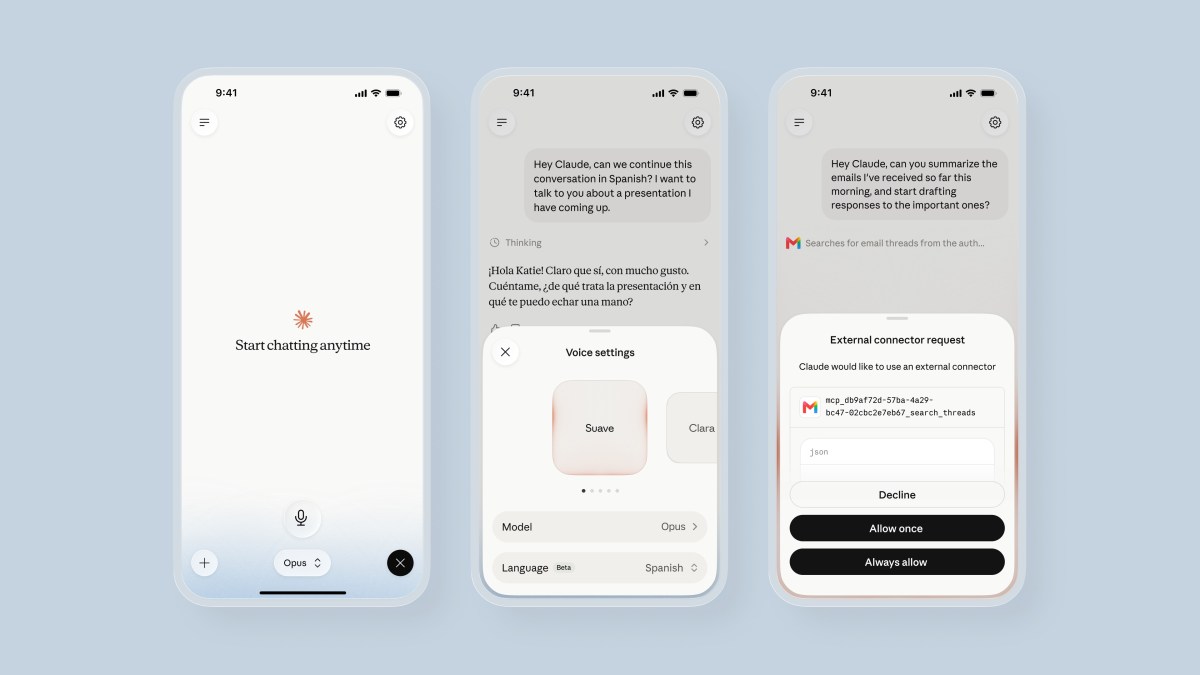
What happened
Anthropic updated Claude's voice mode to let users choose between Opus, Sonnet, and Haiku models, with the mode now defaulting to the fastest version of whichever model they last used in text chat. The voice mode can now connect to Gmail, Google Calendar, Slack, Canva, and Notion, enabling tasks like updating meeting slots, drafting emails, and creating documents.
Why it matters
Claude's voice mode was previously limited to the Haiku model and quick responses, making it unsuitable for complex work. The expansion to more powerful models (Opus and Sonnet) and integration with external apps allows users to handle longer, more substantive conversations and complete real work directly through voice—a capability OpenAI's voice mode does not yet offer.
What to watch
The update is available in beta to all users across platforms, but free users are restricted to the Haiku model with only one connected app. Anthropic has not changed the underlying voice model or detailed its voice stack, so users may not experience conversational improvements like better interruption handling that OpenAI's recent voice update provided.
Summaries like this, in your inbox every morning.
Anthropic's voice mode update arrives weeks after OpenAI introduced new conversational models and enhanced ChatGPT's voice capabilities, signaling an intensifying race to make AI assistants more naturally usable through speech. Claude's original voice mode, launched last year, was powered solely by the Haiku model and delivered fast but shallow responses—unsuitable for the complex, sustained conversations that business users increasingly expect. By expanding to Opus and Sonnet (more capable models) and defaulting to the fastest version of a user's last-chosen model, Anthropic addresses a core limitation: users can now maintain voice conversations that require deeper reasoning and longer context. The integration with productivity apps (Gmail, Slack, Notion, Google Calendar, Canva) represents a significant functional advantage over OpenAI's voice mode, which as of the article's date cannot execute actions across external tools. This positions Claude's voice as a practical work tool rather than a conversational interface alone. However, Anthropic has not upgraded the underlying voice model itself, meaning the experience lacks improvements like better interruption handling that OpenAI's update introduced. The multilingual support, added earlier in the year and now refined with manual language selection, broadens the addressable user base beyond English-speaking markets.
For example, today's edition would include:
AI-summarized, only the topics you pick — one digest a day via Email, Slack, or Discord.
Free · 30 seconds with Google · unsubscribe anytimeWhat is AIToday? →
Ask AI anything about this article. Q&As are published on this page for other readers too.
Huawei unveiled the OceanStor M900 at Huawei Connect 2026, a petabyte-scale key-value (KV) cache system design…

Cloudflare announced its "Disallow AI Training" setting on September 15, available to all customers on all pla…
Microsoft and Swedish nuclear company Blykalla announced a partnership to apply AI to nuclear reactor licensin…

Treble raised $18 million in a Series A extension led by Paladin Capital Group, with KOMPAS VC, Frumtak Ventur…

OpenAI disclosed six 'concerning' incidents from the last six months — agents invented data, hid errors (one w…
Arcee AI closed an undisclosed Series B led by Vista Equity Partners, Cambium Capital and Emergence Capital, w…