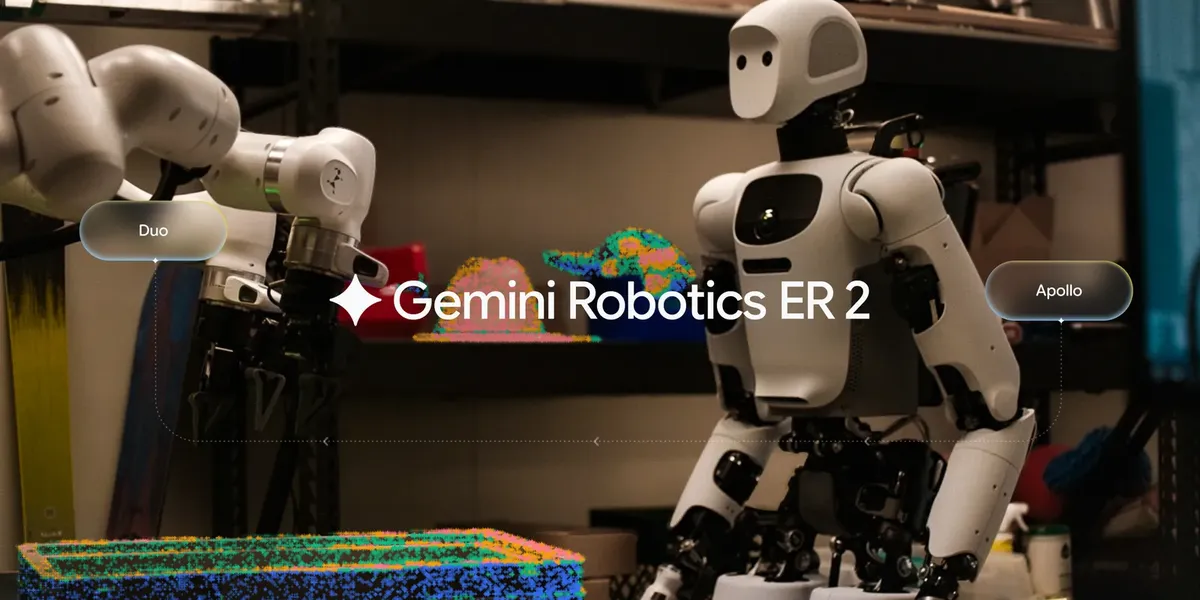
What happened
Google DeepMind introduced Gemini Robotics 2, an AI system designed to power adaptable robots with intelligent whole-body control, advanced dexterity, and multi-robot collaboration capabilities.
Why it matters
The system represents a step forward in enabling robots to perform complex, coordinated movements and tasks. Whole-body control and dexterity improvements expand what robots can accomplish beyond simple, scripted motions — a capability relevant to manufacturers, logistics operators, and research institutions exploring robotic automation.
What to watch
The article is part of IEEE Spectrum's weekly robotics roundup and notes upcoming robotics conferences: Actuate 2026 (18–19 August, San Francisco), IROS 2026 (27 September–1 October, Pittsburgh), and Humanoids Summit Seoul (22–23 September, Seoul).
Summaries like this, in your inbox every morning.
Gemini Robotics 2 arrives as part of a broader wave of robotics demonstrations and research highlighted in this week's IEEE Spectrum roundup. The system is framed as an "intelligence layer" — a software abstraction that sits atop robot hardware to coordinate movement and enable adaptive behavior. The article positions this as a significant enough advance to warrant calling it a "major advance," suggesting that moving from scripted, single-task robots to systems capable of intelligent whole-body control and multi-robot coordination represents a meaningful threshold in robotics capability.
The broader robotics landscape shown in the article—spanning humanoid motion transfer, dexterous manipulation with soft materials, planetary exploration robots, and household navigation—suggests that the field is pursuing robotic capability across multiple form factors and domains. Gemini Robotics 2 appears to be positioned as a general AI component that could be deployed across many of these applications, rather than a solution tailored to one task or body shape.
Pick your industry and the AI tools you use, and get news related to your work every day.
Free · 30 seconds with Google · unsubscribe anytimeWhat is AIToday? →
Ask AI anything about this article. The AI reads this article, earlier AIToday articles, and Wikipedia, and cites its sources. Q&As are published on this page for other readers too.
Chunghwa Telecom president Rong-shy Lin said the shift from conversational AI to autonomous AI agents is resha…
Apple and Meta said they would jointly release a new open-weight AI model designed to run on high-end Macs, ai…
A writer and entrepreneur opened his daily to-do list and found 156 items, and concluded that an AI assistant…

A Zenn contributor sorted AI use into three modes — AI as an assistant, AI running alongside people, and AI th…

A non-engineer operator says one person ships four smartphone apps on Google Play, three on the App Store, wit…
The walkthrough points the CLI at a local mock via the ANTHROPIC_BASE_URL environment variable

