What happened
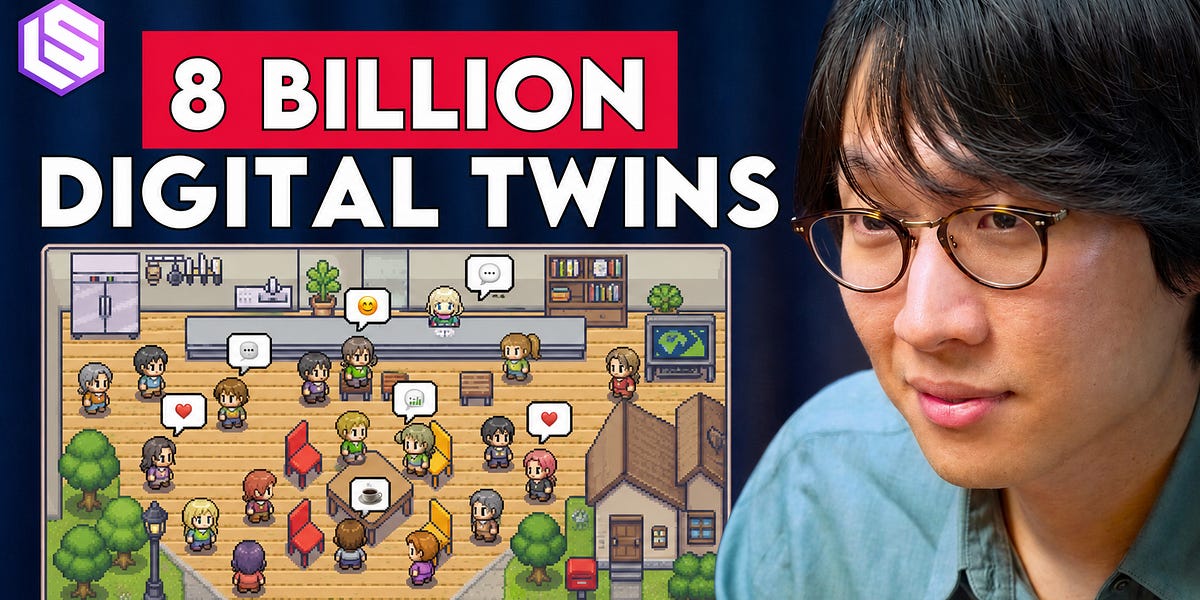
Simile AI, founded by Joon Sung Park (known for the 2023 Smallville generative agents paper), has raised $2B in Series B funding backed by GreenOaks and Index Ventures, with prominent backers including Fei-Fei Li and Andrej Karpathy. The company runs tens of millions of simulations for Fortune 100 clients such as CVS, achieving 85–99% accuracy compared to human focus groups.
Why it matters
Simile moves beyond prediction to enable companies to test products and policies in simulated worlds before deployment. The company builds behavioral foundation models using long-form interviews, observational data, transaction records, and randomized controlled trials—capturing how humans actually behave rather than how rational actors theoretically should. This approach lets organizations find counterintuitive solutions and model emergent behavior across populations.
What to watch
Simile's stated long-term ambition is to simulate all 8 billion people on Earth. The company is also exploring applications to larger societal questions—climate change, democratic instability, and universal basic income—and suggests that scaling simulation may eventually require data-center-scale infrastructure.
Summaries like this, in your inbox every morning.
Simile AI's $2B Series B represents the return of simulation as a practical technology, distinct from the earlier "Summer of Simulative AI" in 2024. The company emerged from Joon Sung Park's 2023 Smallville paper on generative agents, which demonstrated that large language models, when seeded with the right data and memory systems, could exhibit emergent human-like behavior—memory, planning, socialization. Park's insight was that the greatest killer application for foundation models would not be narrow tasks (classification, simple generation) but rather answering a much larger question: what if you could recreate the world before making decisions in it?
The shift from prediction to simulation is fundamental. Traditional AI excels at forecasting outcomes; Simile instead focuses on understanding how to shape outcomes by testing interventions in a modeled population. This requires moving beyond web-scale data—which captures what people say—to behavioral data: interviews, transactions, controlled trials, and causal reasoning about why people actually make decisions. Park's observation that models optimized for rationality are poor simulators of irrational humans points to a deeper problem: frontier LLMs trained on broad web data may perform well on many downstream tasks but fail to capture the full behavioral reality of real populations. Simile's post-training approach—tuning models on randomized controlled trials—is an attempt to correct this gap.
The long-term stakes are ambitious. Simile aims eventually to simulate all 8 billion people on Earth, with applications ranging from product testing to policy evaluation to modeling societal-scale phenomena like democratic instability or climate change. The economics of this vision suggest data-center-scale infrastructure may be necessary. For now, the company has demonstrated proof-of-concept: Fortune 100 clients trust its simulations enough to guide real decisions, and accuracy metrics (85–99% versus human benchmarks) suggest the approach works at meaningful scale.
Pick your industry and the AI tools you use, and get news related to your work every day.
Free · 30 seconds with Google · unsubscribe anytimeWhat is AIToday? →
Ask AI anything about this article. The AI reads this article, earlier AIToday articles, and Wikipedia, and cites its sources. Q&As are published on this page for other readers too.

