What happened
Okta chief revenue officer Jon Addison said customers preparing for the agentic era are doing housekeeping and getting fundamentals right, because many point solutions create vulnerabilities.
Why it matters
Enterprises that built identity stacks piece by piece still spend heavily keeping point solutions talking to each other, so agent deployments may push them to modernize and consolidate first.
What to watch
Some organizations already have shadow agents in production and need urgent access management controls, Addison said. He also said autonomous agents could soon explode in scale.
WHO IT HITSIT and security teams at large enterprises running homegrown identity stacks are being pushed to consolidate access controls before letting agents into production. Okta, as an identity vendor, is positioning itself for that cleanup work.
Summaries like this, in your inbox every morning.
Okta's Oktane event this year became the setting for a candid admission about how enterprises actually run identity. Jon Addison, the company's chief revenue officer, told theCUBE Research's Krista Case and co-host Rebecca Knight that years of stitched-together point solutions have left many customers spending heavily just to keep their tools talking to one another. That sprawl, he said, is exactly what makes the arrival of AI agents uncomfortable.
Addison frames the moment not as a brand-new problem but as an extension of identity work enterprises have done for years. Customers want to innovate quickly, he said, and feel pressure from the business to do so, yet they recognize that security requires visibility and control. Some organizations are already agreeing on reference architectures before deploying agents, while others have shadow agents running in production and need urgent help establishing access controls. Addison described the early phase as efficiency and augmentation for humans and workers, with a future in which autonomous agents explode in scale and demand different thinking.
The stakes, based on Addison's remarks, hinge on whether enterprises finish that foundational cleanup before agents become widespread. If consolidation lags behind deployment, the vulnerabilities he attributes to point solutions may persist even as agents gain broader access, a risk the identity industry appears positioned to address.
Pick your industry and the AI tools you use, and get news related to your work every day.
Free · 30 seconds with Google · unsubscribe anytimeWhat is AIToday? →
Ask AI anything about this article. The AI reads this article, earlier AIToday articles, and Wikipedia, and cites its sources. Q&As are published on this page for other readers too.
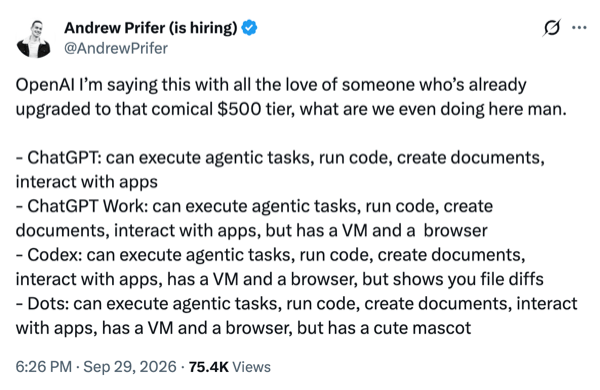
Stratechery published a piece after OpenAI's Dev Day, saying the showcased product is, frankly, pretty confusi…
Kelly Intelligence's Kevin Kelly and Visible Alpha's Melissa Otto laid out the next phase of the AI supercycle…

President Trump and the CEOs of the most powerful AI companies—including Elon Musk, Mark Zuckerberg, Dario Amo…

Anthropic has pushed state-level AI regulation and donated millions for public support, while super PAC Leadin…

Rebellions said ai& will install over 100 RebelRack units, each holding 32 Rebel100 NPUs and delivering 64PFLO…

Electronic Library and NTT Docomo Business co-developed "ELNET AI" and will launch the full version on October…