Claude Fable 5, using Claude Code for web, built a fully playable 3D raccoon heist browser game from a single text prompt and two concept images, without requiring any further input.
The AI autonomously generated textures using OpenAI's image API, wrote procedural 3D models and game logic, designed mobile touch controls, created a procedural audio soundtrack, and tested its own work using Playwright—all deployed live to GitHub Pages so Willison could watch it build in real time.
What happened
Simon Willison prompted Claude Fable 5 (running in Claude Code for web) to build a complete 3D browser game called Raccoon Heist based on concept art and description from a 2024 tweet. Claude produced a working, playable game with procedural 3D characters, dynamically generated textures via OpenAI's image API, mobile touch controls, and a procedural WebAudio soundtrack—all without requiring further input from Willison after the initial prompt.
Why it matters
This demonstrates that current AI coding assistants can autonomously build complex, multi-system projects (3D graphics, game logic, mobile UI, audio synthesis, testing automation) in a single session. The game uses GitHub Pages for live preview during development, letting Claude iterate and self-test in real time using Playwright screenshots—a workflow that bypasses the friction of traditional back-and-forth iteration.
What to watch
The game is playable now at the GitHub Pages deployment; Willison's full transcript of Claude's decisions is publicly accessible. The mechanic of coupling Claude Code with GitHub Pages for immediate visual feedback appears to work well enough that Willison used it to defer all design decisions to the AI, asking only for autonomous quality and fun—a rare example of letting an AI fully own a creative project without human handholding.
In August 2024, Willison had tweeted screenshots showing GPT-3's text-completion output for "a detailed product description of a computer game where a team of raccoons go on heists" and DALL-E concept art of a video game screenshot with raccoons on a heist. Two years later, on August 5, 2026, he decided to revisit the idea: could Claude Fable 5, running inside Claude Code for web, build a full, working game from those same artifacts?
Willison's setup was practical: he created a new GitHub repository and used Claude Code's integration with GitHub to push changes to a branch. He then configured GitHub Pages to deploy from that branch, so the game would be live and accessible within 30 seconds of each push. This workflow meant he could preview Claude's work in real time without leaving his phone—he wrote the entire prompt in the Notes app. The prompt asked Claude to build a 3D browser game with mobile-friendly touch controls, to use OpenAI's image generation API to create textures for 3D models, and crucially, to "work independently—do not ask me to make any further design decisions." He also asked Claude to "commit and push as often as possible" and to maintain a notes.md log of changes.
Claude's build process showed autonomous decision-making at every level. It started with an index.html page and vendored a copy of Three.js, then wrote its own gen_textures.py script to call OpenAI's gpt-image-2 API and generate textures (metal, concrete, wood, grass, asphalt, brick, and a starfield). It used Playwright to take screenshots of its own work at different viewport sizes—desktop, portrait phone, landscape phone—spotted that the raccoon was invisible on mobile, and fixed the issue. It generated a title screen by crafting a detailed image prompt for gpt-image-2: "Video game key art, low-poly 3D render style, moody nighttime scene: a cute low-poly raccoon wearing a tiny black burglar mask sneaking on its hind legs carrying a glowing gold coin, next to a tipped-over metal trash can, suburban house with warm glowing windows in the background, deep blue night, full moon, fireflies, cinematic rim lighting, charming heist caper mood."
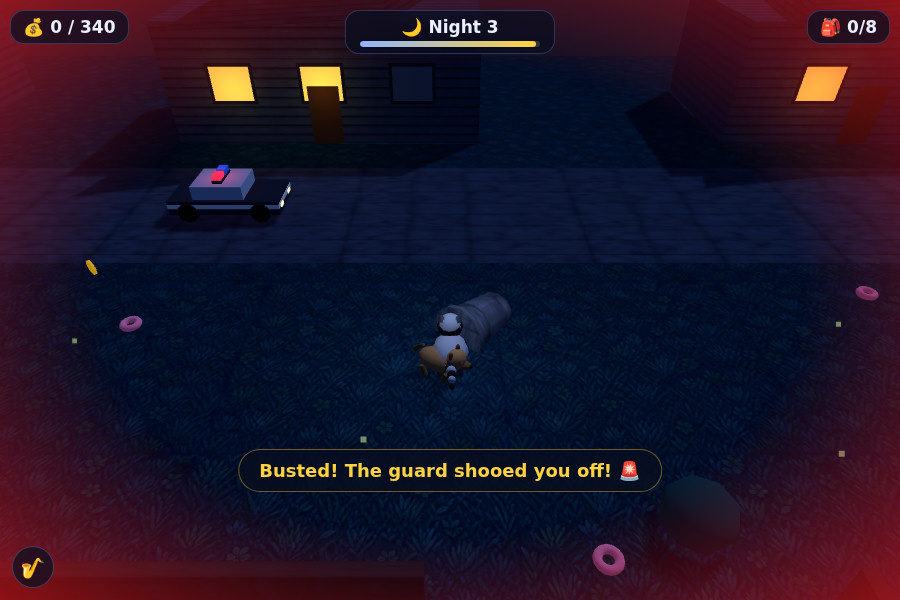
Then came Claude's most striking addition: the guard dog. For night 3, it created a low-poly brown hound with a spiked red collar and wagging tail, implemented it with procedural sphere and cylinder geometry, and programmed behavior where the dog wanders between random spots and, within 12 units, catches the player's scent and tracks by smell (line of sight irrelevant, indicated by a 👃 emoji and barking). The dog gives up if the player opens a 17-unit gap. Claude tested this using Playwright, teleporting the player next to the dog and running automated playthroughs to verify wander, track, and caught states.
The final game is playable at the GitHub Pages URL. The player is a masked raccoon sneaking out of a dumpster hideout into a moonlit cul-de-sac. The goal each night is to collect coins, gems, rings, donuts, fish, and (on later nights) a rare golden TV worth 120 points, carry them back to the dumpster, and bank them before dawn. Each collected item visibly stacks on the raccoon's back and slows movement. Difficulty escalates: night 1 has one guard with a flashlight, night 2 has two guards, and night 3 adds the scent-tracking hound. A police cruiser sweeps the street with headlights, homeowners randomly peek out of windows, a seagull dive-bombs unclaimed loot, and pizza slices trigger a 6-second speed boost. Win ranks are TRASH PANDA ⭐, CAT BURGLAR ⭐⭐, and MASTER OF DISGUISE ⭐⭐⭐; the best run is saved to localStorage. Mobile gets a dynamic touch joystick (appears wherever you touch) plus a DASH button; desktop uses WASD/arrow keys and Space.
During testing, Playwright caught two real bugs: the canvas was rendering at 2× size on phones because a cssText assignment was overwriting Three.js's inline sizing (desktop DPR-1 tests had masked it completely), and the win screen's star-rating div had inherited full-screen .stars CSS from the title screen, silently swallowing taps on the "next night" button. Both were fixed and regression-tested. The game uses a procedural WebAudio soundtrack (sneaky walking-bass jazz plus all sound effects) and zero audio files. All textures and the title art were generated with gpt-image-2 and committed as static assets, so the deployed game makes no API calls at runtime. The full build log is available in notes.md, and Willison's transcript of Claude's code decisions is publicly accessible.
Willison's original 2024 tweet contained a GPT-3-generated game concept and DALL-E concept art for a raccoon heist game. Two years later, he decided to test whether a modern AI coding assistant could build the entire game from those artifacts alone, with minimal instruction. The key innovation here is not just that Claude succeeded, but the infrastructure Willison used to make the task tractable: GitHub Pages as a live-preview system during development, coupled with Claude Code's ability to commit and push changes in real time. This removed the friction of "show me what you've built so far"—Willison could watch the game materialize incrementally in the browser without leaving his phone, where he wrote the entire prompt in Notes. Claude's decision to use Playwright for self-testing is particularly striking; the AI didn't just build features, it verified them with automated playthroughs, caught canvas rendering bugs that desktop-only testing had masked, and wrote regression tests. The game itself is complete: three escalating difficulty levels, procedurally generated low-poly characters, collision detection, guards with line-of-sight logic, a scent-tracking hound that ignores line-of-sight, mobile UI, and a persistent high-score system. All textures and the title art were generated via the OpenAI API and baked into the repo, so the live game makes no external API calls.
AI-summarized, only the topics you pick — one digest a day via Email, Slack, or Discord.
Free · takes 30 seconds · unsubscribe anytime
Ask AI anything about this article. Q&As are published on this page for other readers too.
Amazon and Google are intensifying competitive efforts against The Trade Desk (TTD), a major digital advertisi…

HireRoad, an HR software company, scrapped its 18-month legacy product rewrite plan and instead reorganized it…

OpenAI introduced Premium Seats for ChatGPT Business, priced at $125 per user per month ($100 with annual bill…

Computer scientists at University of Tübingen, Max Planck Institute, MATS Research, and Snyk discovered a meth…

Researchers at A Security disclosed vulnerabilities in Zoom's screen-sharing annotation protocol on Tuesday th…

Anthropic pledged to embed machine-readable watermarks in Claude-generated text and digitally signed provenanc…

The AI news that matters, in one minute each morning.
Sign up free