What happened
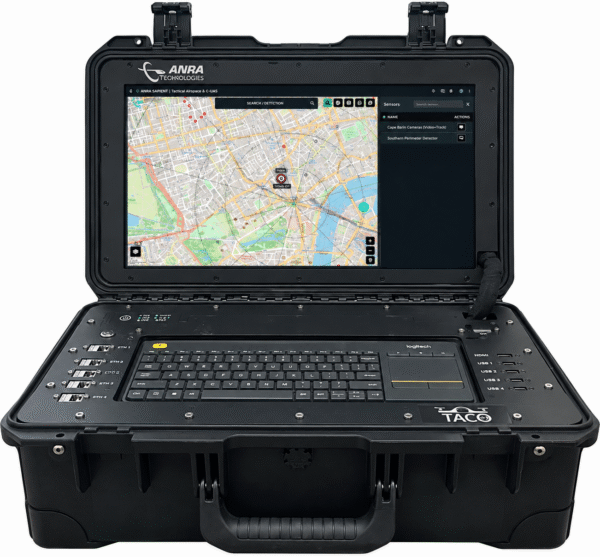
ANRA Technologies announced on October 27, 2026 that its SIOP software and TACO portable system advanced from TRL 5 to TRL 7 after NATO C-UAS exercises and U.S. Army DIRT Days testing.
Why it matters
The upgrade signals the tools are closer to operational use, letting partners combine drone detection with authorized-flight data rather than relying on a single sensor.
WHO IT HITSDefense and homeland security integrators, sensor manufacturers, and public safety agencies evaluating counter-drone setups stand to gain a modular option that pairs detection with airspace data, though the exercises do not constitute NATO certification.
Summaries like this, every morning.
ANRA's update rests on two products: SIOP, a sensor-agnostic command-and-control layer that correlates radar, RF, optical, Remote ID and ADS-B data with UTM information, and TACO, a ruggedized version packaged in a Pelican iM2500 case. TACO weighs 17 kilograms, deploys in under 15 minutes, and has been tested with up to 10 simultaneously connected sensors and 100 tracked targets, with sensor fusion latency under one second. The company says both moved from TRL 5 to TRL 7 through development and testing in defense and security environments.
The testing backdrop matters: ANRA has taken part in NATO C-UAS Technical Interoperability Exercises since 2023 and in the U.S. Army's DIRT Days, which evaluate emerging technologies in realistic military training environments. Those exercises used SAPIENT, an open architecture and interface standard that SIOP and TACO support alongside ASTERIX and proprietary interfaces. ANRA is careful to note the exercises do not amount to NATO certification or endorsement.
The commercial pull comes from federal funding. On October 16, 2026, FEMA announced $250 million through its fiscal 2027 Counter-Unmanned Aircraft Systems Grant Program for states and territories. ANRA is responding by inviting U.S. sensor manufacturers, defense and homeland security integrators, public safety technology companies, critical infrastructure operators and government agencies to explore joint demonstrations, integrations and teaming opportunities. The company's broader UTM operations, which support customers including Amazon Prime Air and the New York Power Authority, launch roughly one BVLOS flight every 10 seconds and serve more than two dozen police departments — a base ANRA can point to as it courts partners.
Pick your industry and the AI tools you use, and get news related to your work every day.
Free · 30 seconds with Google · unsubscribe anytimeWhat is AIToday? →
Ask AI anything about this article. The AI reads this article, earlier AIToday articles, and Wikipedia, and cites its sources. Q&As are published on this page for other readers too.
Qisda President Cally Ko said the company's commercial drones had secured orders and entered production, and q…

KDDI's Nobuya Muramoto said 100 days after Happy Lawson Town opened in June 2026, the Fushiodai area's activit…

FANUC developed AIマスタレスビジョン, a physical AI system that lets robots recognize and act on first-seen tasks with…

EdgeCortix, based in Kawasaki, announced a dedicated semiconductor for physical AI that is power-efficient and…

Maxinsights raised $30 million in seed funding led by PeakXV, with Tola Capital, South Park Commons, INCE Capi…
Faraday Future outlined plans at its "Built in USA" conference to bring a US robot factory online by the end o…