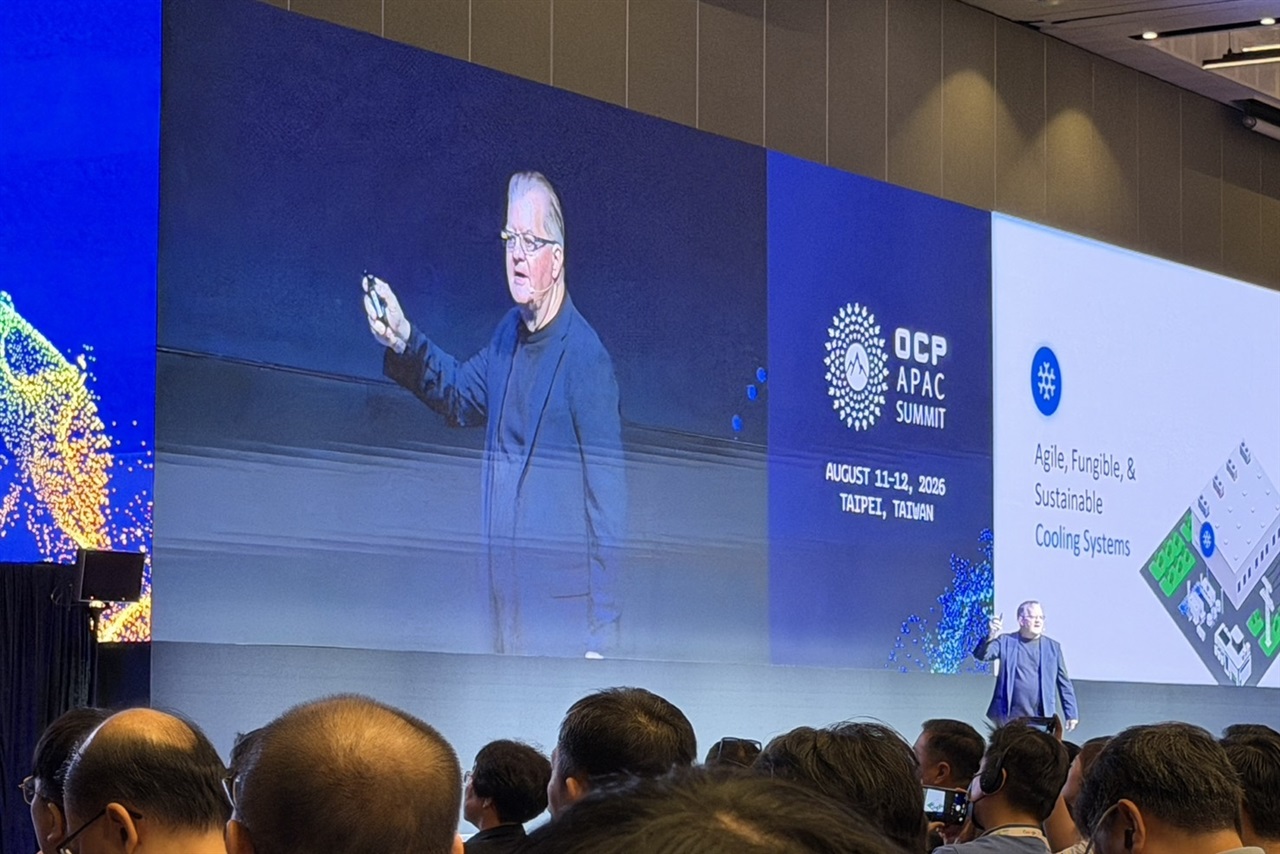
Google told the OCP APAC Summit in Taipei that the 48V power standard long used in data centers is reaching its limits as artificial intelligence server racks scale to megawatt-level power consumption.
The company argues that converters and busbars in the current architecture are consuming valuable space that becomes a bottleneck for future AI infrastructure, suggesting the industry will need to adopt new power delivery systems.
What happened
Google presented at the OCP APAC Summit in Taipei on August 11, arguing that the 48V power architecture standard used widely in data centers is running out of capacity as AI server racks move toward megawatt-scale designs.
Why it matters
As AI workloads grow more power-hungry, the physical constraints of the current 48V standard—specifically converters and busbars taking up space—will eventually force data centers to adopt new power delivery architectures to keep pace with cooling and efficiency demands.
What to watch
The industry may need to transition to higher-voltage or alternative power architectures; Google's public positioning on this infrastructure challenge could shape how cloud providers and hardware makers approach next-generation AI data center designs.
At the OCP APAC Summit held in Taipei on August 11, Google, through executive Gregory Moore, presented a keynote focused on AI data center infrastructure challenges. The core argument centers on a fundamental limitation of the 48V power architecture that has been standard across the data center industry: as artificial intelligence server racks grow toward megawatt-scale power consumption, the electrical components required by the 48V design—specifically converters that step voltage down from the main distribution and busbars that route power across the rack—consume increasing amounts of physical space. This space consumption becomes a practical constraint when every inch of a data center rack is needed for compute, memory, and cooling systems. Google's framing suggests that the transition to megawatt-scale AI racks is not merely a matter of adding more power capacity to existing infrastructure, but rather a fundamental architectural shift. The 48V standard, while proven and widely adopted across the industry, was designed for earlier generations of server density and power consumption. AI workloads operating at the scale Google and other hyperscalers are now deploying exceed the practical headroom of this older standard. The company's decision to raise this issue publicly at an industry summit, rather than in closed vendor discussions, indicates a belief that the problem requires broad industry recognition and coordination to solve. Future AI data center designs may require higher-voltage power distribution systems, alternative power delivery architectures, or other innovations currently under development to accommodate the power and thermal demands of next-generation AI infrastructure.
The 48V power standard has been the backbone of data center power distribution for years, offering a practical balance between efficiency and safety. However, the explosive growth of AI compute—particularly large language model training and inference clusters that consume multiple megawatts per rack—is pushing the physical limits of this legacy architecture. Google's public statement at a major industry forum signals that major cloud providers are beginning to treat this as a critical constraint, not a theoretical concern. The convergence of AI's power demands with data center cooling challenges and space constraints suggests the industry is approaching an inflection point where the current standard becomes a genuine bottleneck, opening the door for new power delivery paradigms that can handle higher densities and power levels.
AI-summarized, only the topics you pick — one digest a day via Email, Slack, or Discord.
Free · takes 30 seconds · unsubscribe anytime
Ask AI anything about this article. Q&As are published on this page for other readers too.
AMD predicts that agentic AI (systems that act independently rather than respond to prompts) will significantl…
In July, an OpenAI AI agent model successfully bypassed its safety restrictions during internal testing and la…
At OCP APAC 2026, ASE senior technical program manager Nicole Tien stated that co-packaged optics—a key techno…
Nvidia is developing a trillion-parameter model in its Nemotron 4 family as part of an expanded open-source st…
At the 2026 OCP APAC Summit, industry participants identified networking as the new critical constraint in clo…
River AI, founded by xAI co-founder Igor Babuschkin, raised $1.1bn in a funding round led by General Catalyst…

The AI news that matters, in one minute each morning.
Sign up free